
In 2008, the Defense Intelligence Agency posted a contract solicitation for something called the Advanced Aerospace Weapon System Applications Program. The official purpose, on paper, was to study "potential breakthrough technology applications employed in future aerospace weapon systems." The solicitation attracted exactly one bidder: Bigelow Aerospace Advanced Space Studies, a subsidiary of a Las Vegas hotel mogul's company that had spent the previous decade investigating ghosts, Bigfoot, and paranormal activity at a Utah cattle ranch.
BAASS won the contract. The work that followed — funded with $22 million in classified congressional earmarks over five years — produced reports on werewolves and "anomalous" cattle mutilations alongside studies of military pilots encountering unidentified craft. When the public found out about it in 2017, the Pentagon initially confirmed the program. Two years later, it denied the program had anything to do with UFOs at all. Then it contradicted itself again. And again.
The conventional read on these contradictions is that the Pentagon was confused, embarrassed, or covering up. The structural read is more interesting: every contradiction was possible because the program was built that way. AATIP wasn't a UFO program with a deniability problem. It was a deniability structure with a UFO program inside it.
The Setup (2007): A Senator, a Billionaire, and a Black-Budget Earmark
The story starts in Nevada. Senator Harry Reid (D-NV), then Senate Majority Leader, had been quietly interested in UAP for years. He knew Robert Bigelow, a Nevada real-estate billionaire who'd made his fortune building the Budget Suites of America hotel chain. Bigelow had founded the National Institute for Discovery Science (NIDSci) in 1995, a privately funded organization that investigated UAP, cattle mutilations, and paranormal phenomena. NIDSci spent years studying Skinwalker Ranch in Utah, where Bigelow had purchased the property in 1996 specifically to investigate persistent reports of strange activity.
By 2007, Reid had become convinced — through Bigelow and through conversations with military pilots — that the Pentagon needed a formal UAP study. The mechanism he used was a classified Defense Appropriations earmark, coordinated with two key allies: Senator Ted Stevens (R-AK), who had reportedly told Reid about his own unexplained aerial encounter, and Senator Daniel Inouye (D-HI), a powerful Appropriations Committee member. Together, the three senators secured $22 million over five years, hidden inside the broader defense budget. No floor debate. No public announcement. No congressional record beyond the line item itself.
Black-budget earmarks are the legal mechanism by which Congress funds programs it doesn't want to talk about. They are constitutionally legitimate. They are also designed to avoid the oversight that ordinary appropriations face. The $22 million for what became AATIP traveled through this channel — which means even most of Congress didn't know it existed.
The Contract (August 2008): One Bidder, One Winner
On August 18, 2008, the Defense Intelligence Agency posted a public solicitation for the Advanced Aerospace Weapon System Applications Program. The solicitation set requirements that were unusually specific: the contractor had to provide a facility cleared for top-secret work and had to have demonstrated capacity in advanced aerospace research. In Nevada. With existing infrastructure for handling classified material.
Critics of the structure have pointed out, in retrospect, that this set of requirements narrowed the bidder pool to almost exactly one company: Bigelow Aerospace, which had recently built a facility in North Las Vegas that met all the security specifications. BAASS was the sole bidder. The contract was awarded on September 16, 2008, with an initial value of $10 million and ceiling authority extending to $22 million over the program's life.
Luis Elizondo, who would later become the program's public face, has pushed back on the framing that this was a sweetheart deal. "There was no direct contract vehicle for Senator Reid to take care of a buddy over here in a stake for a contract," Elizondo told 8 News Now in 2019. "That's complete nonsense." That defense is technically accurate — Reid didn't directly award the contract. But Reid didn't need to. The procurement requirements made the outcome a foregone conclusion.
The Procurement Mechanics
- August 2008: DIA posts AAWSAP solicitation requiring TS/SCI-cleared facility, Nevada-based infrastructure, and demonstrated aerospace R&D capability
- September 2008: BAASS (sole bidder) wins the contract at $10M initial, $22M ceiling
- Subcontractors hired by BAASS: Hal Puthoff (former Stanford physicist), Eric Davis (Earthtech), Colm Kelleher (biochemist), James Lacatski (DIA program manager)
- Research locations: Skinwalker Ranch (Utah), Bigelow's Nevada facility, DIA office in Crystal City
- Reports produced: 38 technical "Defense Intelligence Reference Documents" on subjects ranging from warp drive theory to traversable wormholes
The Research (2008–2012): Werewolves Alongside Warp Drives
What BAASS actually did with the $22 million is the part that gets simultaneously underexplained and oversold. The contract produced two parallel streams of work. The first stream was theoretical physics — papers on exotic propulsion concepts, written by credentialed researchers, that read like serious technical literature even when the subject matter (faster-than-light travel, "negative mass" propulsion, gravitational manipulation) sat outside mainstream physics. The Defense Intelligence Reference Documents from this period are real and have been partially released through FOIA. They're dense, mathematical, and unobjectionable as academic writing.
The second stream is where the story gets stranger. Under BAASS, the program funded extensive on-site investigation of Skinwalker Ranch — the Utah property Bigelow had purchased in 1996 specifically because of repeated reports of unexplained phenomena there. Researchers, including biochemist Colm Kelleher and program manager Dr. James Lacatski (DIA), documented what they later described in their 2021 book Skinwalkers at the Pentagon as "high strangeness" — disembodied voices, cattle mutilations, encounters with what they characterized as "interdimensional" entities. The book includes accounts that, taken at face value, describe phenomena far outside the boundary of any conventional aerospace research program.
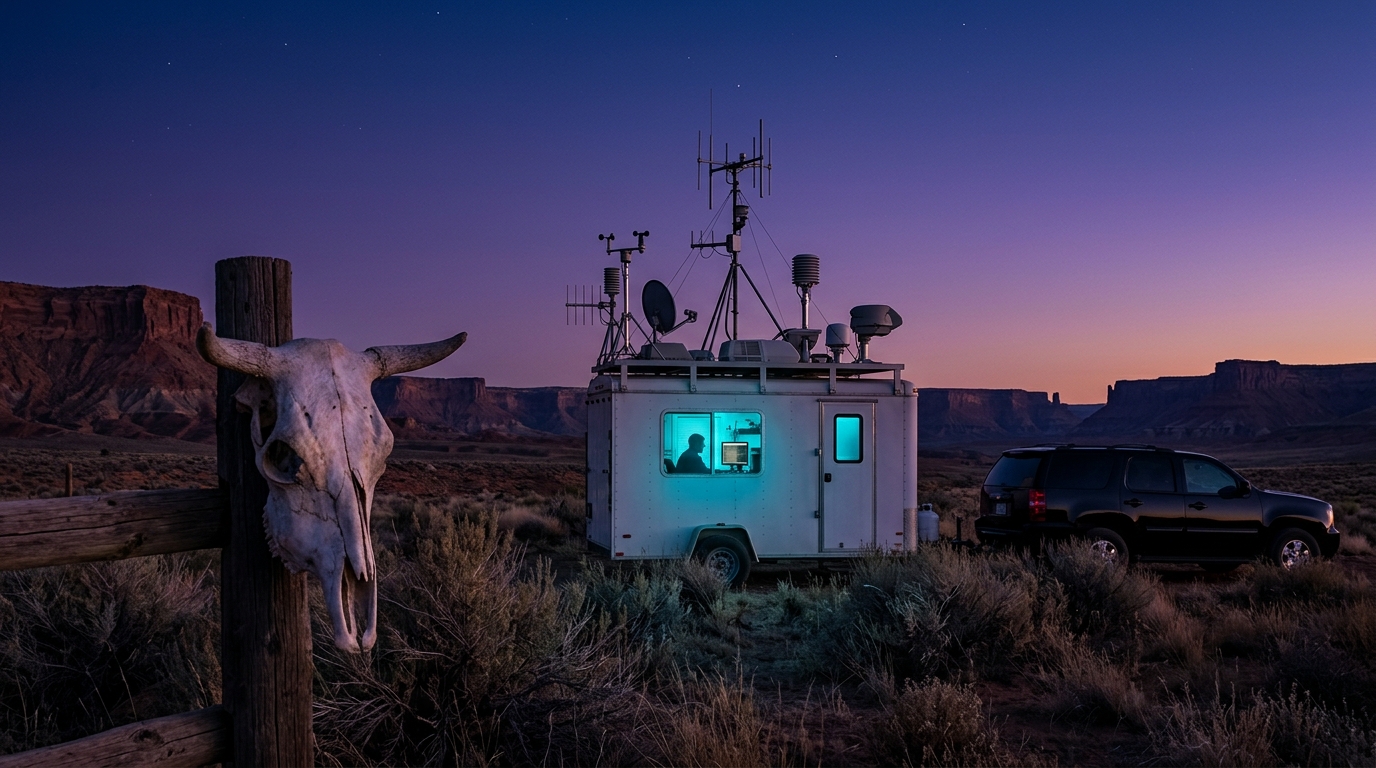
This is where the program's structural genius becomes visible. If you fund "advanced aerospace research" through a private contractor, you can call any output you produce "research." Papers on warp drive theory? Aerospace research. Investigation of "anomalous incidents" at a remote ranch? Also aerospace research. The contractor is responsible for the work product. The government just paid for it.
The Shutdown (2012): Congressional Money Ends
By 2012, the congressional appropriations for AAWSAP had ended. The official line was that the program had completed its goals and produced its deliverables. Lacatski left government service. Bigelow Aerospace reduced its UAP-focused staff. The Defense Intelligence Reference Documents were classified and shelved.
But — and this is where the program's identity gets slippery — Luis Elizondo and a small group of colleagues inside the Office of the Under Secretary of Defense for Intelligence (OUSDI) kept working on UAP cases. They had no dedicated budget. No formal charter. No congressional appropriation. They were doing this work alongside their formally assigned duties, allocating their own "security portfolios" — Pentagon-speak for "we'll handle this in our spare time."
This informal group adopted the name Advanced Aerospace Threat Identification Program. AATIP. The name was almost identical to the now-defunct AAWSAP. The acronyms overlapped. The work overlapped. Whether the post-2012 AATIP was the "same program" as the 2008–2012 AAWSAP became — and remains — the central question that the Pentagon has answered four different ways.
The Reveal (December 16, 2017)
On the evening of December 16, 2017, the New York Times published a 4,500-word investigation by Helene Cooper, Ralph Blumenthal, and Leslie Kean: "Glowing Auras and 'Black Money': The Pentagon's Mysterious U.F.O. Program." The article revealed AATIP's existence to the public, identified Luis Elizondo as its former director, included the Nimitz FLIR1 video (the Tic-Tac encounter from Edition 001), and quoted Harry Reid on the record describing his role in securing the funding.
Within 24 hours, Pentagon spokesperson Dana White confirmed AATIP to multiple outlets including POLITICO. The program existed. Elizondo had run it. The Nimitz video was authentic. The Pentagon, under Trump's first administration, did not push back on the framing.
This is the moment in the story when the deniability structure becomes inconvenient — and when the Pentagon starts retreating from its initial confirmation.
The Contradictions (2017–Present)
Over the next two years, four separate Pentagon spokespeople gave four substantively different answers to the question "What was AATIP and what did it do?"
Read the four statements together. The Pentagon has, in turn: confirmed AATIP existed and was run by Elizondo; confirmed it studied UAP; denied it studied UAP; and denied Elizondo had any formal role in it. Each statement was issued by a sitting Pentagon spokesperson, on the record, in response to legitimate press inquiries.
The conventional explanation — that the Pentagon's public affairs office was simply confused or that institutional positions evolved with new information — falls apart on close inspection. The same office issued these contradictory statements. Sometimes the same spokesperson contradicted earlier spokespeople and then contradicted herself. Susan Gough, who now serves as the sole Pentagon spokesperson for UAP matters, has issued at least three substantively different formulations of "what AATIP was" over six years.
The Take: Deniability Was the Design, Not the Defect
Most analysis of the Pentagon's AATIP statements treats the contradictions as a problem to be solved — as if there exists a "true" version of what AATIP was, and the Pentagon's public affairs office just needs to find it and stick to it. That framing assumes the wrong thing.
What if the contradictions aren't a failure of the institution to communicate clearly? What if the contradictions are the institution doing exactly what it was structurally set up to do? Consider what the AATIP architecture allows:
- If someone asks whether the Pentagon studied UFOs, the answer can be "no — that was a private contractor" (technically true; BAASS did the work).
- If someone asks whether the contractor was studying UFOs on the government's behalf, the answer can be "no — the contract was for advanced aerospace weapons research" (technically true; that's what the AAWSAP solicitation said).
- If someone asks whether Elizondo ran a Pentagon UFO program, the answer can be "no — Elizondo had no formal AATIP responsibilities at OUSDI" (technically true; the post-2012 group had no dedicated budget or charter).
- If someone produces evidence that all three of the above were happening simultaneously, the answer can be "yes — there was an AATIP, and it did investigate UAP" (also technically true).
This is not bureaucratic confusion. This is the institutional equivalent of compartmentalization. The structure — government funding flowing through congressional earmarks to a private contractor doing work that exists across multiple categorical boundaries — was designed to allow the Pentagon to occupy multiple positions about its own program simultaneously. Every contradictory statement the Pentagon has issued since 2017 is supported by the program's actual architecture. The contradictions are features, not bugs.
This matters for everything that has happened since. The 2020 Unidentified Aerial Phenomena Task Force, the 2022 All-Domain Anomaly Resolution Office (AARO), the 2023 Schumer-Rounds UAP Disclosure Act, the 2026 PURSUE releases — none of these institutional structures emerged from a Pentagon that wanted to clearly explain what it had been doing. They emerged from a Pentagon being forced, one congressional hearing at a time, to acknowledge structures that were designed to remain unacknowledgeable.
The Honest Take
AATIP is not a story about a Pentagon UFO program that failed at communication. It's a story about a Pentagon UFO program that succeeded at exactly what it was built to do — operate in the gap between "official program" and "private contractor research," produce real work product on real military encounters, and remain structurally deniable in every direction simultaneously.
The four contradictory Pentagon statements aren't bugs in the disclosure process. They're proof that the program worked.
What We Know, What We Don't, What Cannot Be Determined
What we know:
- ✅ AAWSAP was a real DIA contract awarded to BAASS in September 2008 for $22M ceiling
- ✅ Bigelow Aerospace was the sole bidder on the contract
- ✅ Senators Reid, Stevens, and Inouye secured the congressional earmark
- ✅ The contract produced 38 Defense Intelligence Reference Documents on advanced aerospace concepts
- ✅ Some BAASS-funded research occurred at Skinwalker Ranch, Utah
- ✅ Congressional funding for AAWSAP ended in 2012
- ✅ Luis Elizondo claims to have continued UAP work under "AATIP" at OUSDI from 2012–2017
- ✅ The December 2017 New York Times article revealed the program publicly
- ✅ The Pentagon has issued at least four substantively different official statements about AATIP since 2017
What we don't know:
- ❌ The full content of the 38 Defense Intelligence Reference Documents (most remain classified)
- ❌ The total scope of work performed at Skinwalker Ranch under the contract
- ❌ Whether the post-2012 "informal AATIP" had any classified funding source we haven't seen
- ❌ Why Pentagon spokespeople have substantively contradicted each other on the public record
- ❌ Whether other contractors received similar arrangements during the same period
What cannot be determined:
- ⚠️ Whether the program produced findings supporting non-human technology claims
- ⚠️ Whether the structural deniability was intentional design or emergent property
- ⚠️ Whether similar structures continue to operate today under different names
Why This Matters for 2026
Every UAP institutional structure that exists today — AARO, the PURSUE initiative, the alien.gov registrations covered in Edition 004, the recent Pentagon releases covered in our latest breaking briefing — descends from the AATIP/AAWSAP architecture. Same playbook, different paint job.
The lesson isn't that you should distrust everything the Pentagon says about UAP. The lesson is that you should pay attention to the structure of what they say. When official statements are designed to be technically true while leaving the substantive question unanswered, that's not communication failure — that's communication strategy. And it's been the Pentagon's strategy on this subject for nearly two decades.
Sources & Primary Documents
- New York Times — "Glowing Auras and 'Black Money': The Pentagon's Mysterious U.F.O. Program" (Cooper, Blumenthal, Kean, Dec 16, 2017)
- The Black Vault — Pentagon AATIP contradictions documented via FOIA
- DoD FOIA Release 21-F-0938 — Elizondo emails to Pentagon Public Affairs (PDF)
- 8 News Now (KLAS-TV Las Vegas) — Documents on Bigelow Aerospace AAWSAP contract
- The Debrief — DIA $22M AAWSAP contract documents
- CBS News — Pentagon AATIP coverage (Dec 2017)
- Kelleher, Colm A. and Knapp, George. Skinwalkers at the Pentagon: An Insiders' Account of the Secret Government UAP Program. RTMA, 2021.
- Kean, Leslie. UFOs: Generals, Pilots, and Government Officials Go on the Record. Harmony, 2010.
All links open in new tab. External sources are not endorsed by TruthCapsuleTV; they are provided for independent verification.
Related Briefings
- Edition 001: Nimitz 2004 — Sensor Data vs Testimony Weight (the case AATIP investigated)
- Edition 004: alien.gov Is Real — And the White House Said "Stay Tuned" (where the AATIP playbook leads in 2026)
- Edition 007: The UFO Industrial Complex — Who Profits from the Mystery? (follow-the-money companion piece)
- Breaking: Pentagon Drops 64 More UAP Files in PURSUE Release 02 (current institutional moment)
Key Takeaways
- AATIP/AAWSAP was funded with $22M in classified congressional earmarks from 2008–2012
- Bigelow Aerospace was the sole bidder on the DIA contract
- The program funded both serious aerospace physics research AND Skinwalker Ranch field investigation
- Pentagon spokespeople have issued at least 4 substantively different official statements about the program since 2017
- The structural design allows every contradictory statement to be technically true
- Every current UAP institutional structure (AARO, PURSUE, alien.gov) descends from this architecture
- The lesson is to pay attention to the structure of official statements, not just their content