The UFO Industrial Complex: Who Profits from the Mystery?
Methodology note: This edition uses public FOIA documents, contractor patent records, USAspending.gov data, and cross‑referenced personnel histories. We distinguish between verified contracts (like BAASS/AAWSAP) and speculative connections, labeling each accordingly. Our goal is to map the financial infrastructure around UAP investigation, not to assert conspiracy without evidence.
The $22 Million Question: BAASS and the AAWSAP Program

AAWSAP Contract Status Briefing — DIA document released via FOIA. Full 9-page document (PDF) · Source: The Black Vault (FOIA-00349-2018)
The Pentagon's most explicit UFO contractor link is historical and well-documented: Bigelow Aerospace Advanced Space Studies (BAASS) was the contractor for the Defense Intelligence Agency's Advanced Aerospace Weapon System Applications Program (AAWSAP) from 2008-2012. The full FOIA document set is available at The Black Vault (FOIA-00349-2018).
Key Facts
- Contract value: $22 million over five years
- Documentation: Fully available via FOIA at The Black Vault
- Relationship to AATIP: Separate but overlapping Pentagon efforts; AAWSAP (DIA) focused on technical analysis, while AATIP (later) focused on broader UAP investigation. Not the same program.
Why it matters: This shows the established pattern — when the Pentagon wants to study UAP, it turns to private contractors. The question is: who holds those contracts today?
What the $22 Million Actually Bought
The money did not vanish into a black hole. It produced a paper trail — specifically, 38 Defense Intelligence Reference Documents (DIRDs), technical literature surveys commissioned from outside scientists. Their subjects read like a science-fiction syllabus: warp-drive metrics, traversable wormholes, antigravity, invisibility cloaking, negative energy, metamaterials, and high-frequency gravitational-wave communication. The Defense Intelligence Agency released 37 of the 38 to researcher John Greenewald's Black Vault in March 2022 under the Freedom of Information Act, more than a decade after the work was done.
This is the part that matters for following the money: the Pentagon did not build anything with the $22 million. It bought reports — surveys of what might be physically possible, written largely by a small circle of physicists already associated with the program's contractor. Steven Aftergood, who directed the Federation of American Scientists' Project on Government Secrecy, told Popular Mechanics in 2020 that the whole arrangement "was irregular from start to finish," adding that while it "sounds like it was a good deal for the contractor," it would be "hard to argue that either the military or the public got their money's worth."
How the Contract Came to Be
The program existed because of a friendship. Senator Harry Reid of Nevada — then Senate Majority Leader — secured the funding at the urging of his friend, Nevada real-estate billionaire Robert Bigelow, with support from the late senators Ted Stevens and Daniel Inouye. Reid's company of choice was Bigelow's own: Bigelow Aerospace Advanced Space Studies. When the DIA solicited bids for the contract (HHM402-08-C-0072), BAASS was the sole bidder, and won. A senator directs funding to a program, the program is built around a contract, and the contract goes uncontested to the senator's friend. None of that is illegal. All of it is exactly the kind of money-and-relationships structure this edition exists to map.
A note on the names, because they are routinely confused — including in much of the press coverage. AAWSAP was the official, contracted DIA program (2008–2012). "AATIP" — the Advanced Aerospace Threat Identification Program — appears on some documents as what looks like a successor or parallel effort, but the declassified record indicates it was largely an informal nickname Reid used when requesting Special Access Program status, and a label a small internal group kept using after AAWSAP's funding ended. The two are tangled enough that even official documents use them interchangeably. What's solid: the $22 million, the 2008–2012 timeframe, and the 38 DIRDs all belong to the AAWSAP/BAASS contract — not to some larger, better-funded "AATIP" that the popular retelling sometimes implies.
The Contractor Landscape: UAP-Adjacent vs. UAP-Labeled

F‑35 Lightning II at Eglin Air Force Base, home to numerous defense contractor testing programs. Public domain photo via U.S. Air Force.
Our research found a curious gap: while defense contractors receive billions for technologies essential to UAP detection, no public USAspending records show contracts explicitly labeled "UAP," "AARO," or "All-domain Anomaly Resolution Office."
Instead, companies are funded under broader technical categories that overlap completely with AARO's stated mission needs:
| Company | Contract Area | AARO Relevance |
|---|---|---|
| MAG Aerospace | Navy Regional Multi-Domain Awareness Capability (RMAC) | Detection/tracking across domains |
| SciTec | Air Force tracker fusion / data fusion | Cross-domain data integration |
| University of South Florida | "Data-Centric AI in Multi-Domain Awareness" (DoD-Air Force via Epitome Inc.) | AI pattern recognition for anomalies |
| Virginia Tech | $10M DoD award for Sensing and Cyber Center of Excellence | Sensor fusion, cyber-physical security |
Why it matters: UAP investigation capabilities are baked into broader defense contracts rather than being explicitly labeled. This makes tracking the money harder — and oversight more difficult.
The reason this is hard to see is that the relevant technologies are dual-use by nature. A sensor-fusion system that stitches radar, infrared, and electro-optical feeds into a single track does not care whether the object it's resolving is a hostile drone, a weather balloon, or something genuinely unidentified — it's the same hardware and the same algorithms either way. "Multi-domain awareness," the phrase that recurs across these contracts, is precisely the capability AARO needs to do its job. But because it's funded as generic detection-and-tracking infrastructure rather than as a line item labeled "UAP," it never shows up when a journalist or a congressional staffer searches the spending database for anomaly-resolution money.
That's not necessarily evidence of a cover-up. It may simply be how modern defense procurement works: capabilities are bought in broad, reusable categories, and a niche mission like UAP analysis draws on them without commissioning its own bespoke contracts. But the practical effect is the same as concealment would be. The money that funds the government's ability to investigate unidentified objects is, by design, nearly impossible to trace as such — which means the public has no straightforward way to know how much is being spent, by whom, or to what end.
The Revolving Door: Scant Evidence, One Notable Connection

The Pentagon, headquarters of the U.S. Department of Defense. DoD photo by Master Sgt. Ken Hammond, U.S. Air Force (public domain) via Wikimedia Commons.
Contrary to some conspiracy theories about a 'revolving door' between defense contractors and the Pentagon's UAP office, AARO's leadership appears drawn mainly from intelligence community and military backgrounds, not directly from defense contractors. One documented connection, however, stands out:
This is worth stating plainly because it cuts against the grain of how these stories are usually told. The popular version assumes a seamless revolving door — contractors staffing the very office meant to oversee them. The documented reality is more mundane: AARO's senior personnel have come overwhelmingly from the intelligence agencies and the uniformed military, the normal feeder pools for any national-security office. If there is industrial capture of the UAP question, it isn't happening through obvious personnel swaps at the top of the org chart. It's happening, if at all, one layer down — in who holds the contracts, not who holds the director's chair.
Dr. Sean Kirkpatrick's SAIC Patent Connection
The former AARO director is listed as an inventor on a patent originally filed by SAIC (Science Applications International Corporation) and later assigned to Leidos.
SAIC is one of the companies UAP researcher UAPgerb highlights as a node in what he calls the "legacy program" contractor ecosystem.
A note on sourcing: UAPgerb is an independent, anonymous researcher whose contractor analysis circulates on social media. We include it as a lead worth examining, not as verified fact — his connections (e.g., Northrop Grumman's acquisitions of TRW, Teledyne Ryan, and BDM) are publicly checkable, but his "legacy program" thesis remains his interpretation, not established record.
What we didn't find: No evidence of former defense contractor executives moving directly into AARO leadership positions. The staff appears drawn mainly from intelligence community and military backgrounds.
What is SAIC, and why does it keep surfacing? Science Applications International Corporation is one of the largest pure-play government-services contractors in the country — the kind of firm that doesn't build famous hardware but supplies the engineering, systems integration, and analysis that everything else runs on. In 2013 it split in two; the larger technical-services half became Leidos, now a Fortune 500 defense and intelligence contractor in its own right. A patent migrating from SAIC to Leidos, with a future AARO director listed among its inventors, is exactly the sort of quiet institutional thread that's real, checkable, and easy to over-read. It establishes that the people who later run UAP offices come from inside this contractor ecosystem — which is unsurprising, given that's where the relevant expertise lives. It does not, by itself, establish a conspiracy. Holding both of those thoughts at once is the entire discipline this edition is built on.

The Pentagon illuminated at night for a Sept. 11 anniversary commemoration. Photo by Aude via Wikimedia Commons, licensed CC BY-SA 3.0.
Watch: UAPgerb on Northrop Grumman
UAPgerb's investigation into Northrop Grumman's alleged role in legacy UAP programs. His work connects acquisitions (TRW, Teledyne Ryan, BDM) to program continuity.
The University Pipeline
The least-discussed link in this chain isn't a defense giant — it's the research university. Look again at the contractor table: the University of South Florida appears for a DoD-funded "Data-Centric AI in Multi-Domain Awareness" project, and Virginia Tech for a $10 million award to build a Sensing and Cyber Center of Excellence. These are not UFO grants. They are mainstream academic research programs in sensor fusion, machine learning, and signal processing — the foundational science of teaching machines to detect and classify things in cluttered environments. Which is to say: the foundational science of identifying unidentified objects.
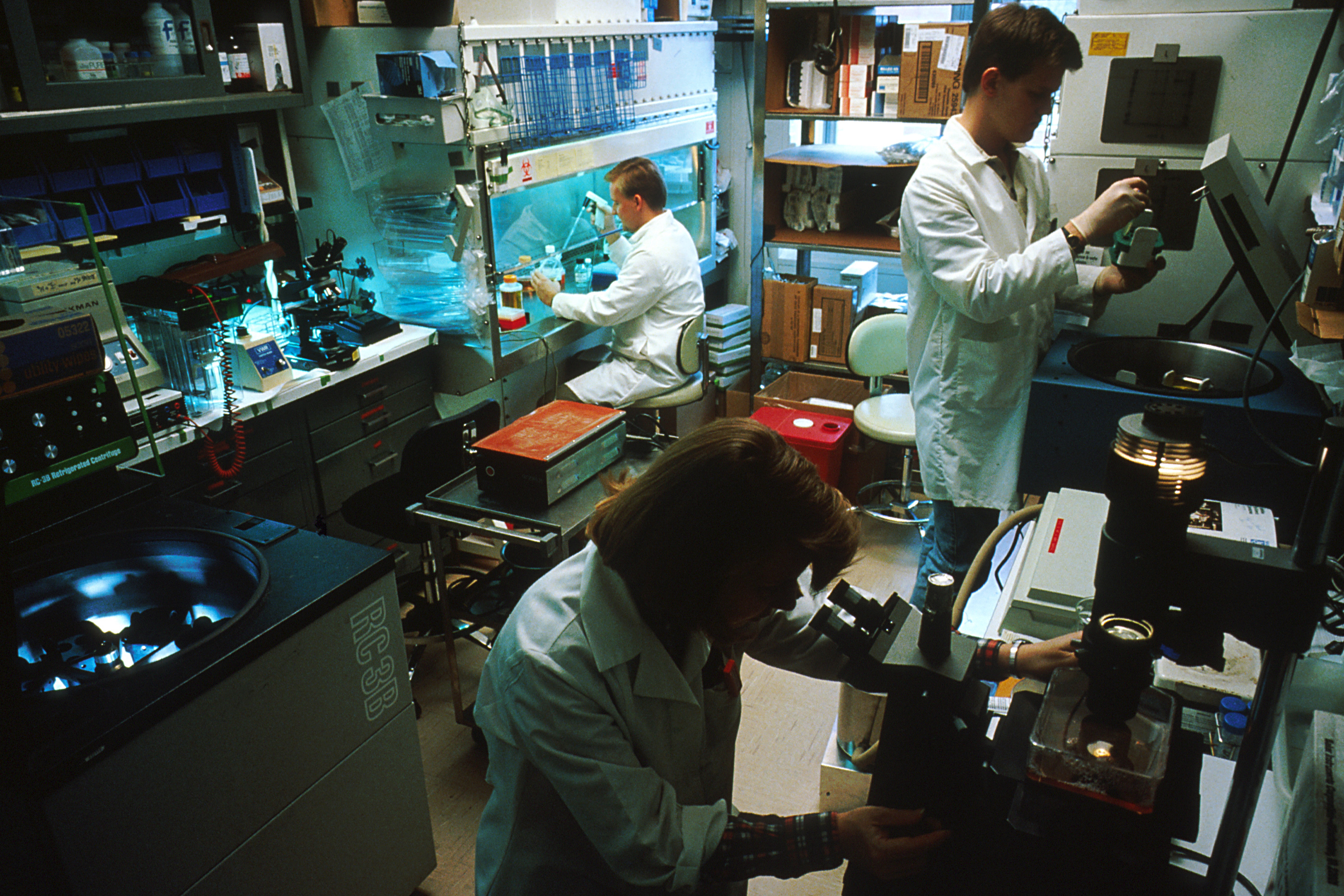
Scientists in a basic research laboratory. Public domain photo by Bill Branson, National Cancer Institute (January 1989).
This is how capability actually propagates. A graduate student trains an anomaly-detection model on a Defense Department grant; the technique gets published, refined, and licensed; a contractor folds it into a multi-domain awareness platform; the platform is sold to a service branch that, among many other uses, feeds AARO. No one in that chain is "working on UFOs." Each link is doing ordinary, fundable, publishable work. But the cumulative output is a national sensing apparatus increasingly capable of resolving exactly the kind of fast, ambiguous targets that have driven the UAP question for decades. The pipeline runs from the campus lab to the contractor to the cockpit — and almost none of it is labeled for what it ultimately enables.
The Structural Analysis: Why This Matters
- Contract hiding: UAP capabilities are embedded in broader defense categories, not explicitly labeled
- Technical pipeline: Universities → contractors → potential UAP applications
- Oversight challenges: Without explicit labeling, congressional oversight and FOIA requests hit dead ends
- Incentive alignment: Companies profit from developing capabilities; limited disclosure maintains funding streams
The real question isn't "who's hiding aliens" but "who builds the systems that investigate anomalies, and what are their incentives?"
The Honest Take
There is no smoking gun here, and that's the point. We went looking for the financial infrastructure around UAP investigation and found something less cinematic than a cover-up but more durable: a system where the relevant money is real but unlabeled, the relevant expertise is concentrated in a handful of contractors and universities, and the people who staff the oversight offices come from inside that same world. The $22 million BAASS contract shows the template — Pentagon interest routed through a private firm via a well-connected senator, producing reports rather than answers. The modern version is quieter and harder to trace, baked into multi-domain-awareness line items that no keyword search will surface.
None of this proves anyone is hiding aliens. What it shows is that the question "who profits from the mystery?" has a real, documentable answer that has nothing to do with whether the mystery is genuine. The infrastructure to investigate — and to keep investigating, indefinitely, on the public's dime — is already built, already funded, and already nearly invisible. Following that money won't tell you what the objects are. It will tell you why the question never quite gets resolved.
Action Items: Help Us Dig Deeper
This is a living investigation — the financial trail keeps moving, and our readers see more of it than any single newsroom can. If you can document a piece of it, we want to hear from you:
- Specific contractor connections: If you know of defense contractor personnel who worked on UAP programs, share (anonymously if needed)
- University research leads: Professors/students who've participated in DoD-funded sensor fusion/AI projects
- Document finds: Contract documents, procurement records, or technical reports showing UAP-relevant work
- Personnel movement: Defense contractor employees who later joined AARO or related offices
Email tips to: truthcapsuletv@gmail.com (encrypted if sensitive)
Don't miss the next investigation
Get exclusive deep dives, breaking UAP news, and investigative reporting delivered to your inbox — free.
Get the next briefing first
Briefings go to subscribers before they're posted here. One email per edition, no filler, and your 10% store code arrives with the welcome email.
Subscribe Free →