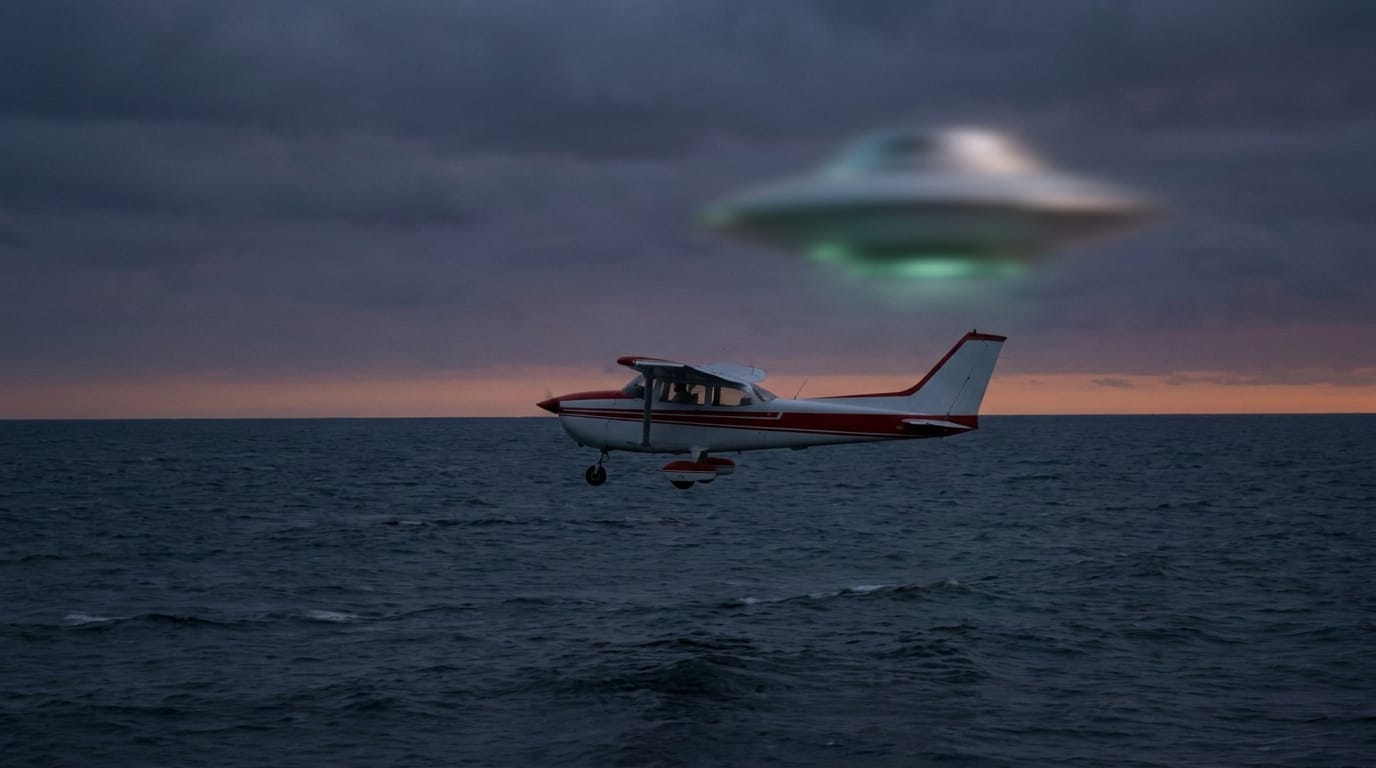
At 6:19 PM on Saturday, October 21, 1978, Frederick Valentich took off from Moorabbin Airport just south of Melbourne in a rented Cessna 182L, registration VH-DSJ. He was 20 years old, had about 150 hours of flight time, and held a class-four instrument rating that allowed him to fly at night under visual meteorological conditions only. The weather that evening was clear. Visibility was good. Winds were light.
His flight plan was a short overwater hop: south from Moorabbin, over Cape Otway, and out across Bass Strait to King Island — a 232-kilometer trip he expected to complete in just over an hour. He had filed properly. He had cleared his airframe. He was, by every metric available before takeoff, a routine general-aviation departure on a calm Australian spring evening.
At 7:00 PM he radioed Melbourne Flight Service to report passing Cape Otway and beginning his crossing of the strait. The flight service officer on duty, Steve Robey, logged the position and acknowledged.
Six minutes later, at 7:06:14 PM, Robey heard from Valentich again. The conversation that followed lasted six minutes and fourteen seconds. It is the most complete real-time audio record of a pilot describing — and apparently being affected by — an unidentified aerial object that exists anywhere in the world.
The Transcript
Reproduced from the Australian Department of Transport's official aircraft accident report (released April 27, 1982). Speakers: DSJ = Frederick Valentich; FS = Steve Robey, Melbourne Flight Service. Times shown in 24-hour AEST.
The Search
A Search and Rescue alert was triggered at 19:12. When Valentich failed to arrive at King Island by his expected ETA of 19:33, the alert became a full-scale search operation. Over the next four days, a Royal Australian Air Force P-3 Orion maritime patrol aircraft, eight civilian aircraft, and ocean-going shipping covered more than 1,000 square miles of Bass Strait. The search ended on October 25 without finding any wreckage, oil slick conclusively linked to the aircraft, body, or debris.
An oil slick spotted on October 22, about 18 miles north of King Island, was investigated and ruled out as unconnected to the missing Cessna. Bass Strait is shallow in places and not famously deep elsewhere. A Cessna 182L that crashed into it would, by every aviation precedent, have left something — flotsam from the cabin, a fuel sheen, a piece of an aluminum airframe washing up somewhere on the Australian or Tasmanian coast eventually. Nothing did.
The Department of Transport's official investigation, released in its final form on April 27, 1982 — more than three years after the disappearance — concluded that the cause was "unknown" and that Valentich was "presumed fatal." It did not offer an explanation for the object he reported seeing.
The Skeptical Case
The most rigorous skeptical analysis of the case comes from Joe Nickell of the Committee for Skeptical Inquiry, writing in Skeptical Inquirer in 2013. Nickell's argument has two parts.
First, the "four bright lights" Valentich described could correspond to a real astronomical conjunction visible from his position that evening: Venus (at maximum brightness), Mars, Mercury, and the bright star Antares, arranged in a vertically elongated diamond shape. A pilot looking up and slightly forward would have seen what could plausibly be misread as the landing lights of a large aircraft. The "long shape" Valentich described later in the transcript matches the diamond geometry.
Second, an early Department of Transport theory — never officially endorsed but floated in early news coverage — proposed that Valentich became spatially disoriented and may have been flying upside down by the end of the transmission, with the lights of the Cape Otway lighthouse reflecting off cloud particles below him. In this reading, the "aircraft hovering on top of me" was his own reflected lights seen as though above him because his perception was inverted.
What the skeptical reading explains: the four-light geometry, the "long shape" description, the possibility of pilot error in a low-time pilot's first night overwater crossing.
What it does not explain: the 17 seconds of metallic scraping noise on the open microphone after Valentich's final words. The complete absence of wreckage despite an extensive multi-day search across a relatively shallow body of water. The engine "coughing" Valentich described — pilots disoriented by their own reflections do not produce real engine roughness. And Robey himself, in a 1999 interview, told investigator Bill Chalker: "I don't believe he was disorientated. I don't believe he faked it or committed suicide."
The Honest Take
The Valentich case is the rare aviation mystery where the controversial element is not what was seen but what was said about it, in real time, by a sober pilot in radio contact with a trained controller, while it was happening. The transcript is not a memoir. It is not a witness statement reconstructed years later. It is the recording itself.
You can read the case as a tragedy of pilot disorientation made dramatic by a bright planetary conjunction and an unfortunate radio audio artifact at the end. You can read it as an authentic encounter with something the Australian Department of Transport was unable to identify and made no further effort to identify after publishing its 1982 report. What no one has ever produced is a piece of physical evidence that would resolve the question. Forty-seven years later, the Cessna is still missing.
What We Know
- ✅ Frederick Valentich departed Moorabbin at 18:19 AEST on October 21, 1978 in Cessna 182L VH-DSJ on a properly filed flight plan to King Island
- ✅ He held a class-four instrument rating and 150 hours of flight time
- ✅ He spoke with Melbourne Flight Service Officer Steve Robey for six minutes and fourteen seconds beginning at 19:06:14
- ✅ He described an object with four bright lights, a long shape, a green light, and a shiny metallic exterior, which he reported as "hovering" and "orbiting" his aircraft
- ✅ He reported his engine "rough idling" and "coughing" in his final two minutes
- ✅ His final intelligible words were "It is hovering, and it's not an aircraft"
- ✅ The recording captured 17 seconds of metallic scraping noise after the final transmission
- ✅ A four-day search covered over 1,000 square miles and found no wreckage
- ✅ The Department of Transport's April 1982 report ruled the cause "unknown"
- ✅ Steve Robey publicly stated in 1999 that he does not believe Valentich was disoriented, faked the disappearance, or committed suicide
Sources & Primary Documents
- Wikipedia — Disappearance of Frederick Valentich (case overview, transcript)
- UFO Research NSW — Full transcript and Cape Otway memorial
- Skeptical Inquirer — Joe Nickell's skeptical analysis (2013)
- Flight Safety Australia — Leaving this world (2025 aviation-industry retrospective)
- Snopes — Frederick Valentich's UFO Sighting and Disappearance (fact-check)
- Think AboutIt — The Valentich Mystery (Bill Chalker's 1999 Robey interview)
All links open in a new tab. External sources are provided for independent verification and are not endorsed by TruthCapsuleTV.