Case File Index
If the classic era established the shape vocabulary of the phenomenon, the modern era added harder edges: radiation, medical pathology, instrumentation, flight telemetry, declassification, and witnesses with security clearances. In these cases, the central question is no longer whether something strange was seen. The question is what framework can accommodate all the data at once without collapsing into absurdity.
1. Rendlesham Forest, United Kingdom (December 26-28, 1980)

Rendlesham is the file that embarrassed the old gatekeepers because it occurred in a controlled military environment and refused to stay buried. Two adjoining RAF stations—Bentwaters and Woodbridge—used by the United States Air Force became the setting for one of the most studied close encounter sequences in modern history. What makes Rendlesham endure is not that every detail is undisputed. It is that even after decades of argument, the core event remains too dense with evidence to dismiss casually.
In the early hours of December 26, 1980, security personnel observed unusual lights descending into the forest beyond the east gate. Airman John Burroughs and Sergeant Jim Penniston were among those sent to investigate. This is the first critical point: the event begins as a security response, not a civilian adventure. Men on duty, at a nuclear-adjacent Cold War installation, moved toward an anomalous incursion. Their institutional job was to identify threats, not invent them.
As the team entered the forest, the lights did not resolve into a lighthouse beam or distant aircraft in any simple way. Penniston and Burroughs reported closing in on a structured object among the trees. Descriptions vary in wording, but the strongest thread is consistent: a small triangular or conical craft, metallic in appearance, with a dark glossy surface reflecting light and carrying strange hieroglyphic-like symbols. The object was not seen at a remote distance. Penniston claimed he approached close enough to touch it.
That touch claim is one reason the case became divisive. Yet what is often missed is the operational texture of his description. He did not depict a glowing fantasy machine in theatrical language. He described a solid object with surface features and symbols that could be examined at arm’s length. Whether one accepts every later elaboration is secondary to the immediate importance of the original claim: a trained military witness encountered a landed or near-ground structured craft in the forest at close range.
Penniston later stated that he received a form of binary code message associated with the event, often summarized as “Exploration of Humanity, Origin Year 8100.” Critics seize on this as evidence of embellishment. Perhaps some aspects were added later through interpretive layers. But even if one brackets the binary claim entirely, Rendlesham remains formidable. The case does not stand or fall on that one element. It stands on multiple military witnesses, a documented search, physical trace evidence, radiation anomalies, and the later involvement of Lt. Col. Charles Halt.
Rendlesham is best understood not as one sighting but as a sequence: initial security response, close-range encounter, site traces, follow-up command-level investigation, audio documentation, and a long aftermath in which the witnesses paid professionally for refusing to recant.
Halt’s role is pivotal because it transformed the event from lower-level testimony into command-level documentation. On the night of December 27-28, after additional unusual reports, Halt led a team into the forest. He carried a microcassette recorder, creating one of the most extraordinary pieces of contemporaneous UFO evidence ever preserved. The tape captures the real-time uncertainty of trained personnel observing anomalous lights, discussing bearings, noting movement through the trees, and reacting to what appeared to be structured luminous sources maneuvering beyond conventional expectation.
The Halt memo, later sent to the UK Ministry of Defence, condensed the essentials: unexplained lights in the forest, physical ground indentations, broken branches on nearby trees, and radiation readings ten times background at specific points. That last detail has often been misunderstood. Ten times background in itself does not indicate catastrophic radioactivity. But in context it matters because it identifies localized anomalous readings at the very spots tied to the event. It suggests that the site was not merely imagined. Something measurable had changed or had been deposited there.
The landing site indicators are also central. Three small ground depressions in a triangular arrangement were documented, along with branch breakage consistent with an object moving among the trees or emitting force sufficient to affect the immediate environment. These are exactly the sorts of site details investigators look for. Not vague “the grass looked funny” claims, but specific measurable effects that can be photographed and mapped.
Radar remains contested. Some operators and later commentators have asserted that unusual returns were tracked during the broader event sequence. Official denials and fragmentary records complicate the issue. Yet even without clean radar corroboration, Rendlesham remains one of the best-evidenced cases on record. Add any credible radar component and it becomes even more potent. The ambiguity itself fits a familiar government pattern: enough documentation exists to confirm concern, but not enough is openly retained to settle every technical question.
The most corrosive argument against Rendlesham has long been the lighthouse theory. The nearby Orford Ness lighthouse did indeed sweep a beam across the region, and that fact has been used repeatedly as a solvent for the entire case. But the theory explains only a fraction of the witness experience at best. It cannot account for close-range observation of a structured object in the forest, touch claims, symbols, site depressions, radiation hotspots, or the intense immediacy heard on the Halt tape when lights appeared to move and fragment in ways inconsistent with a fixed lighthouse beacon.
What Rendlesham also reveals is the career consequence pattern. Speaking publicly about the event was not advantageous for the witnesses. It invited ridicule, professional complication, and decades of cross-examination. That matters. Witnesses who gain money, status, or immunity through their claims must be scrutinized carefully. Witnesses who risk reputation by sticking to a difficult account deserve a different analytical posture.
The craft morphology is especially important in the longer timeline. By 1980 the archive begins showing more triangular and angular configurations alongside the older domed-disc and oval forms. Rendlesham’s compact triangular/conical object suggests an evolutionary branch in the visible craft types reported by witnesses. Whether that reflects actual technological variation, changing observation conditions, or deeper classification issues is open to debate. But the morphology shift is real in the data.
Rendlesham remains unexplained because too many independent evidentiary lines survive: multiple USAF witnesses, command-level memo, audio recording, trace evidence, radiation anomalies, and a persistent core narrative that has resisted full conventional collapse for more than four decades. It is not a perfect case. No major case is. But it is a devastatingly important one, precisely because it shows how the phenomenon behaves when it intersects a military security perimeter.
2. Cash-Landrum, Texas (December 29, 1980)
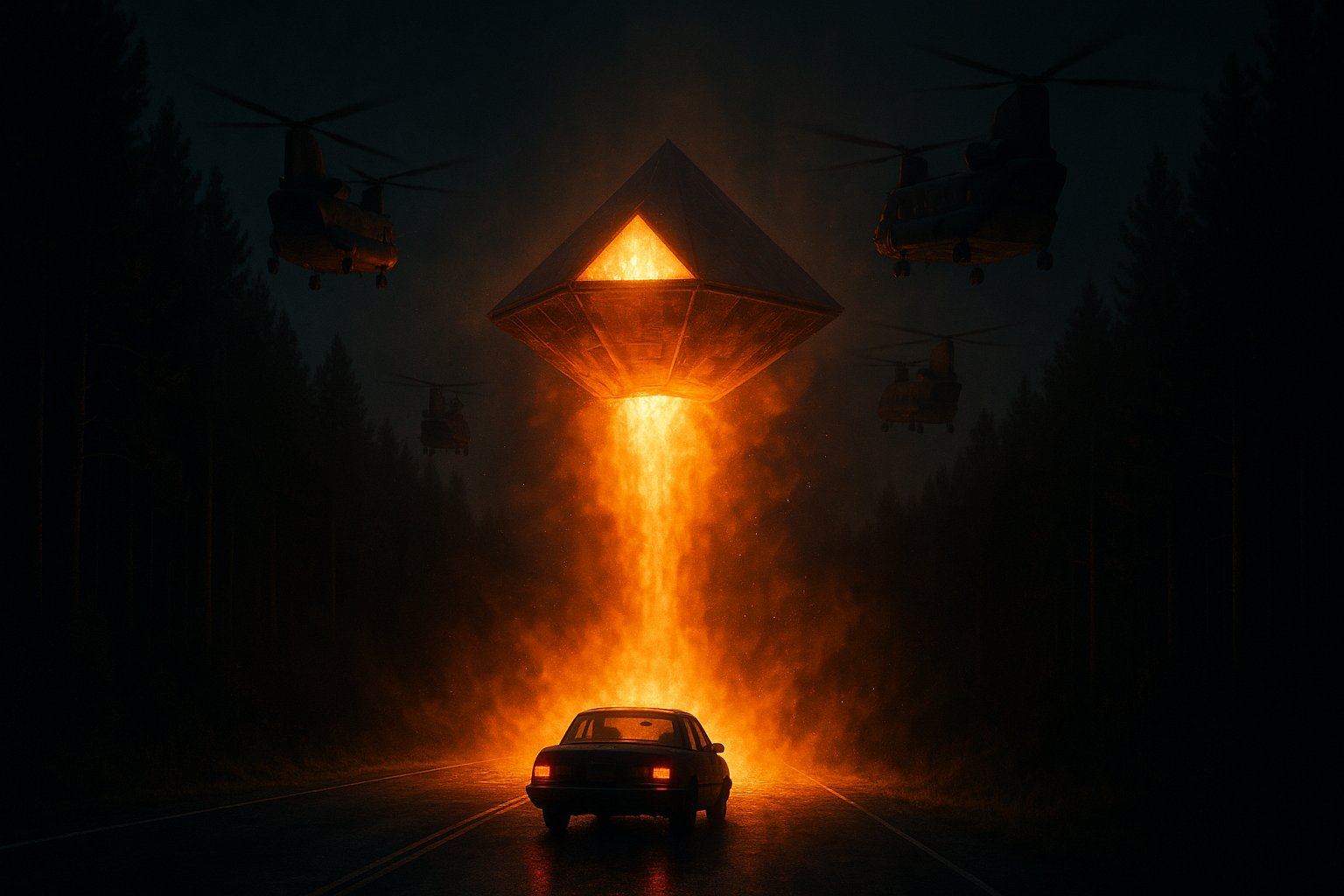
If Rendlesham is the military perimeter case, Cash-Landrum is the medical pathology case—the file that refuses to fit neatly into either folklore or comfortable denial. On a Texas roadway near Huffman on December 29, 1980, Betty Cash, Vickie Landrum, and young Colby Landrum encountered a brilliant diamond-shaped object low over the road. Flames or exhaust poured from the bottom. The heat was so intense that the witnesses later said the car’s dashboard became soft to the touch. This is not language from a distant light sighting. It is language from an exposure event.
The witnesses had stopped the vehicle or slowed dramatically because the object dominated the roadway environment. It hung there, brilliant and menacing, as if fighting gravity. Betty Cash reportedly stepped partly or fully outside the car to get a better look and was immediately subjected to fierce heat. Vickie and Colby, inside the vehicle, were also affected. The object was not simply bright. It was physically punishing.
Then came one of the most astonishing features in the modern UFO record: the helicopter escort. According to the witnesses, the object was accompanied or later surrounded by a large formation of military-style helicopters, often described as including Chinooks. Estimates reached twenty-three aircraft. That number sounds so extravagant that many listeners recoil on first hearing it. But the difficulty is this: independent witnesses, including a Dayton police officer and his wife, also reported seeing helicopters in the area that night. The military presence cannot be waved away as a fever dream of already-injured civilians.
Why does the helicopter component matter so much? Because if accurate, it suggests official awareness or pursuit. Either the military was escorting the object, tracking it, or converging on it. All three possibilities are explosive. If the object was theirs, the later government denial becomes extraordinary. If it was not theirs, then the formation demonstrates a rapid operational response to an aerial anomaly of severe concern. In either scenario, Cash-Landrum becomes far more than a roadside curiosity.
Cash-Landrum is the point in the record where one must confront a deeply uncomfortable possibility: whatever was in the sky that night left not just frightened witnesses, but documented injuries consistent with extreme thermal and possibly radiological exposure.
The medical aftermath is what sets this case apart. Betty Cash reportedly suffered severe radiation-like burns, nausea, weakness, vomiting, blistering, and dramatic hair loss. She required hospitalization. Vickie and Colby experienced burns, eye problems, nausea, and other symptoms. Critics have argued over diagnosis, sequence, and degree, but the essential fact remains: there were serious physical injuries after the encounter, and those injuries were documented. This is a threshold many cases never cross.
One must be careful with the term “radiation” because it is often used loosely in UFO literature. Not every burn or illness implies ionizing exposure. Yet the cluster of symptoms—skin damage, hair loss, profound sickness—strongly suggests something more than emotional distress. At minimum the witnesses were exposed to extraordinary heat and intense radiant energy. At maximum they experienced some combination of thermal and radiological insult. Either conclusion is deeply significant.
The lawsuit against the U.S. government for $20 million only sharpened the contradiction. The suit was ultimately dismissed, largely on the grounds that the plaintiffs could not prove which branch or agency was responsible and that no such craft officially existed. That legal outcome has often been misunderstood as disproof. It was nothing of the kind. It was a jurisdictional and evidentiary failure in court—not a technical explanation of what the witnesses encountered. In fact, the government’s position effectively amounted to this: even if the event happened, it was not ours, or at least cannot be tied to any acknowledged asset.
The craft itself has one of the most memorable profiles in the archive: diamond-shaped, intensely luminous, with flames or a fiery exhaust descending from the underside. This is not the clean white oval of Socorro or the domed disc of the 1950s. It is a harsher machine, or harsher presentation—almost as if the witness caught it in a stressed operating mode. Several researchers have noted that the object appeared to be in trouble or struggling to maintain position. That impression may explain the helicopter convergence if military units were attempting to shadow or monitor it.
The “dashboard softened” detail is frequently repeated because it provides an intuitive measure of heat load. Even if the phrase is not a lab-grade metric, it conveys witness proximity to a thermal event intense enough to affect the vehicle interior. Combined with body symptoms, it suggests an exposure environment far beyond any ordinary aircraft overflight. No helicopter formation, no atmospheric effect, no hidden industrial flare explains the totality cleanly.
Another key factor is witness demeanor. Betty Cash was by most accounts a strong-willed, practical woman, not someone inclined toward mystical invention. The Landrums were likewise ordinary people whose lives became harder, not easier, because of the event. The medical ordeal, legal battle, and public attention were not prizes. They were burdens. That gives the case its moral gravity. These were not performers. They were casualties of an unexplained exposure incident.
Cash-Landrum remains unexplained because any adequate account must explain all of the following simultaneously: a low diamond-shaped craft, extreme radiant heat, severe physical injury, multiple helicopters observed by primary and collateral witnesses, and a government response that denied operational ownership. Conventional aviation fails. Hoax fails. Misperception fails because it cannot produce burns and hospitalization. Secret technology remains possible in abstract, but then one must explain why such a dangerous platform was operating over civilians and why no coherent accountability trail ever emerged.
For investigators focused on pattern analysis, the case is indispensable because it anchors the radiation and injury category. Many UFO cases report fear. Fewer report scorched ground. Fewer still report bodies damaged badly enough to enter medical records. Cash-Landrum crossed that line. It is one of the rare files where the phenomenon left human tissue as evidence.
3. Pirassununga, Brazil (November 1969)

Brazilian UFO history is one of the richest bodies of material in the world, yet English-language discussion often gives it only cursory attention. That is a mistake. Brazil’s case files repeatedly feature close-range landings, military attention, witness clusters, and physical traces. The Pirassununga incident of November 1969 sits squarely within that tradition and deserves far more serious study than it usually receives.
Multiple local residents, including children, reported a metallic dome-topped disc roughly thirty feet in diameter. The object hovered silently and then ascended vertically with remarkable speed. Such a sequence is already familiar from the classic archive, but Pirassununga gains added importance from the reported landing-site effects: strange radiation-type symptoms near the area, vegetation changes, and burn marks where the object had been.
The Brazilian environment is instructive because the country has long combined intense public interest with official military documentation. This creates an unusual research landscape in which one can sometimes compare civilian narratives against state-collected material more directly than in certain other countries. Pirassununga sits within a broader national pattern in which landed or near-landed craft were treated not merely as tales but as incidents worthy of institutional attention.
The object’s shape belongs to the classic family: a disc with a dome, metallic in finish, compact and structured rather than amorphous. This is precisely the morphology seen in so many 1950s and 1960s cases worldwide. If one were mapping craft-shape recurrence as a historian, Pirassununga would slot almost perfectly into the global matrix. That consistency matters because it indicates stability of form across geography and culture.
Pirassununga reinforces a major but underappreciated point: South American cases are not peripheral to the UFO record. They are central to it, especially when landings, radiation complaints, and vegetation effects enter the file.
Children among the witnesses can be a double-edged sword for researchers. Skeptics dismiss them quickly; sensationalists exploit them too eagerly. The proper approach is to treat child witnesses as supplementary unless adult testimony and physical traces independently support the event. In Pirassununga that support appears to exist. The significance lies not in children telling a marvelous story, but in a wider local witness cluster describing a structured disc and an altered landing area.
Vegetation effects are one of the more interesting but difficult categories in UFO research. Plants can change for many reasons—heat, dehydration, contamination, disease. Yet again and again in landing cases, witnesses and later investigators report localized withering, scorching, unusual drying, ring formations, or altered growth. The repetition suggests that at least some objects were depositing heat, radiation, or another stressor into the immediate environment. Pirassununga fits that pattern. Whether the cause was thermal, radiological, or electromagnetic remains uncertain, but the site did not appear untouched.
The reported radiation-like effects near the landing site deserve cautious emphasis. Many historical reports use nontechnical language for sensations such as burning skin, malaise, headache, or unusual warmth. Without instrument readings, one must avoid overclaiming. But the recurrence of these reports—especially when paired with damaged vegetation—implies that some landing cases involved more than a simple visual event. The ground, air, and nearby biological systems were being affected in some measurable way.
Pirassununga also demonstrates how silent-hover behavior coexists with dramatic ascent. Witnesses reportedly observed a quiet object holding position before it rose vertically at high speed. This combination is so recurrent across decades that it is difficult to see it as coincidence. It suggests a propulsion method capable of maintaining local station with minimal acoustic signature, followed by a transition into a radically different motion regime when departing.
Because Pirassununga is less famous internationally than Rendlesham or Nimitz, it is sometimes treated as a secondary case. That is poor comparative analysis. In fact, it may be more valuable than many overpublicized files because it preserves the essential components in cleaner form: multiple witnesses, classic morphology, apparent landing, environmental traces, and unexplained vertical departure. Fame and quality are not the same thing.
Placed within Brazil’s larger UFO tradition—which includes military investigations, airborne interceptions, and physical trace cases—Pirassununga becomes part of a substantial evidentiary ecosystem. It is not an isolated village rumor. It is one tile in a national mosaic that repeatedly points toward structured craft interacting with terrain and witnesses at close range.
The case remains unexplained because no mundane candidate fits the full package. A helicopter does not present as a metallic dome-topped disc in silent hover and then shoot vertically away. A hoax must account for vegetation changes and local witness convergence. An astronomical object cannot land. The residue of the case, once all weak explanations are stripped off, is a familiar one: a landed or near-landed structured craft that left the environment altered.
4. USS Nimitz “Tic Tac” (November 14, 2004)
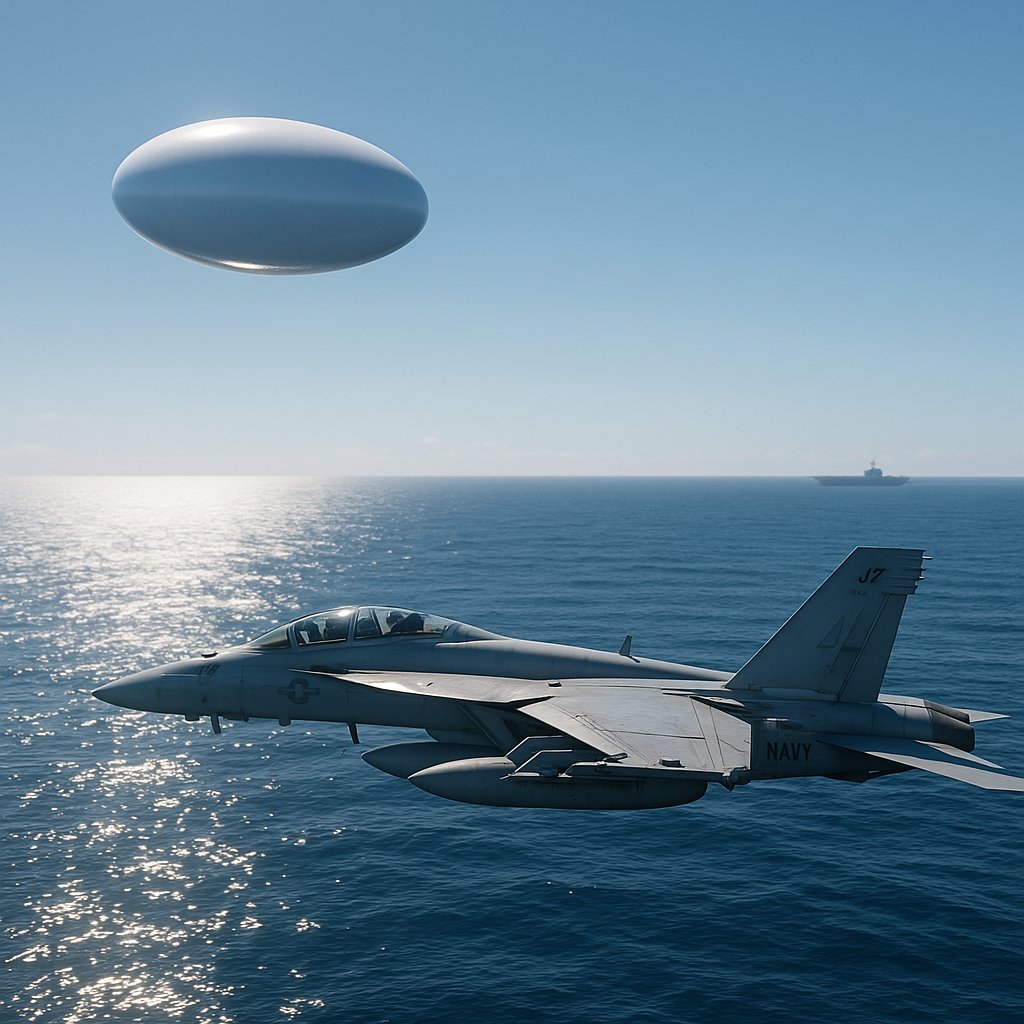
The USS Nimitz encounter is the case that forced the modern security establishment to stop pretending the old archive did not matter. By 2004 the sensors were no longer analog curiosities. They were advanced military systems running in a carrier strike group environment. And yet what they recorded reads like an upgraded version of patterns already present in the classic record: smooth white ovoid shape, no visible control surfaces, abrupt altitude changes, intelligent response to intercept, and a disappearance so sudden that veteran aviators struggled to compare it to anything in their experience.
For days before the famous intercept, radar operators aboard the USS Princeton had been tracking anomalous objects descending from altitudes reportedly above 80,000 feet to near sea level in a matter of seconds. Kevin Day and others watched the tracks appear repeatedly, sometimes moving in formation, sometimes dropping like stones and then stabilizing. In any conventional aerospace framework, such motion should have torn apart an airframe, generated immense thermal signatures, or left some obvious propulsion trail. It did none of those things.
On November 14, Commander David Fravor and Lieutenant Commander Alex Dietrich were vectored toward one of the contacts during training operations off Southern California. Their account has become famous, but its value lies in its disciplined simplicity. Upon arrival in the area, the aviators observed disturbed water below, as if something large had been just beneath the surface. Above that patch maneuvered a white, oblong object—smooth, wingless, approximately forty feet long, with no rotors, no exhaust, no cockpit glazing, and no visible means of propulsion.
Fravor’s description is particularly compelling because it comes from a commanding officer with deep tactical aviation experience. He was not guessing at what aircraft can and cannot do. He knew. The object moved like nothing in the inventory. As Fravor descended in a circling maneuver, the Tic Tac responded by climbing and mirroring his motion. This is one of the most striking aspects of the case. The object did not behave like a balloon, bird, or drifting target. It reacted intelligently to the intercept geometry.
The Nimitz event is where the old UFO problem collides with the full credibility of modern military sensing: radar sees it, aviators see it, infrared later captures it, and the government eventually admits the videos are real while still failing to explain what the object was.
Then came the acceleration. Fravor has described it as if the object simply disappeared—gone “like a bullet.” But even that metaphor understates the problem. Bullets follow ballistic arcs and shed energy. This object, by witness account and radar association, appeared capable of instantaneous repositioning with no transition phase. It later arrived at the pilots’ prearranged CAP point, suggesting either foreknowledge, extraordinary sensor awareness, or a maneuvering capability so superior that distance was effectively irrelevant.
The follow-up FLIR video, captured by another aircraft, does not provide the dramatic close-up the public often wants. What it does provide is confirmation that an anomalous object with no obvious wings or exhaust was tracked in infrared under operational conditions. Critics have tried to reduce the video to glare, angle effects, or mundane aerial targets. But those reduction arguments cannot erase the larger case context: days of radar tracks, multiple trained witnesses, visual intercept by elite aviators, and command-level awareness.
The lack of visible propulsion is the technical hinge. Every known aircraft telegraphs how it works in some way—lifting surfaces, hot exhaust, rotor wash, contrails, acoustic footprint, or control morphology. The Tic Tac offered none of this. It was a smooth, aerodynamic-seeming white capsule moving through the atmosphere without the signatures expected of jets, rockets, helicopters, or lighter-than-air platforms. That alone is extraordinary. Add the acceleration and altitude transitions, and it becomes nearly intolerable within known engineering constraints.
Calculations by various analysts have suggested that the observed or inferred accelerations, if taken at face value, imply enormous g-forces and velocities reaching tens of thousands of miles per hour equivalent over brief intervals. One must treat such estimates carefully because they depend on reconstructed timing and distance. Still, the broad conclusion is unavoidable: the performance envelope described by the witnesses and associated sensor data lies far outside acknowledged human aircraft capability, especially without visible propulsion or sonic effects commensurate with that motion.
The sea-surface disturbance below the object adds another layer. Some have speculated that a submerged vehicle or transmedium interaction may have been involved. Whether or not that is correct, the disturbance indicates the event was not confined to a single point of light in open sky. Something about the scene tied air and ocean together. This is important because later UAP discussions increasingly include transmedium behavior—objects transitioning between air and water with minimal apparent loss of performance.
Official acknowledgment in 2017 and beyond changed the historical status of the case. For decades, classic UFO reports were dismissed as anecdotal precisely because they lacked sanction from authority. Nimitz shattered that excuse. The Pentagon confirmed that the released videos were authentic military footage associated with unidentified aerial phenomena. Yet official acknowledgment did not produce official explanation. The core mystery remained in place.
The Nimitz case also closes a historical loop. Look carefully and the object’s morphology—the smooth white oval—is not as alien to the old files as many assume. It resembles, in stripped-down form, the egg and elongated oval craft reported in classic decades. What changed was not necessarily the phenomenon but the instrumentation available to witness it. In that sense Nimitz is not a rupture with history. It is a continuity event, one finally observed by 21st-century sensors.
It remains unexplained because the evidence is tri-layered at minimum: radar, visual, infrared. Add trained military witnesses, repeated detections over days, and later official confirmation of authenticity, and the case becomes one of the strongest in the entire historical record. It does not prove extraterrestrial origin. It proves something equally disruptive: the United States military encountered an intelligently maneuvering aerospace object with performance characteristics beyond acknowledged human capability, and no satisfactory public explanation has followed.
Pattern Analysis: What 60+ Years of Pattern Data Tells Us
Across these four cases, we can chart an apparent evolution in visible craft forms. The earlier decades are rich in discs, domes, and egg-shaped machines. By 1980, Rendlesham presents a compact triangular or conical object, while Cash-Landrum gives us a harsh diamond-shaped craft with severe radiant output. By 2004, the Tic Tac appears as a highly simplified elongated oval, almost as if the old ovoid forms had shed every decorative or structural element visible to the human eye. Whether this reflects genuine design variation, mission differences, or observer limitations is unknown. But the shape history is not random.
Electromagnetic and radiation effects persist throughout the timeline. In classic cases we see stalled engines and failed headlights. In more advanced close encounters we see radiation hotspots, physiological symptoms, eye injury, heat damage, vegetation changes, and possible sensor disruption. This continuity strongly suggests that the phenomenon is often accompanied by energetic side effects—sometimes mild, sometimes catastrophic. That alone should have earned it a far more serious technical research program decades ago.
The military witness pattern also hardens over time. Rendlesham features USAF security personnel and a deputy base commander. Nimitz involves carrier group radar operators and top-tier naval aviators. Even in cases where the primary witnesses are civilians, as in Cash-Landrum, military hardware appears on the periphery. The pattern is difficult to ignore: the phenomenon repeatedly intersects people trained to identify aircraft and assess threats, and those people often suffer professionally when they speak openly.
Physical evidence remains consistent across decades, though its form varies. In the classic era we see landing impressions and scorched vegetation. In Rendlesham, ground indentations, broken branches, and radiation readings. In Pirassununga, altered vegetation and apparent landing effects. In Cash-Landrum, the evidence migrates into the bodies of the witnesses themselves. In Nimitz, the trace becomes electronic and multi-sensor rather than strictly terrestrial. The pattern is not that every case leaves the same residue; it is that serious cases leave some residue.
The government response pattern is perhaps the most politically revealing. First comes investigation, because an anomalous incursion cannot be ignored in the moment. Then classification or internal compartmentalization, because the event touches defense, intelligence, or public order concerns. Then denial or trivialization when public explanation is demanded. And finally, in some cases, partial acknowledgment years or decades later when the documentary pressure becomes impossible to resist. Rendlesham and Nimitz fit this model especially well. Cash-Landrum illustrates the denial phase in brutal form. Classic cases like Socorro and Levelland foreshadowed the pattern long before the modern UAP era gave it a new acronym.
What does sixty-plus years of data suggest? At the very least, it suggests that humanity has been dealing with a recurring class of aerospace anomalies exhibiting structured craft morphology, advanced maneuverability, occasional transmedium behavior, and a measurable ability to interact with technology, biology, and terrain. These events are not confined to one nation, one decade, or one witness type. They form a durable historical pattern.
For the serious researcher, this means the debate must advance. The question is no longer whether the archive contains strong cases. It does. The question is whether our institutions are willing to compare those cases honestly across time. If they do, they will find repeating signatures: shape families, energy side effects, military intersections, trace evidence, and denial cycles. Put bluntly, the evidence became undeniable years ago. What remained deniable was only the willingness to face it.
TruthCapsuleTV conclusion: the modern cases do not replace the classic record—they confirm it.