Case File Index
The most useful way to approach these reports is the way a military aerospace historian would approach a forgotten black-project memo: isolate the witness class, define the object geometry, document the environmental effects, and compare performance against the state of the art for the period. When you do that, the fluff drops away quickly. What remains is a sequence of field reports that should have forced a much more sober public conversation decades ago.
1. Socorro, New Mexico (April 24, 1964)

Socorro is the case seasoned investigators bring out when they are done arguing with armchair skeptics. It is not merely famous; it is mechanically strong. A trained police officer sees an object at close range in daylight. He describes shape, size, markings, audible propulsion effects, and nearby humanoid figures. He then walks into a landing zone containing scorched vegetation and impressions in the soil. Multiple agencies arrive. The site is photographed. Measurements are taken. Hynek examines it. The FBI is informed. Army personnel look at it. Project Blue Book cannot make the case go away.
The sequence began with what should have been an ordinary law-enforcement moment. Sergeant Lonnie Zamora was in pursuit of a speeding vehicle when he heard a roar and noticed a bluish-orange flame in the distance. The sound was not a routine aircraft passage. It was abrupt, localized, and near enough to redirect his attention. He drove toward the source and climbed an area that gave him visual access to the arroyo. What he saw there permanently altered both his own life and the trajectory of official UFO investigation.
Below him sat a smooth, whitish, egg-shaped craft. Estimates vary slightly in retellings, but the core geometry remains stable: compact, metallic, seamless, and unlike any helicopter, aircraft fuselage section, weather balloon, or automotive wreckage. There were no wings. No rotors. No rivet line. No tail boom. No external control surfaces. Zamora noted what looked like a red insignia on the side, often described as an inverted V form with horizontal bars. This is one of those details serious researchers pay attention to because it is too specific to be useful as a vague fantasy marker. Witnesses invent generic disks all the time. They do not as often invent strange heraldic-like symbols with repeatable geometry.
More arresting still were the two figures near the object. Zamora described them as small and wearing white coverall-type clothing. They were not ten-foot giants. They were not glowing phantoms. They were practical, almost workmanlike figures near a landed machine. This detail matters because it gives the encounter an operational feel. The scene reads less like spectacle and more like interruption: a patrolman cresting a rise and finding what appeared to be personnel around a landed craft conducting some unknown task.
Hynek would later regard Socorro as one of the strongest close encounter cases on record because it did not depend on a single dramatic statement. It rested on witness quality, temporal coherence, and a trace site that could be walked, photographed, measured, and argued over by multiple agencies.
Zamora’s response was exactly what you would want from a credible witness under stress. He did not launch into cosmic speculation. He reacted to immediate field conditions. He moved, observed, sought cover, and attempted to assess danger. Then came the departure. Flames—blue and orange in tone by several tellings—were visible beneath the object, accompanied by a loud roar. The craft lifted and departed with a performance profile that is still one of the signatures of the phenomenon: a brief powered ascent sequence followed by rapid withdrawal beyond the capabilities of any conventional craft expected in that location.
Afterward, the ground told the rest of the story. Investigators found burned brush where heat had affected the vegetation. Impressions in the earth suggested contact points or landing struts. There were reports of fused or heat-altered sand. That combination is essential. Burn marks alone can be faked. Depressions alone can be caused by mundane equipment. But when you begin to assemble the trace package—heat, weight, geometry, witness observation, propulsion effects, timing—the case stiffens dramatically. It becomes increasingly difficult to explain with a prank or misidentification.
The attempted conventional explanations have never worn well. A popular fallback was that Zamora saw a lunar lander test article, or some sort of secret experimental device. But the timeline, logistics, and operating pattern fail under scrutiny. Secret tests near a public road in front of a local policeman, with two figures outside the machine and physical trace evidence left for multiple agencies to inspect, is a poor operating procedure for any serious military or contractor program. Nor does the object’s shape, site behavior, and departure profile map cleanly onto the known rocket test hardware of the period.
Socorro also benefits from something that many weaker cases lack: the witness had little to gain and a great deal to lose. Lonnie Zamora was not a fringe publicist looking for a stage. He was a police officer whose career now carried the permanent burden of having reported something impossible. His account did not become more grandiose over time in the way fabricated stories often do. At its core it stayed disciplined, specific, and stubbornly terrestrial in tone. That gives the file weight.
Hynek’s involvement further elevated the case. By 1964 he had moved well beyond his earlier reflexive skepticism and had become acutely aware that some Blue Book files were being disposed of too casually. He understood witness stratification. A close daylight encounter from a reliable officer, accompanied by physical evidence, belonged in a very different category than a distant nocturnal light. Socorro was exactly the kind of incident that demonstrated why the phenomenon could not be dismissed as a sociological mirage.
The FBI and Army attention is another indicator of seriousness. Agencies do not insert themselves into every local oddity. The reason they took notice is plain: a reported landed craft, apparent occupants, and a trace site near a community in the Cold War Southwest immediately raised national-security questions. Was this foreign technology? Was it an advanced domestic platform? Was it a psychological operation? The fact that no satisfying answer emerged is one reason the case endures.
One of the enduring strengths of Socorro is the shape itself. The classic UFO archive is saturated with circles, domes, and ovals, but here the object was not merely called a "saucer" out of cultural habit. It was described in more structural terms: smooth, egg-like, compact, white metallic, legged. That places it in a recurring morphological family seen repeatedly in the 1950s and 1960s—a family associated less with cinematic spinning disks and more with efficient, pressure-vessel-like forms. In aerodynamic terms, the craft made no conventional sense. In recurring witness-pattern terms, it made perfect sense.
Socorro remains unexplained because every serious path of reduction runs into a wall. Hoax? Too risky, too well evidenced, too specific. Misidentified helicopter? Wrong geometry, wrong sound profile, wrong trace package. Secret test? Poor operational fit and no persuasive documentary backstop. Hallucination? Impossible once the independent trace evidence is folded in. That is why Hynek later referred to it as perhaps the best-documented close encounter of the third kind. The case does not ask for belief. It asks for technical honesty.
2. Fort Lamy, Chad (March 1955)
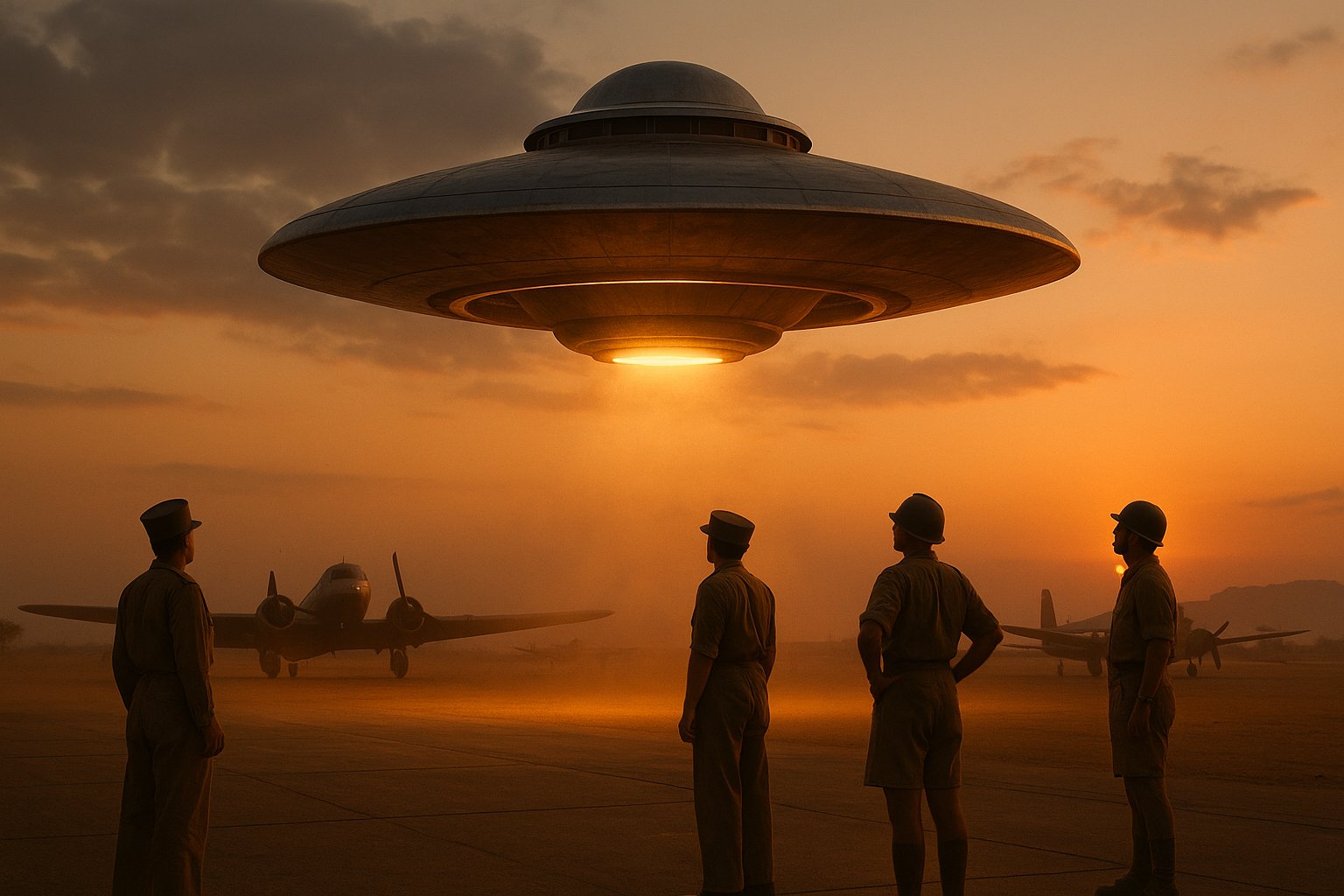
If Socorro is the archetypal landed encounter on American soil, Fort Lamy is the kind of colonial-era military case researchers overlook at their own expense. The event unfolded in March 1955 near the Fort Lamy airfield in Chad, then part of French Equatorial Africa. What matters is not the exotic geography. What matters is witness quality. These were military men working in an airfield environment—people accustomed to engines, silhouettes, procedures, and the distinction between ordinary traffic and impossible machinery.
Accounts describe a disc-shaped object with a prominent dome and a metallic surface, roughly sixty feet across. That size estimate is significant because it pushes the event out of the category of small luminous oddity and into the realm of aircraft-scale machinery. Witnesses reported a rotating outer rim, a loud humming noise, and even ground vibration, indicating that the object was not perceived as a silent hallucination or a star-like light. It had mass, mechanical presence, and environmental coupling.
One of the central rules in evaluating historic sightings is this: airfield witnesses deserve more attention than distant casual observers because the environment itself trains perception. Personnel working around runways and military installations spend their professional lives judging approach angles, sound profiles, air movement, beacon behavior, and aircraft dimensions. They know how objects look when they hover, taxi, climb, or flare. They know what a rotating beacon looks like at distance and what an engine run-up feels like through the ground. When they say something was wrong, that statement carries more weight than a roadside anecdote stripped of context.
In Fort Lamy, the object reportedly hovered over the field and then accelerated vertically at a rate no ordinary aircraft of the era could match. This detail alone moves the case into elite territory. Vertical performance in the mid-1950s had clear limits. Helicopters existed, certainly, but they announced themselves unmistakably through rotor signature and shape. Jet aircraft could climb, but not by rising from a hover in disc form with a dome and rotating perimeter. No known French, British, American, or Soviet aircraft operating openly in Africa fit that profile.
The geometry of the object is equally important. The classic domed disc appears again and again in the 1950s record. Contrary to popular caricature, these descriptions are often surprisingly technical. Witnesses do not merely say "flying saucer" because the newspapers taught them the phrase. They describe a lenticular platform with central cupola, metallic sheen, and structured peripheral motion. That recurring shape language across languages and continents is difficult to explain away as pure cultural contagion, particularly when the witnesses are trained military personnel with no evident motive to produce sensational narratives.
Another underappreciated element is the reported humming and ground vibration. Investigators tend to focus on visual testimony because it is easy to quote, but acoustic and tactile details often reveal more about the witness experience. A humming object that can be felt through the ground implies energy transfer of some kind. It suggests field interaction, mechanical resonance, or propulsion coupling. Witnesses were not simply watching an object pass through the sky; they were experiencing a local disturbance. That kind of multisensory report is harder to dismiss because it engages more than imagination.
The Fort Lamy file is valuable because it combines military witness reliability with classic domed-disc morphology and an ascent profile beyond the known postwar aerospace envelope. It reads like one node in a global pattern, not an isolated colonial curiosity.
French military documentation gives the case a documentary spine. Official reports do not guarantee correctness, but they do indicate that the event crossed the threshold from rumor into recorded concern. In the Cold War context, any unusual aerial object over an airfield required classification as a potential intelligence matter. The central issue was not whether the witnesses believed in extraterrestrials. The issue was whether an unknown machine with unusual performance characteristics had entered controlled military airspace.
There is a tendency among modern commentators to assume that if a case occurred outside the United States or United Kingdom, it must be weaker because fewer secondary books were written about it. That is bad historical method. In fact, cases like Fort Lamy are valuable precisely because they were less exposed to the later myth-making machinery. They were not endlessly recycled through American television. They often remain closer to the original reporting texture—short, practical, official, and unembellished.
Attempts to reduce the sighting to astronomical misidentification or weather phenomena do not survive contact with the core testimony. Stars do not hum over airfields, vibrate the ground, exhibit a rotating outer rim, and then launch vertically at extreme speed. Nor does a meteor hover. Nor does ball lightning adopt a structured metallic disc profile with a dome and sustained presence. When skeptics are forced into the language of rare atmospheric effects, it often means the conventional inventory has already failed them.
The rotating outer rim is especially intriguing when viewed across decades of case literature. We find many witnesses describing not simple spinning craft, but perimeter movement—bands, rims, segmented lighted edges, or rotational effects confined to an outer section. That suggests a patterned technical appearance rather than a child’s toy top. If these reports are accurate, then the outer rim may have had something to do with field generation, stabilization, or witness-visible energy effects. We cannot prove that from one sighting, but the recurring motif deserves note.
Fort Lamy remains unexplained because the normal pathways of dismissal do not fit. The witness base was military. The object had definite shape and size. There were acoustic and tactile effects. It hovered and then climbed vertically with extraordinary acceleration. The event entered official reporting channels. If the file had occurred over an American base in Arizona or Ohio, it would probably be cited in every serious discussion of Cold War UFO history. Its African location should not relegate it to the footnotes.
What the case contributes to the larger archive is an unmistakable reminder: the phenomenon was international early on, and the object morphologies were already showing repeatability. The disc with the dome. The hovering display. The abrupt vertical departure. The witness class. The military report. Those are not random ingredients. They are the contours of a pattern.
3. Levelland, Texas (November 2-3, 1957)

Levelland is the electromagnetic interference case that should have ended the lazy assumption that UFO reports are merely lights in the sky. Across the night of November 2-3, 1957, witness after witness reported a luminous object near the roadways around Levelland, Texas. The reports were not confined to a single observer, a single stretch of road, or a single emotional outburst. They arrived in clusters over time, and they carried an astonishingly consistent mechanical consequence: when the object came near, car engines died and headlights failed. When it departed, the vehicles restarted.
This is precisely the kind of repeatable effect researchers prize because it points away from subjective interpretation and toward environmental interaction. A witness can exaggerate fear. A witness can misjudge altitude. But a line of motorists independently reporting that their engines stalled in the presence of a nearby luminous object and restarted after its withdrawal is a much more durable evidentiary pattern. It suggests electromagnetic interference, field coupling, or at minimum some external influence on ignition systems.
The first calls described a brilliant object crossing the road or resting nearby, often egg-shaped or elongated oval, glowing blue-white against the West Texas night. Some witnesses estimated the object at extraordinary size—on the order of hundreds of feet. Large size estimates in nighttime cases must always be handled cautiously, but the consistency of the close-range roadway encounters is the real center of gravity here. Drivers were not reporting a star, a planet, or distant weather. They were reporting something low, proximate, and behaviorally connected to their stalled vehicles.
Levelland unfolded in a region where practical men judged practical things. Farmers, drivers, law officers. West Texas in 1957 was not a petri dish for avant-garde mythology. These were people used to weather, machinery, open roads, and darkness. That cultural context matters. It is much harder to dismiss a multi-witness machinery-disruption event when it occurs among individuals who are intimately familiar with combustion engines and rural nighttime conditions.
Sheriff Weir Clem’s involvement pushes the case over another credibility threshold. Law-enforcement participation acts as a stabilizing factor in historical cases because it introduces documentation habits and reduces the chance that the entire event can be written off as rumor contagion. Clem not only investigated but reportedly saw the object himself. That is not a trivial detail. It means the witness chain included not merely anonymous motorists but an officer who entered the event stream directly.
Levelland is not one story. It is a wave of coordinated incidents tied together by a very specific operational effect: engines out, lights dead, object present; engine returns, lights return, object gone.
Project Blue Book’s explanation—ball lightning—has aged poorly. Ball lightning is one of those convenient categories officials invoke when they need a scientific-sounding label for something strange without actually explaining it. The problem in Levelland is that the label does not account for the structured, repeated, road-level interactions with vehicles and witnesses across multiple locations. Ball lightning does not routinely shut down automotive systems in a synchronized pattern and then depart in a controlled fashion. Nor does it reliably appear as a massive, elongated, blue-white object traversing roads and fields over a sustained period.
Some investigators have noted that many of the cars involved in 1957 used electrical systems more vulnerable to external interference than modern vehicles. That is true, and it strengthens rather than weakens the case. If an unknown field-emitting object entered proximity, these systems might well have been affected. Levelland therefore reads less like nonsense and more like a primitive but compelling field test from nature—or from something that was not nature.
The shape data are revealing. Again we see not merely a generic disc but an egg or elongated oval form. This is one of the most persistent patterns in the pre-1970 period. The public imagination remembers saucers because the term is catchy, but the archives are full of ovoid and lenticular craft. In engineering terms, such forms suggest compactness, smooth energy distribution, and minimal external protuberances. Whether or not one accepts exotic propulsion hypotheses, the recurrence of this morphology across witnesses is notable.
The object’s glow also deserves careful handling. A blue-white luminosity is often associated in reports with high-energy states rather than painted surfaces illuminated by ordinary light. If the object was producing ionization, corona effects, or some other energetic envelope, that could plausibly relate to the simultaneous vehicle disruptions. Again, we cannot claim more than the data support, but Levelland is precisely the sort of file that invites serious engineering speculation because the witness effects are so concrete.
Critics sometimes argue that weather conditions that night may have predisposed observers toward sensational interpretations. But weather cannot by itself explain the repeated engine-failure motif. Nor can it explain consistent low-altitude object reports over hours from independent parties. Once you chart the calls temporally and geographically, the event begins to resemble a moving operational presence rather than a diffuse atmospheric anomaly.
The massive size estimates in some Levelland accounts are worth mentioning not because they are exact, but because they reflect how imposing the object seemed at close range. Witnesses often struggle with scale under unusual luminous conditions, yet they are usually good at distinguishing a small light from something that dominates the roadway environment. The psychological texture of the reports is telling: not curiosity but immediate alarm. The thing was there, low and near enough to interfere with the machine they were sitting in.
Levelland remains unexplained because it contains a near-laboratory repetition of an unusual effect. Fifteen or more witnesses. Multiple locations. Several hours. Similar luminous object descriptions. Similar vehicle failures. Law-enforcement attention. A weak official explanation that did not fit the mechanics. This is not a one-off campfire tale. It is a regional event cluster with one of the clearest electromagnetic signatures in the classic UFO record.
When later military cases describe instrument interference, power anomalies, or radar disturbances, the seasoned researcher hears an echo of Levelland. The roads of West Texas may have recorded one of the earliest mass civilian demonstrations that these objects were not simply seen; they could interact.
4. Edmonton, Alberta (May 1967)

The Canadian wave of 1967 produced a number of valuable sightings, but the Edmonton encounter stands out because it preserves one of the central signatures of the phenomenon in clean form: close-range observation by multiple witnesses, a structured metallic craft with rim lighting, silent stationary behavior, and then a departure so abrupt it breaks ordinary expectations of inertia and propulsion.
Witnessed by multiple family members, the object was described as a silver saucer roughly forty feet in diameter. Around its rim ran pulsating colored lights. That lighting detail is worth more than it may appear. The classic archive repeatedly distinguishes between self-luminous diffuse objects and structured craft with organized light placement. The latter are particularly significant because they imply architecture. Lights arranged around a rim suggest a perimeter system, not a random glow or a celestial body distorted by atmosphere.
The family observed the object at close range for several minutes. Duration matters. Brief glimpses generate uncertainty. Prolonged observation allows witnesses to compare angles, judge size relative to background features, note surface reflectivity, and discuss what they are seeing in real time. Multiple witnesses doing so together create a valuable internal cross-check. If one person misperceives, another often corrects. When the entire group converges on the same broad description, the report gains structural integrity.
The object reportedly hovered silently. This detail recurs with almost unnerving regularity across decades. Conventional aircraft telegraph themselves acoustically. Even at modest distance, the ear often detects what the eye cannot yet resolve. But many strong UFO cases invert that expectation. Large objects appear capable of stationary or low-speed behavior with little or no corresponding sound. Then, when the departure occurs, it is sometimes not a gradual acceleration at all. It is instantaneous, as though the object simply ceases to participate in familiar aerodynamic constraints.
That was the Edmonton signature. After holding position long enough to be studied, the craft departed at impossible speed. Witnesses frequently struggle to describe this because ordinary language is built around ordinary motion. They resort to phrases like “it shot away,” “it was gone in a second,” or “it vanished like a bullet.” These are not technical metrics, but they consistently indicate an acceleration profile far sharper than fixed-wing aircraft of the era could safely achieve at low altitude and far beyond the capabilities of helicopters.
The Edmonton case is valuable because it captures a complete behavioral sequence in miniature: structured metallic craft, perimeter lights, silent hover, close observation, and a departure profile so abrupt it severs the event from conventional aviation.
The craft’s approximate forty-foot diameter also places it in a familiar operational class. It was large enough to read as a machine, small enough to hover near a residential or semi-rural environment, and proportioned like many other reported close-range discs from the era. In historical comparison studies, this size band appears repeatedly. It suggests that whatever witnesses were seeing in the 1950s and 1960s often belonged not to giant mothership mythology but to a recurring tactical or local-operational platform scale.
The colored rim lights raise another important issue: witnesses in classic cases were often seeing more than a featureless metallic shell. Some objects displayed organized color changes or pulsation patterns. These may have served a functional purpose, or they may have been byproducts of whatever energy system was in operation. Either way, they recur too often to be dismissed as decorative fantasy. In Edmonton, the combination of silver body and rhythmically pulsating lights fits neatly within a broader worldwide pattern.
Because the witnesses were family members rather than military personnel, some researchers rank Edmonton below cases like Socorro or Rendlesham. That is too simplistic. Civilian multi-witness cases can be extremely strong when observation range is close, duration is sufficient, and the object displays coherent structure and impossible motion. In fact, family groups are often excellent witnesses because they have no institutional script to protect and no professional incentive to dramatize the event. They simply describe what interrupted their evening.
The 1967 Canadian wave provides contextual support. A single close-range saucer report in isolation is interesting. The same report occurring during a broader surge of anomalous sightings is more significant because it suggests a wider operational pattern rather than an isolated perceptual error. Waves do not prove exotic origin, but they do increase the probability that multiple communities are independently encountering the same class of phenomenon.
Edmonton remains unexplained because there is no clean conventional aircraft candidate. A helicopter fails on sound and geometry. A small plane fails on hover and acceleration. Astronomical sources fail on proximity, structure, and duration. A hoax fails on the internal consistency of the observation and the need to account for the craft’s sudden motion. What we are left with is a classic near-field structured-craft case from the high-water mark of the 1960s UFO wave era.
When viewed alongside Socorro, Fort Lamy, and Levelland, Edmonton helps complete the shape-and-behavior matrix. The object is metallic. It is geometrically coherent. It hovers. It can remain almost eerily quiet. And when it chooses to leave, it does so in a manner that makes the witness feel ordinary aerospace rules have been suspended. That is not a random collection of impressions. It is a recognizable signature set.
Pattern Analysis: What the Classic Era Was Trying to Tell Us
When the four cases are laid side by side, the pattern is more illuminating than any single incident. First is the dominance of egg, oval, lenticular, and domed-disc shapes across the 1950s and 1960s. Despite media shorthand about “saucers,” the stronger reports repeatedly point to smooth, compact, structurally disciplined forms. Socorro gives us the egg-like landed craft. Levelland gives us the elongated oval under luminous conditions. Fort Lamy presents the domed disc. Edmonton offers the silver saucer with rim lighting. Different continents, same broad engineering language.
Second is the electromagnetic interference pattern. Levelland is the clearest example, with engines and headlights failing in the object’s presence, but it is not isolated. In many classic cases, witnesses describe dead radios, odd static, compass disruption, battery anomalies, or power interruption. This is one of the strongest recurring signatures because it bridges the gap between sighting and physical interaction. A phenomenon capable of interfering with ignition or electrical systems is not merely decorative.
Third is the consistency of physical trace evidence. Socorro is the benchmark: burned brush, impressions, heat-affected soil. But trace evidence shows up globally in classic cases—flattened vegetation, scorched ground, ring marks, dehydrated plants, and unusual soil disturbance. These are not always decisive individually, yet across many files they create a profile of objects that, at least on occasion, contact the environment in measurable ways.
Fourth is the witness credibility pattern. Military and law-enforcement witnesses recur again and again. Fort Lamy was observed by trained French military personnel. Socorro was anchored by a police sergeant and then elevated by multi-agency response. Levelland drew law-enforcement involvement. Even Edmonton, though civilian, involved multiple observers in prolonged close-range conditions. The strongest files rarely depend on one excitable voice. They arise where credibility is layered.
Fifth is the signature flight envelope: silent hover to instant acceleration. This might be the single most important recurring behavior in the archive. Conventional aircraft telegraph themselves acoustically and accelerate gradually. The objects in these classic cases often do the opposite. They hold position with uncanny steadiness and then depart in a burst that seems to ignore inertia, lift transition, and aerodynamic drag. That pattern appears in the 1950s, the 1960s, and, as later decades would prove, it never really went away.
There is also a subtler sociological pattern. Official agencies tend to respond in four steps: document, reduce, dismiss, and quietly retain interest. Blue Book did this repeatedly. Local and military authorities treated incidents seriously when they happened, especially if national security or public safety was potentially involved. But once the public explanation phase began, the pressure shifted toward normalization. Weather. Astronomy. Misperception. Ball lightning. Hoax. Yet the strongest cases kept resisting those categories.
What, then, do these classic encounters tell us? At minimum, they demonstrate that by the 1950s and 1960s there already existed a globally distributed pattern of reports involving structured craft, close-range observation, anomalous propulsion, physical traces, and witness pools far too credible to sweep aside with a smirk. Whether one interprets the phenomenon as nonhuman technology, an unknown terrestrial program, or something even stranger, the archive itself is clear on one point: the serious cases were never about lights in the sky. They were about machines—or machine-like objects—behaving in ways that outpaced the acknowledged aerospace state of the art.
And that is why these old files still matter. They are not quaint relics from a more gullible age. They are the foundation stones of the modern mystery. The shapes were there early. The trace evidence was there early. The military witnesses were there early. The silent hover and impossible acceleration were there early. If we want to understand the present phase of the UFO problem, we have to stop treating the classic era as folklore and start treating it as a technical archive.
TruthCapsuleTV conclusion: the classic record established the pattern long before the world was ready to admit it.