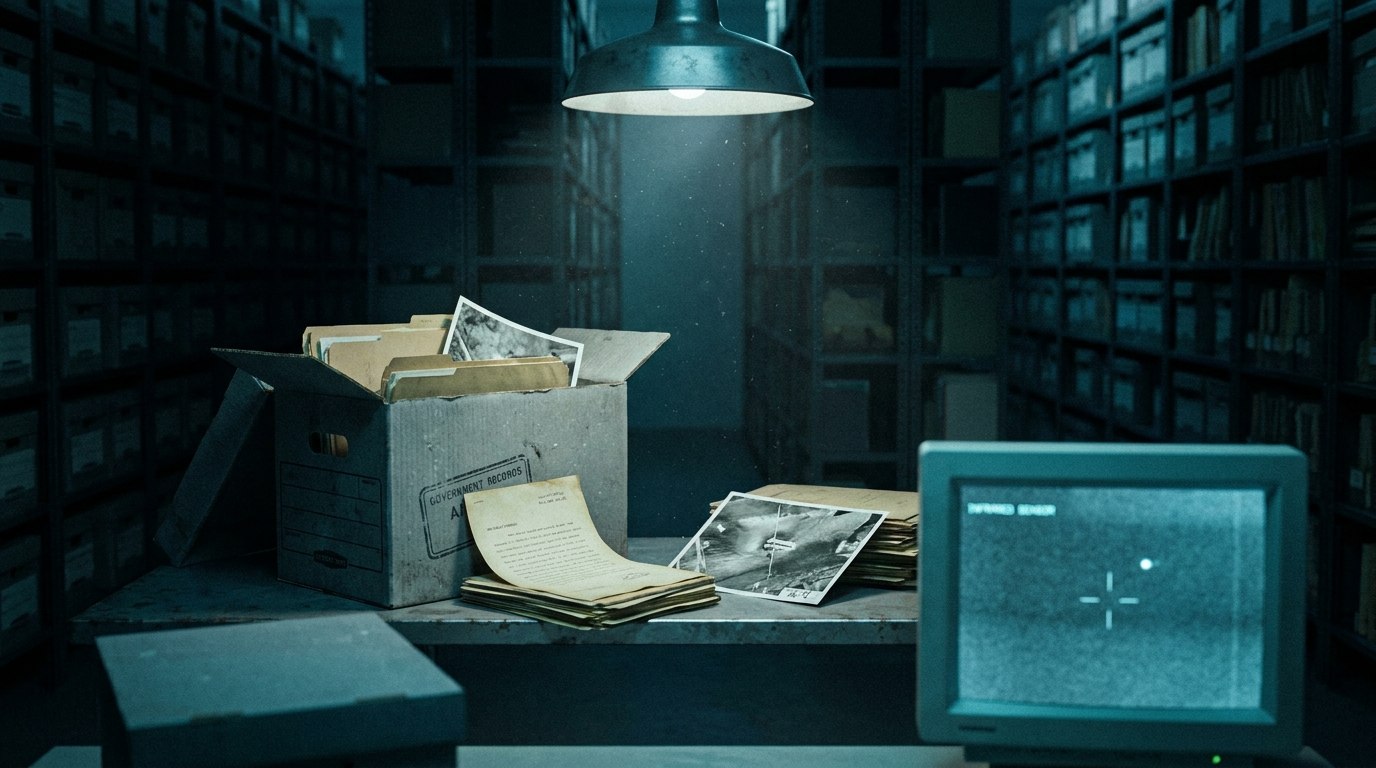
The Department of War has moved to issue a sole-source contract for a commercial data subscription to the archives of the National Unidentified Flying Object Historic Records Center (NUFOHRC) — a private, New Mexico-based nonprofit that a War Department official describes as holding "the world's largest private collection of historical UAP-related records," including hundreds of thousands of case files that exist nowhere else, in or out of government. The plan surfaced this week in a Department of War contracting notice and was first reported by DefenseScoop.
This is not a new claim about aliens. It is the All-domain Anomaly Resolution Office (AARO) doing something narrower and more procedural: trying to buy its way into a paper record it does not otherwise have access to, in order to fill in a history it has been ordered by Congress to reconstruct.
What the Contract Actually Is
Per the contracting notice and the War Department official's on-record description to DefenseScoop, this is a subscription, not a data dump or a partnership announcement. The proposed structure is a one-year base period with four one-year options, buying AARO "digital access to proprietary data, metadata, and analytical products" NUFOHRC already maintains. The official was explicit about the boundary: "The subscription service will provide AARO with access to a pre-existing, proprietary commercial data subscription and is not for professional labor or advisory services."
The justification, in the same official's words: "Market research conducted to date indicates that no other organization possesses the historical depth, volume of unique records, and specialized analytical expertise to meet the government's minimum needs." AARO declined to disclose the estimated total cost of the deal.
-
A UAP historian and researcher who has spent decades personally accumulating books, journals, newspapers, audio and video recordings, photographs, and physical artifacts spanning more than 75 years of UFO history.
-
Over the last six years, Marler took custody of several major legacy collections, including the complete historical files of one of the earliest civilian scientific UFO research groups, founded in the 1950s.
-
NUFOHRC holds the personal files of Dr. J. Allen Hynek, the astronomer who developed the "close encounter" classification system while working on the Air Force's Project Blue Book — among the most historically significant personal archives in the field.
The Congressional Chain Behind It
AARO was established in 2022 under that year's National Defense Authorization Act, largely in response to public and congressional concern about UAP incursions near sensitive sites. The mandate this contract serves traces through the NDAAs that followed: the FY2023 NDAA directed AARO to compile a comprehensive historical record of the government's UAP-related intelligence and military activity going back to 1945. The FY2024 NDAA separately created the UAP Records Collection at the National Archives and Records Administration (NARA), ordering every federal agency to review, digitize, and transfer its UAP-related holdings for eventual public release.
Read against that chain, the NUFOHRC contract is AARO acknowledging a gap it cannot fill from inside government channels alone. As DefenseScoop's report puts it, mid-20th-century military records on this subject were "heavily hidden, decentralized, fragmented, or often preserved only by civilian researchers and private organizations after official projects concluded." A private archivist who spent 75 years collecting what agencies didn't keep is, in a narrow and unglamorous sense, exactly the kind of gap this mandate anticipated.
The two quotes worth sitting with are both about scale, not substance. "NUFOHRC possesses the world's largest private collection of UAP-related historical records, including hundreds of thousands of unique case files that exist exclusively within its archives," the official told DefenseScoop. Nothing in the notice or the reporting describes what any specific file contains. This is a contract to gain access to a large body of records — not a disclosure of what reviewing them has found.
What This Doesn't Tell Us
Buying an Archive Is Not the Same as Finding an Answer
1. Volume isn't evidence. "Hundreds of thousands of case files" is a claim about the size of a filing system, not about what any of those files actually document. A large archive of unresolved sighting reports and newsletters is still, mostly, an archive of unresolved sighting reports and newsletters.
2. The source describing the deal has an interest in it sounding necessary. The quotes justifying the contract's sole-source status come from the government side making the case for why only NUFOHRC will do — standard language in a sole-source justification, and worth reading as such rather than as an independent assessment of NUFOHRC's holdings.
3. NUFOHRC itself said nothing. The organization did not respond to DefenseScoop's request for comment. That's not suspicious on its own — small nonprofits often don't have a press function — but it means every specific claim about the archive's contents currently traces back to one side of the transaction.
4. A subscription is not a publication. Nothing here obligates AARO to make anything it finds in NUFOHRC's files public. The NDAA mandates point toward eventual disclosure through NARA, but that pipeline runs on its own schedule, and this contract is a data-access step, several stages upstream of anything reaching the public record.
What to Watch Next
- Contract award confirmation — whether the sole-source award actually clears (sole-source justifications can be challenged) and its final value, which AARO declined to disclose to DefenseScoop.
- Whether NUFOHRC ever comments — on the deal, or on what its own holdings actually contain beyond the government's characterization of them.
- Any pre-1990 material that surfaces in a future PURSUE release — the clearest sign this contract produced something reviewable, rather than just archival access.
- Whether Hynek's papers specifically get referenced — a marquee holding like that would be a natural first citation if AARO's review turns up something it considers noteworthy.
The Honest Conclusion
This is a real, citable institutional action: a federal contracting notice, an on-record government quote, and a clear line back to AARO's own congressional mandate to reconstruct the pre-1990 UAP record. It belongs in the same category as the PURSUE releases we've covered — official machinery doing what it was told to do — not in the category of a whistleblower claim or a leak.
What it is not is evidence of anything. AARO buying access to a large private archive tells you the government thinks the archive might contain useful historical context. It does not tell you what that context is, whether it changes anything, or whether the public will ever see it. The honest read is the boring one: a research office trying to do its paperwork properly, on a subject where paperwork has historically been the whole problem.
Sources: DefenseScoop (Brandi Vincent, September 2, 2026) · AARO (All-domain Anomaly Resolution Office)