Nine days after the Department of War published its sixth batch of UAP files, the first wave of headlines has passed and the people who actually opened the files have started reporting what they found. No seventh release has appeared. This briefing goes back through Release 06 with that week of scrutiny added: what the database holds, which parts were already public, what the government's own video frames show, and what the first independent analysts made of the modern clips.
On September 18, the Department of War published the sixth tranche of files under the Presidential Unsealing and Reporting System for UAP Encounters (PURSUE). The official statement, attributed to Assistant to the Secretary of War for Public Affairs and Chief Pentagon Spokesman Sean Parnell, is two paragraphs long and says the collection "continues to be housed on WAR.GOV/UFO" and that the Department "will release additional files on a rolling basis." It gives no file count and names no case.
The database does. Release 06 holds 72 files: 56 PDFs, 15 videos, and one audio recording. (Several outlets, including CBS News, reported 71 files and 55 PDFs; the one-file difference is a PDF transcript filed under the new law enforcement category, which those counts appear to have omitted. The figures here are the database's own, and EarthSky's count of 72 matches.) Forty-four of the 72 belong to a single program: the Advanced Aerospace Weapon System Applications Program (AAWSAP), a Defense Intelligence Agency effort funded from 2008 to 2010, according to the contract documents in this tranche, and wound down by 2012. Through a Las Vegas contractor, AAWSAP commissioned studies on subjects ranging from warp drives and wormholes to metallic glasses. Thirty-seven of those studies, the Defense Intelligence Reference Documents or DIRDs, are in this tranche. On March 25, 2022, the DIA released 37 of AAWSAP's 38 DIRDs to researcher John Greenewald's The Black Vault under the Freedom of Information Act, a release we covered in Edition 007. The Pentagon's largest release in three months is, by the numbers, just over half re-publication.
What is new in Release 06 is older. The tranche reaches back to the earliest material PURSUE has published: the July 1952 Tremonton, Utah film and its complete Project Blue Book case file, the personnel record of the Navy officer who shot it, and a March 1952 recorded presentation by Captain Edward J. Ruppelt, the Blue Book chief widely credited with coining the term "unidentified flying object." It also adds a file prefix PURSUE has not used before: LLE, for a local law enforcement agency in Colorado.
-
President Trump posts that he will direct the Secretary of War and "other relevant departments and agencies" to begin identifying and releasing government files on UAP and UFOs.
-
158 files. The launch tranche and still the largest.
-
64 files, including the Syrian "instant acceleration" MQ-9 footage. Our coverage.
-
72 files.
-
40 files, the oldest batch to that point. Our coverage.
-
41 files, including the AC-130J "cold orbs" tape. Our coverage.
-
72 files. Ties Release 03 as the largest since the launch tranche. Cumulative total: 447.
Sixty-One Percent of the Release Is One Program's Paperwork
The AAWSAP files form a complete administrative arc. The tranche includes the program's Statement of Objectives dated July 18, 2008, the solicitation and original contract order dated September 22, 2008, and five contract modifications running from September 2009 to September 2010. As Edition 002 laid out, that solicitation drew exactly one bidder, Bigelow Aerospace Advanced Space Studies, and the program spent roughly $22 million, the DIA's own figure as reported by the Federation of American Scientists, in appropriations arranged by three senators. The contracting documents are the least glamorous part of the release and, for anyone tracing the program, the most useful: they show, in the government's own paperwork, what it asked for and when.

The 37 DIRDs have already drawn the headlines, and the titles explain why. Dated between December 2009 and January 2011 in the database entries, they include Warp Drive, Dark Energy, and the Manipulation of Extra Dimensions (April 2, 2010); Traversable Wormholes, Stargates, and Negative Energy (April 6, 2010); Antigravity for Aerospace Applications (March 30, 2010); Invisibility Cloaking Theory and Experiments (March 2, 2010); Negative Mass Propulsion (January 3, 2011); and An Introduction to the Statistical Drake Equation (March 11, 2010). Others are conventional engineering surveys: metallic glasses, spintronics, ultracapacitors, hypersonic tracking, cockpit design, and an unclassified paper titled State of the Art and Evolution of High-Energy Lasers.
Two things about these documents matter more than their titles. First, they are literature reviews and theoretical papers commissioned from outside authors. A DIRD titled Warp Drive is a survey of what the physics literature said about warp drives in 2010, not a report that anyone built or observed one. Second, they are largely not new. AAWSAP produced 38 DIRDs, according to the list the DIA sent Congress in January 2018. When the DIA answered The Black Vault's FOIA request on March 25, 2022, it released 37 and withheld one: a separate high-energy laser weapons report, classified Secret, distinct from the unclassified laser survey in this tranche. That classified report is absent from Release 06 as well. Since only one of the 38 was classified, the 37 unclassified papers here are the same 37 the DIA released in 2022. There is one real difference. CBS News reported that Friday's copies "include some details the agency had previously withheld, like the names of the agency offices that produced the documents." Less redaction is a real addition; CBS described the restored details as office names, and we have not compared the two sets of redactions ourselves. What Release 06 mainly changes is their status: they now sit on an official government platform, under a presidential disclosure program, tagged as UAP records.
The distinction the release does not draw for you. PURSUE's own directive says the materials archived on the site are "unresolved cases, meaning the government is unable to make a definitive determination on the nature of the observed phenomena." A 2010 paper on wormhole geometry is not a case, resolved or otherwise. By filing the DIRDs under PURSUE, the Department has broadened what the platform holds from sightings to the government's own history of thinking about the subject. That is a reasonable archival choice, and it is not evidence of any craft or phenomenon.
The Oldest Film in the Archive
On July 2, 1952, Navy Chief Warrant Officer Delbert C. Newhouse was driving with his family near Tremonton, Utah, when he stopped and filmed a group of bright objects moving against a blue sky. His released personnel record shows a career photographer with more than a thousand hours of aerial camera work. He reported seeing twelve to fourteen objects and, according to the case file as described in press accounts, used a handheld Bell & Howell camera. The film became one of two motion pictures examined by the CIA-convened Robertson Panel in January 1953, according to the panel's report.
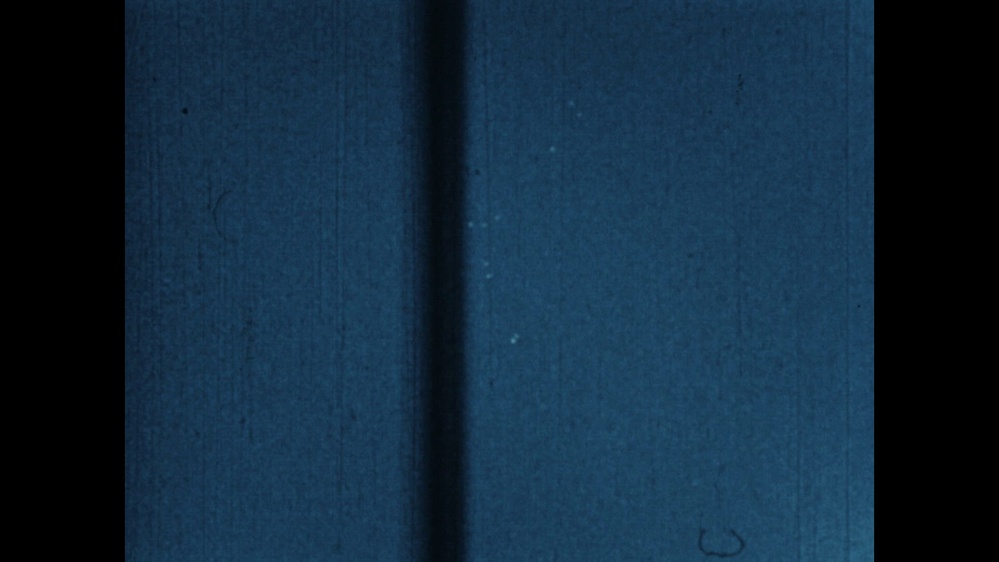
Release 06 publishes the film itself (DOW-UAP-PR159), the Project Blue Book case file on it (DOW-UAP-D102), a separate Blue Book photo file (DOW-UAP-D103), and Newhouse's final Navy personnel record from 1957 (DOW-UAP-D104). Alongside them sit a U.S. Air Force "Flying Discs" file covering September through December 1952 (DOW-UAP-D105) and a March 26, 1952 presentation in Boston by Captain Edward J. Ruppelt, released as both a transcript (DOW-UAP-D154) and an audio recording (DOW-UAP-PR160), the only audio file in the tranche. Ruppelt ran Project Blue Book and is credited with introducing the term "unidentified flying object" to replace "flying saucer."
The dispute over what the film shows was never settled, and it ran through three government bodies that reached different conclusions along the way. The Naval Photographic Interpretation Center at Anacostia spent roughly a thousand man-hours on the frames, according to the Robertson Panel's record of the Navy's briefing. Above The Norm News, reading the newly released file, reported that the Navy analysts found the objects "were self-luminous or light sources and could not be aircraft or balloons," and that "no known bird would reflect enough light to produce the images recorded on the Tremonton film." The Robertson Panel, meeting in January 1953, rejected that reading; its report found the objects' "apparent motions, sizes and brightnesses" were "considered strongly to suggest birds, particularly after the Panel viewed a short film showing high reflectivity of seagulls in bright sunlight." The newly released Blue Book file adds a third opinion. Fox's LiveNOW, reading the file, reported that a December 1952 review by Blue Book staff, balloon specialists, and representatives of General Mills concluded the objects "closely resembled pillow balloons," with one dissenter, before the project's official conclusion settled on seabirds reflecting sunlight. PURSUE's own note on the case says its "limited detail and lack of fixed reference points prevented a conclusive resolution." Seventy-four years on, the file records the argument without ending it.
One oddity for anyone who downloads the government's copy: the DVIDS page for DOW-UAP-PR159 notes that after about 55 seconds the reel "transitions to unrelated footage appearing to show a demonstration of sewing equipment." Somewhere in seventy years of storage, the film was spliced onto something else.
The Ruppelt recording is the tranche's only audio file. The PURSUE database dates the talk March 26, 1952, and places it in Boston, Massachusetts; the Department's DVIDS page describes Ruppelt telling his audience the project had reviewed approximately 800 cases. CBS News quoted him from the recording, with its own elision: "about 20% are very good reports offered by very reliable people and… just absolutely no conclusions can be drawn."
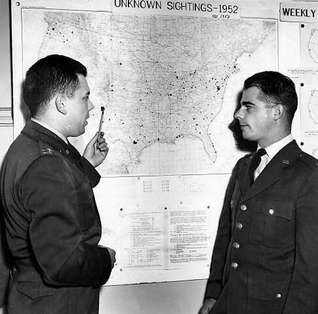
Representative Eric Burlison of Missouri, who had sought the recording's release, said in a September 21 statement: "This tape presents a juxtaposition to the framing that UAP interest in our nation's nuclear sites is new and can be explained as adversarial drones from foreign countries." That is the congressman's reading. The recording itself is a government file anyone can play, at DOW-UAP-PR160 on DVIDS, and Ruppelt's own 1956 account of running Blue Book, The Report on Unidentified Flying Objects, is free on Project Gutenberg.
A Police Department Joins the Record
In our review of the PURSUE database, every prior file carries a federal agency prefix: DOW for the Department of War, and in Release 05, FBI and EOP for the Executive Office of the President. Release 06 adds a new one. Five files are tagged LLE, for Local Law Enforcement: one transcript (LLE-UAP-D001) and four videos (LLE-UAP-PR001 through PR004), all described as "Unresolved UAP Report, Colorado, October 2023." The database identifies the contributing agency only as "Local Law Enforcement" and the location only as Colorado; no outlet we could find has named the department. The Pentagon's file notes, as quoted by Fox and The National Desk, describe cellphone video in which an officer reports a "silent" object with "red, blue, and green flashing lights." The National Desk characterized the submission as the first time a non-federal agency has contributed to PURSUE. No official has said so on the record, and the claim rests on the file prefixes rather than on any statement from the Department.
Nine days on, the department is still unnamed. The Denver Gazette reported on September 22 that the location "appears to be noted" in the records but "remains redacted," and no agency has come forward.
That may prove more significant than the four clips themselves. PURSUE's directive describes a "government wide" effort across "dozens of agencies." Until now every agency visible in the file prefixes was federal. A county sheriff's office or city police department handing its dashcam or bodycam footage to the Department of War for publication is a different pipeline, and if it continues it would widen the record considerably.
The Modern Files
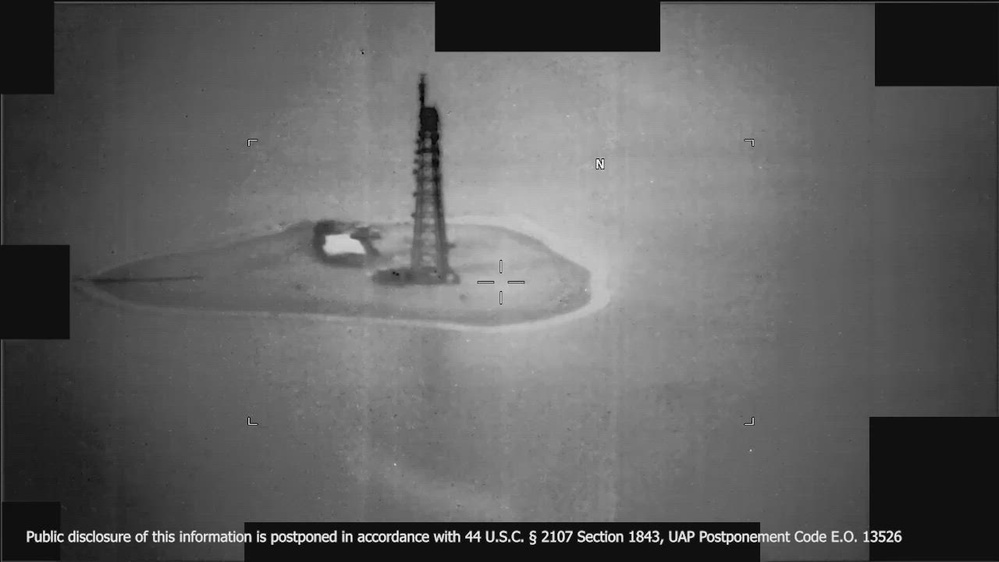
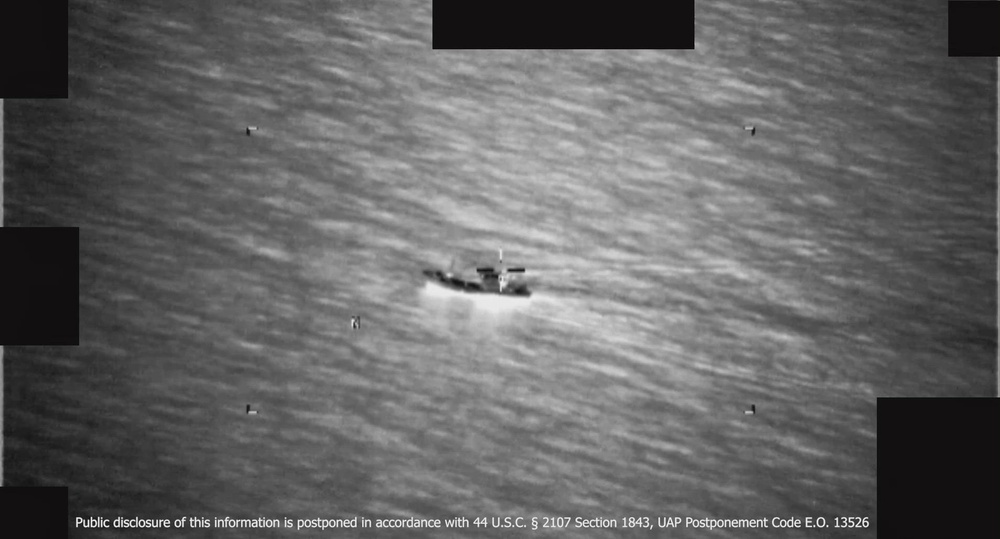
The remaining sixteen records are the kind PURSUE has published since May: recent, military, and unexplained by label. Six are mission-report PDFs from Iraq in 2022 and the Middle East in 2022 and 2025. Ten are videos. Five are from the Yellow Sea in 2023, one from the East China Sea in 2023, and four from the Middle East and Iraq between 2022 and 2025. As with every prior tranche, they arrive with a location, a year, and the word "unresolved," and with no accompanying analysis of what the sensors recorded.
The first independent readings arrived within hours. Mick West, the video analyst who runs the Metabunk forum and has spent years examining military UAP footage, wrote on September 18 that DOW-UAP-PR135, a 2025 Middle East clip, "looks like a group of six birds," adding: "Ambiguous enough apparently that AARO could not just say it's birds, and so it's a fleet of UAP for the media." He placed it at Qaruh Island, Kuwait. Of the paired clips PR140 and PR141, which appear to show a sharp turn, he wrote that the second object's motion "seems entirely consistent with a bird." He also noticed that two of the mission reports, D106 and D109, use identical "80-180 MPH" and "SPORATICALLY" wording, and called them "more like a boilerplate report rather than even superficial technical details." West is an independent skeptic, not an official source, and these are his readings. They are also the most specific analysis of these clips we have found from anyone, including the government that released them.
| Category | Files | What it is |
|---|---|---|
| AAWSAP DIRDs | 37 | Commissioned studies, Dec 2009 to Jan 2011. Released to The Black Vault under FOIA, March 2022. |
| AAWSAP contract | 7 | Statement of Objectives, solicitation and order, five modifications (2008 to 2010). |
| 1952 package | 7 | Tremonton film, Blue Book case and photo files, Newhouse personnel record, USAF Flying Discs file, Ruppelt transcript and audio. |
| Modern military | 16 | 6 mission-report PDFs and 10 videos: Yellow Sea, East China Sea, Middle East, Iraq (2022 to 2025). |
| Local law enforcement | 5 | Colorado, October 2023: one transcript, four videos. New agency category. |
What This Doesn't Prove
More Than Half of the Biggest Tranche in Months Was Already Public
1. Fifty-one percent of the release was downloadable four years ago. The 37 DIRDs went to The Black Vault under FOIA in March 2022. Republishing them on a government platform is largely a change of address, with the reduced redactions CBS noted as the one real gain. Counting Release 06 as 72 new files means counting 37 that researchers have been reading since 2022.
2. A physics paper is not a craft. The DIRDs are surveys of theoretical literature, credited on their cover pages to outside academics and contractors. Their titles read like a science-fiction shelf because they were written to canvass speculative propulsion ideas. By their titles and abstracts, none reports an observation, a recovery, or a working device, and PURSUE's decision to file them as UAP records does not change what they contain.
3. Tremonton has carried a mundane candidate explanation since 1953. The film shows small bright points with no reference object for scale or distance. The Robertson Panel concluded in January 1953 that their motion and brightness strongly suggested birds, and Project Blue Book's official conclusion was seabirds reflecting sunlight. The Navy's photo analysts disagreed at the time, and the newly released file shows Blue Book itself briefly favored balloons. The release puts the argument on the record; it does not adjudicate it, and neither should anyone reading the film for the first time this week.
4. "Unresolved" is a label, not a finding. The site's own definition is that the government "is unable to make a definitive determination," which "can occur for a variety of reasons, including a lack of sufficient data." Every modern video in this tranche carries that label and nothing else. Six releases in, the government has not published a technical analysis of any PURSUE video, and the first outside analyst to look at Release 06 found birds in at least two of its clips within a day.
What to Watch Next
- The thirty-eighth DIRD. The one AAWSAP study still unpublished is the high-energy laser weapons report the DIA classified Secret. Whether PURSUE ever declassifies it is the most specific open question we see in the tranche.
- The rest of the Tremonton file. The December 1952 "pillow balloons" review is the first detail reported from DOW-UAP-D102. The Blue Book case file and photo file run to more than that, and a full read may add to the historical record.
- Which Colorado agency, and whether more follow. Still redacted nine days on. The LLE prefix either stays a one-off or becomes a pipeline, and Release 07 will show which.
- Whether anyone official answers the bird readings. Mick West's identifications of PR135 and PR140/141 are specific and checkable. The Department has not responded to them.
- Release 07 timing. As of September 27, none. The Department says the next release is being "actively" prepared, and the intervals between tranches have been widening.
The Honest Conclusion
Release 06 is official and citable: a dated statement from the Pentagon's chief spokesman and 72 files in a searchable government database. Its most consequential content is the government formally entering two pieces of its own history into the disclosure record: the receipts of the program that paid for the warp-drive papers, and the seventy-four-year argument over a film shot by a Navy photographer on a family road trip.
The re-publication of the DIRDs is worth saying plainly. Just over half of this tranche was already public. The parts that were not, the contract documents, the 1952 Blue Book files, and the police department's footage, are smaller and quieter, and they are where the new information is. Six releases and 447 files in, PURSUE has still not published a single analysis telling the public what any of its videos show. It took one independent analyst less than a day to offer a mundane reading of two of them.
WAR.GOV/UFO, filter to Release 06. All 72 files, plus bulk downloads of the documents (2.23 GB) and videos (1.4 GB).
DOW-UAP-PR159, the Tremonton film. Watch past the 55-second mark for the unrelated spliced footage.
The audio (PR160), and his 1956 book The Report on Unidentified Flying Objects.
LLE-UAP-PR001, PR002, PR003 and PR004, the police department's videos.
The full DIRD collection and FOIA case file, online since the DIA's 2022 release, with the title list of all 38.
The Robertson Panel report (PDF), including its "strongly to suggest birds" finding on Tremonton.
Mick West's threads on PR135 and PR140/141, with frame-by-frame discussion.
Sources: WAR.GOV/UFO, PURSUE Release 06 database (September 18, 2026) · Department of War, statement of Sean Parnell (September 18, 2026) · DVIDS, DOW-UAP-PR159 · DVIDS, DOW-UAP-PR160 · CBS News (Stefan Becket, September 18, 2026) · EarthSky (Paul Scott Anderson, September 20, 2026) · Fox / LiveNOW (September 18, 2026) · Above The Norm News (David Freeman, September 18, 2026) · The National Desk (September 18, 2026) · Denver Gazette (Spencer McKee, September 22, 2026) · Rep. Eric Burlison statement (September 21, 2026) · Metabunk, Mick West on PR135 · Metabunk, Mick West on PR140/141 and D106/D109 · The Black Vault, AAWSAP DIRD collection · Robertson Panel report (January 1953) · Ruppelt, The Report on Unidentified Flying Objects (1956) · Ruppelt photograph (St. Louis Post-Dispatch, 1953) · TruthCapsuleTV Edition 007 on the AAWSAP contract · TruthCapsuleTV Edition 002 on the AAWSAP solicitation
Related Briefings
- Breaking: Cold Orbs and a Gunship Tape — Inside the Pentagon's Fifth UAP Release (August 7, 2026)
- Edition 007: The UFO Industrial Complex — Who Profits from the Mystery? (the $22M AAWSAP contract and the 2022 DIRD release)
- Edition 002: The Program Built to Deny Itself — How AATIP Was Designed for Plausible Deniability
- Edition 018: Trump Administration Launches PURSUE Platform (the Release 01 launch, May 2026)