The wave
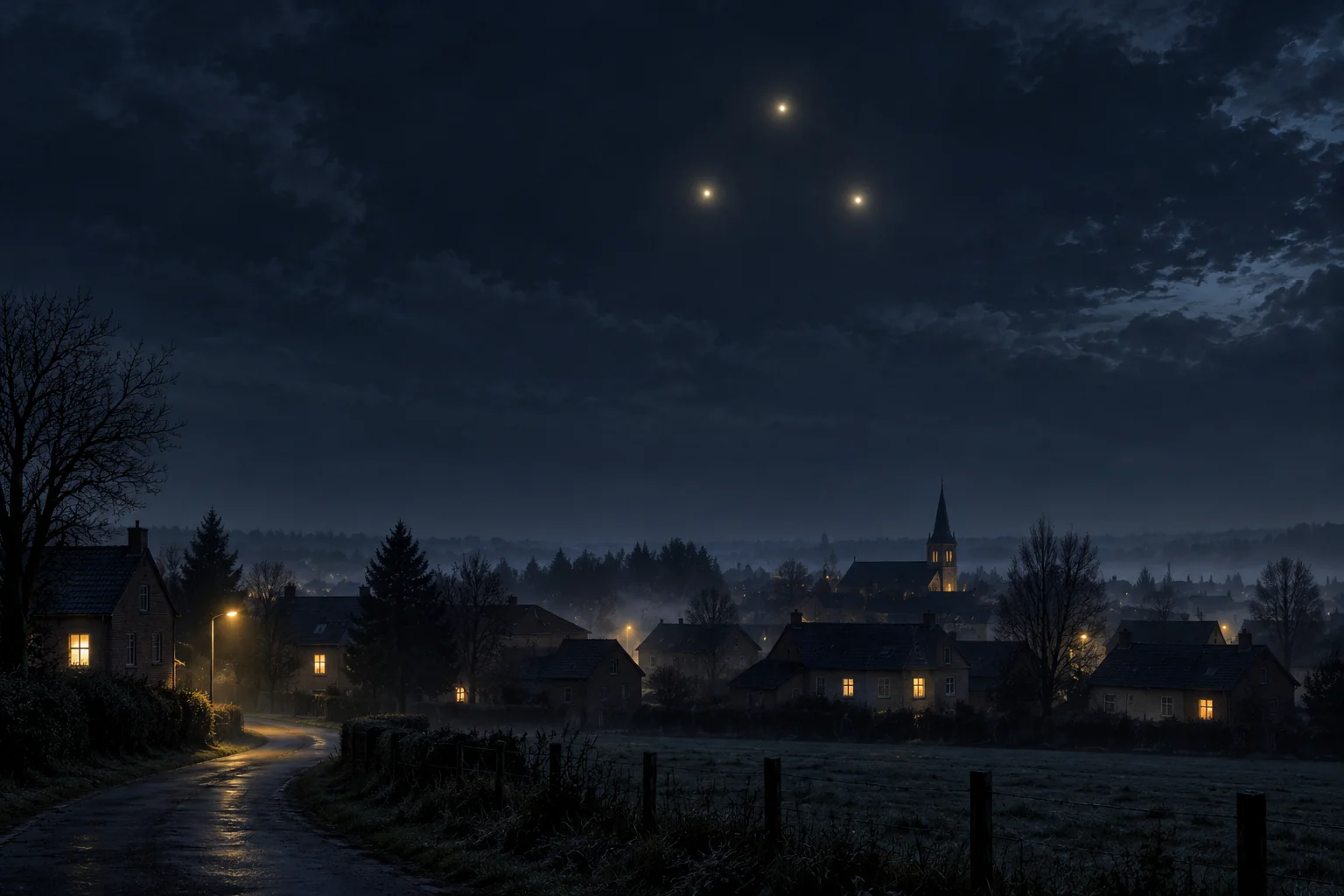
On the evening of November 29, 1989, the gendarmerie in the eastern Belgian town of Eupen begins fielding calls about a large, silent triangular platform with three brilliant downward-facing lights moving slowly over the countryside. Two gendarmes on patrol, Heinrich Nicoll and Hubert von Montigny, observe the object at close range for an extended period — a flat triangle, the size of a large aircraft or bigger, hovering and creeping at speeds no fixed-wing aircraft can sustain. That single night produces well over a hundred witness reports in the Eupen region alone. It is the opening of a wave that continues through April 1990, during which the civilian research organization SOBEPS — working in open cooperation with the Belgian Air Force, itself a remarkable arrangement — collects hundreds of reports describing the same morphology: a dark triangle, three lights at the corners, a central red light, near-silence, low altitude, slow flight punctuated by sudden acceleration.
The F-16 scramble
On the night of March 30-31, 1990, gendarmerie units report lights in the sky south of Brussels and ground radar stations at Glons and Semmerzake register unidentified returns. The Belgian Air Force scrambles two F-16s from Beauvechain Air Base. Over roughly 75 minutes the fighters make multiple interception attempts and briefly achieve radar lock-ons; the recorded data appears to show targets changing speed and altitude at rates far outside conventional performance — in one sequence accelerating from a few hundred to well over a thousand kilometers per hour within seconds while descending. The pilots never obtain visual contact. On July 11, 1990, the Air Force holds a press conference, presents the radar recordings publicly, and states that the events cannot be explained. Colonel Wilfried De Brouwer, then Chief of Operations of the Air Staff, becomes the institutional face of that admission and maintains for the rest of his career — including in writing, as a retired Major General — that the core November 29 sightings remain unexplained.
The skeptical case
The Belgian Wave has been substantially eroded at its edges, and an honest file says so. Subsequent analysis — some of it conducted by the Air Force itself — concluded that the famous F-16 radar lock-ons were plausibly atmospheric effects and ground returns rather than solid targets, and that the ground witnesses on the scramble night may have been observing stars under unusual conditions. Worse, the single most iconic image of the wave — the Petit-Rechain photograph of a lighted triangle, reproduced for two decades as the best UFO photo ever taken — was confessed to be a styrofoam-and-lights hoax by its maker in 2011. What the skeptical work has never accounted for is the wave itself: months of consistent close-range reports of a structured triangular craft from thousands of witnesses, including trained police officers on duty, before the photograph existed and independent of the radar data.
Why it ranks here
The Belgian Wave sits at credibility 7.9 because of its official dimension. A NATO air force scrambled fighters at unknowns, released its radar tapes, cooperated openly with civilian investigators, and said 'we don't know' on the record — a posture no other Western government adopted before 2017. The case loses altitude because its two hardest pieces of evidence, the photo and the radar locks, have been respectively destroyed and seriously contested. What survives is the witness corpus and the institutional acknowledgment, and those alone make it the strongest European mass-sighting case on file.
Key Facts
- November 29, 1989: over 140 sighting reports in the Eupen region in a single evening, including two on-duty gendarmes
- March 30-31, 1990: two Belgian Air Force F-16s scrambled; brief radar lock-ons recorded on unknowns
- July 11, 1990: Belgian Air Force press conference publicly released the F-16 radar data as unexplained
- Maj. Gen. Wilfried De Brouwer went on the record, post-retirement, that the core sightings were never explained
- The iconic Petit-Rechain triangle photograph was confessed to be a hoax in 2011 — the witness wave predates and survives it
Key Witnesses
- Gendarmes Heinrich Nicoll and Hubert von Montigny (Eupen patrol, November 29, 1989)
- Col. Wilfried De Brouwer (Chief of Operations, Belgian Air Staff; later Major General)
- Two Belgian Air Force F-16 pilots (March 30-31, 1990 intercept)
- Radar operators at Glons CRC and Semmerzake
Primary Sources
Live Coverage Desk
Our Intelligence Hub monitors the UAP wire continuously. Fresh reporting that mentions this case surfaces here automatically.
Checking the wire…