The three nights
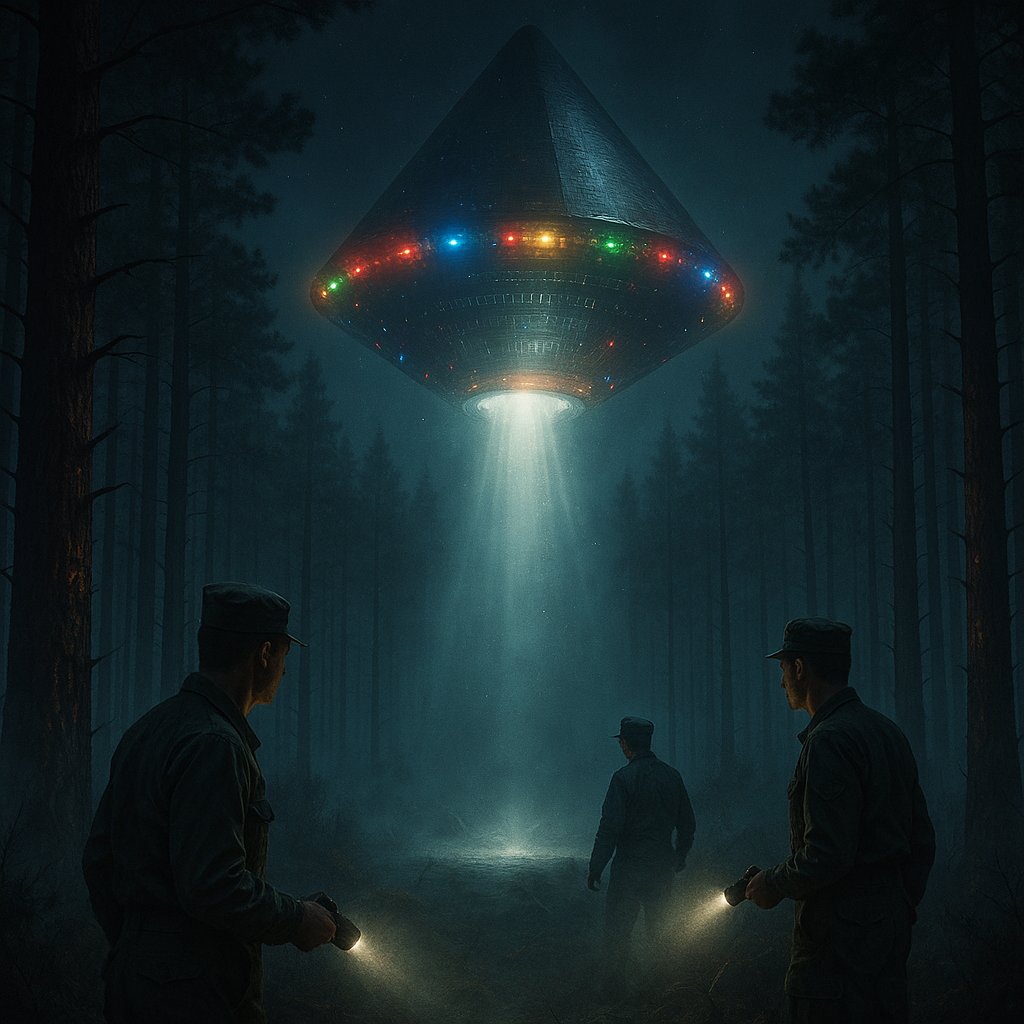
In the early hours of December 26, 1980, security personnel at RAF Bentwaters in Suffolk observe unusual lights descending into the forest beyond the east gate. Airman John Burroughs and Sergeant Jim Penniston are sent to investigate. The event begins as a security response, not a civilian adventure — men on duty at a nuclear-adjacent Cold War installation, moving toward an anomalous incursion they were operationally required to identify. The team enters the forest. Penniston later reports closing in on a structured object: a small triangular or conical craft, metallic in appearance, with a dark glossy surface reflecting light and what he describes as 'hieroglyphic-like' symbols. He claims he approached close enough to touch it.
The Halt memo and tape
On the night of December 27-28, after additional reports, Deputy Base Commander Lt. Col. Charles Halt leads a team into the forest carrying a microcassette recorder — creating one of the most extraordinary pieces of contemporaneous UFO evidence ever preserved. The 18-minute tape captures the real-time uncertainty of trained personnel observing anomalous lights, discussing bearings, noting movement through the trees, and reacting to what appeared to be structured luminous sources maneuvering beyond conventional expectation. The Halt memo, later sent to the UK Ministry of Defence, condensed the essentials: unexplained lights in the forest, three small ground depressions in a triangular arrangement, broken branches on nearby trees, and radiation readings approximately ten times background at specific points.
Why it endures
Rendlesham is the file that embarrassed the old gatekeepers because it occurred in a controlled military environment and refused to stay buried. What makes it endure is not that every detail is undisputed. It is that even after decades of argument, the core event remains too dense with evidence to dismiss casually: multiple military witnesses with security clearances, a command-level memo, an 18-minute audio recording, physical trace evidence at the site, and radiation anomalies. The witnesses paid professionally for refusing to recant — Penniston and Burroughs both faced career consequences over decades for sticking with their accounts.
The skeptical case (and its limits)
The most corrosive argument against Rendlesham has long been the lighthouse theory. The nearby Orford Ness lighthouse does sweep a beam across the region, and that fact has been used repeatedly as a solvent for the entire case. But the theory explains only a fraction of the witness experience at best. It cannot account for close-range observation of a structured object in the forest, the touch claim, the symbols, the site depressions, the radiation hotspots, or the intense immediacy heard on the Halt tape when lights appeared to move and fragment in ways inconsistent with a fixed lighthouse beacon.
Key Facts
- Halt memo filed officially with the UK Ministry of Defence on January 13, 1981
- Halt audio tape (18+ minutes of real-time recording) survives intact
- Radiation readings approximately 10× background at three triangular ground depressions
- Penniston claimed close-range observation of structured craft with hieroglyphic-like symbols
Key Witnesses
- Sgt. Jim Penniston (USAF, RAF Bentwaters)
- Airman John Burroughs (USAF, RAF Bentwaters)
- Lt. Col. Charles Halt (Deputy Base Commander)
Live Coverage Desk
Our Intelligence Hub monitors the UAP wire continuously. Fresh reporting that mentions this case surfaces here automatically.
Checking the wire…