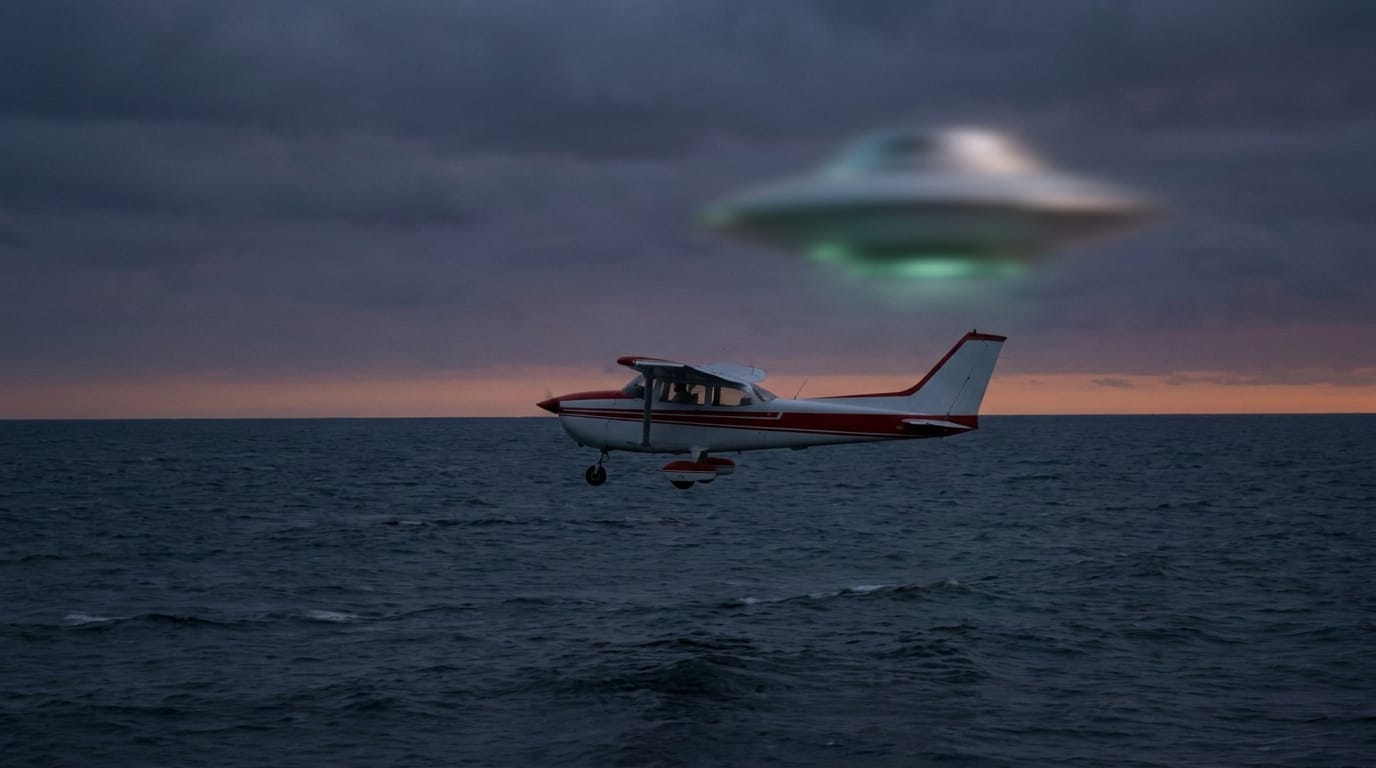
The flight
At 6:19 PM on Saturday, October 21, 1978, Frederick Valentich departs Moorabbin Airport south of Melbourne in a rented Cessna 182L, registration VH-DSJ, on a properly filed night flight to King Island across Bass Strait. He is 20 years old with about 150 hours of flight time. The weather is clear, visibility good, winds light. At 7:00 PM he reports passing Cape Otway to Melbourne Flight Service officer Steve Robey. At 7:06:14 PM he calls again, asking whether there is any known traffic below five thousand feet. There is none. Over the next six minutes and fourteen seconds — all of it recorded — Valentich describes an object with four bright landing-light-like sources passing a thousand feet above him, returning at speeds he cannot identify, then 'orbiting' on top of him: a long shape, shiny and metallic, with a green light. At 7:12 he reports his engine rough-idling and coughing. His final intelligible words, at 7:12:49: 'It is hovering, and it's not an aircraft.' Then 17 seconds of open microphone carrying a metallic, staccato scraping noise. Then nothing.
The search and the official record
Valentich never arrives at King Island. Over the following four days a RAAF P-3 Orion, eight civilian aircraft, and surface shipping search more than 1,000 square miles of Bass Strait. No wreckage, no body, no debris conclusively linked to VH-DSJ is ever recovered — unusual for a light-aircraft loss in relatively shallow water, where flotsam or a fuel sheen ordinarily appears. The Australian Department of Transport's accident investigation, released in final form on April 27, 1982, concludes the cause of the disappearance is 'unknown' and the pilot 'presumed fatal.' It offers no explanation for the object Valentich described, and the transcript of the exchange is published within the official report itself.
The skeptical case
The most rigorous skeptical analysis, by Joe Nickell in Skeptical Inquirer (2013), argues that the 'four bright lights' match a real planetary conjunction visible that evening — Venus, Mars, Mercury, and Antares in an elongated diamond — and that a low-time pilot on his first night overwater crossing became spatially disoriented, possibly entering a graveyard spiral while interpreting his own situation as an external threat. The hypothesis explains the light geometry and the 'long shape.' It does not explain the engine roughness Valentich reported in real time — disorientation does not make engines cough — nor the 17 seconds of metallic noise after his final words, nor the total absence of wreckage. Robey himself told investigator Bill Chalker in 1999: 'I don't believe he was disorientated. I don't believe he faked it or committed suicide.'
Why it ranks here
Valentich sits at credibility 6.8 — last among the ranked cases — for an honest reason: there is no trace evidence at all. No radar track of the object was preserved, no wreckage, no photograph, one primary witness. What keeps it on the list is the nature of the one piece of evidence that does exist. The six-minute recording is not a memoir or a reconstructed witness statement; it is a sober pilot describing an unidentified object to a trained controller, in real time, while it was happening — the most complete record of its kind anywhere in the world. Forty-seven years later, the Cessna is still missing.
Key Facts
- Six minutes and fourteen seconds of recorded radio between Valentich and Melbourne Flight Service, beginning 19:06:14 AEST
- Final words: 'It is hovering, and it's not an aircraft' — followed by 17 seconds of metallic scraping noise
- Four-day search covered over 1,000 square miles of Bass Strait; no wreckage ever recovered
- Department of Transport's official 1982 report ruled the cause 'unknown,' pilot 'presumed fatal'
- Flight Service Officer Steve Robey stated in 1999 he does not believe Valentich was disoriented or faked the disappearance
Key Witnesses
- Frederick Valentich (pilot, Cessna 182L VH-DSJ — missing, presumed fatal)
- Steve Robey (Flight Service Officer, Melbourne Flight Service — on the radio throughout)
Primary Sources
Live Coverage Desk
Our Intelligence Hub monitors the UAP wire continuously. Fresh reporting that mentions this case surfaces here automatically.
Checking the wire…