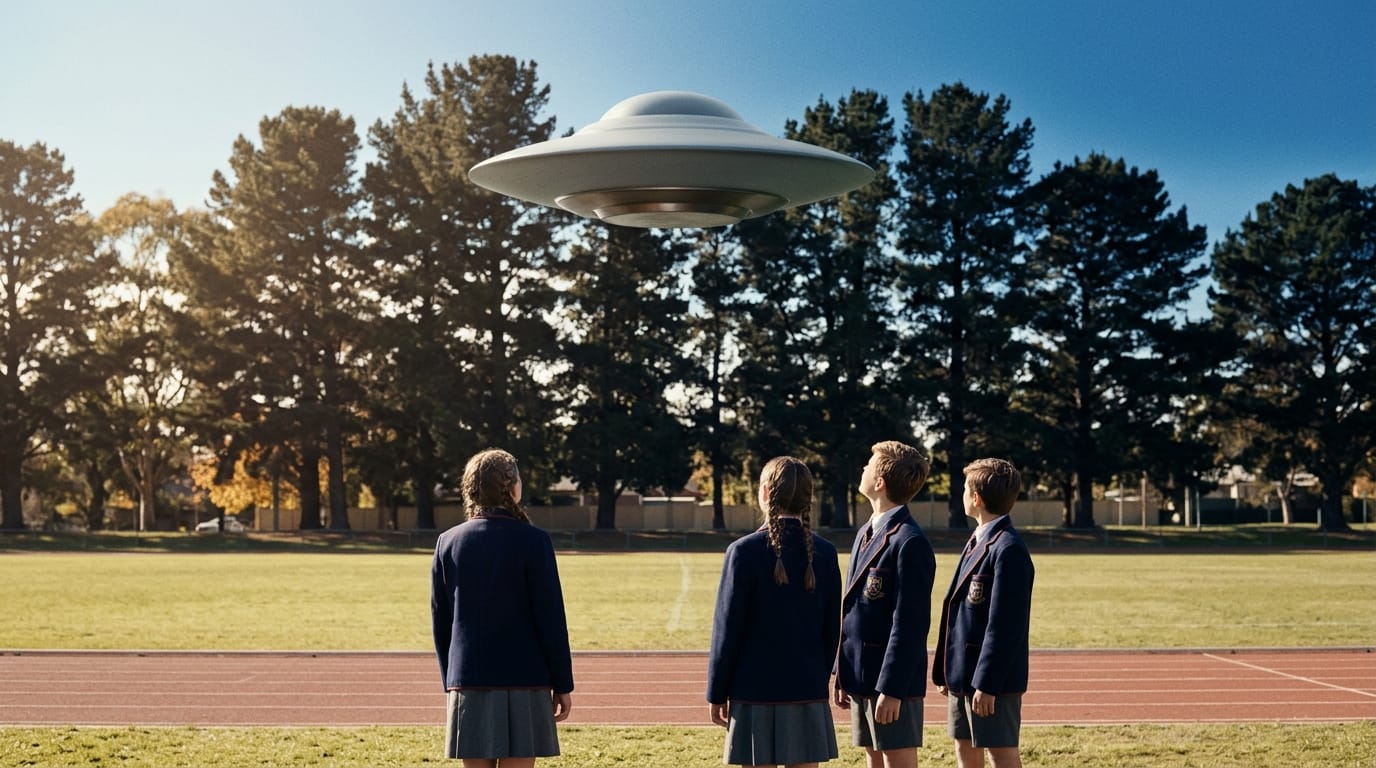
The class is doing science when a child runs in saying there is a flying saucer outside.
Andrew Greenwood, a science teacher at Westall High School in Clayton South, suburban Melbourne, thinks the child is being hysterical. It is around 11:00 on a Wednesday morning, April 6, 1966, sunny and clear, the kind of autumn day in southern Australia when the air is bright but the light has already started to slant. Greenwood is a self-described UFO skeptic. He keeps teaching. The child insists. Eventually Greenwood walks outside to look.
He sees a group of children clustered together on the school oval, staring at the northeastern sky. Following their gaze, he sees a silver-grey disc-shaped object — domed on top, smooth metallic underside, roughly half the length of a Cessna light aircraft — hanging in the air just above a power line. It is not moving like an aircraft. It is not making noise like an aircraft. It is just there.
Within the next 20 minutes, Greenwood will watch the object descend behind a row of pine trees into a bushland reserve called The Grange that adjoins the school property. He will watch five light aircraft arrive and attempt to pursue it. He will watch it accelerate away from them in a way he will later describe as "the most amazing flying" he has ever seen. He will, with other staff and students, sneak through a fence to see the landing site and find a circular patch of flattened, scorched grass guarded by men with equipment.
And then, beginning that same afternoon and stretching across the next 60 years, an extraordinary act of institutional disappearance will begin. The headmaster will tell staff and students to talk to no one. A Senior Air Force officer in uniform and a man in plain clothes will visit Greenwood at the school and threaten to report him as "drunk on duty" if he keeps talking publicly. The RAAF will call the headmaster and the headmaster will tell them, on the record, to "go jump in the lake." A girl who got close to the landing site will be carried away in an ambulance and reportedly never return to school. And in 1984, when Australian UFO researcher Bill Chalker spends weeks in the National Archives reviewing every RAAF and Department of Defence UAP file in the country, he will find that no file about Westall exists. None.
The Encounter (April 6, 1966, 11:00 AM)
Most accounts agree on the broad shape of what happened, even where they differ on details. A class of students returning from a sports lesson on the school oval was the first to notice the object. By the time word spread through the corridors, an estimated 200 to 300 people — students from Westall High School and the adjacent Westall State School, plus teachers, plus a handful of local residents who happened to be nearby — were watching the sky.
The object was described as silver or grey, with a domed top and a smooth metallic underside. Witnesses estimated its size as roughly twice that of a family car. One witness, Shaun Matthews, who was on school holidays at The Grange when the event began, described it as having a slight purple hue. Most witnesses agreed the object made no audible noise.
Some witnesses described seeing only one craft. Others described two or three moving together. This discrepancy has been used by skeptics to dismiss the entire case as memory contamination, and it is worth taking seriously as a piece of evidence — but it is also exactly the kind of variation you would expect from 200 untrained observers watching an aerial event from different angles over 20 minutes. What does not vary, across the witness corpus, is the core sequence: the object hovered above the school grounds; it descended behind the pine trees into The Grange; it remained low or on the ground for several minutes; aircraft arrived and attempted to chase it; the object accelerated away from the aircraft repeatedly and impossibly; and eventually the entire scene departed in the direction of the Westall railway line.
Andrew Greenwood's account, recorded mid-1966 by the American atmospheric physicist Dr. James E. McDonald, is the single most detailed contemporary witness statement in the case. McDonald — a senior researcher at the University of Arizona Institute of Atmospheric Physics and one of the few credentialed scientists to take UFO reports seriously in the 1960s — traveled to Australia and interviewed Greenwood directly. The audio recording of that interview survives. It is sober, technical, and consistent.
What Greenwood described to McDonald was not a single moment of awe but a 20-minute aerial event with structural features that resisted explanation. He focused particularly on the aircraft pursuit. The five planes — most often described as Cessna-type light aircraft, though some researchers have suggested they may have been RAAF Winjeel trainers — were apparently trying to intercept the disc, and failing.
Greenwood, in 1966: "Every time they got too close to the object it would slowly accelerate, then rapidly accelerate and then move away from them and stop. Then they would take off after it again and the same thing would happen. It was the most amazing flying I have ever seen."
This is the detail that makes Westall difficult to reduce. A weather balloon — the official explanation that would eventually be floated by The Age newspaper — does not maneuver in response to pursuit. A weather balloon does not accelerate. A weather balloon does not play, in the words of one local newspaper account, "a game of cat and mouse" with five light aircraft. Whatever the object was, it appeared to be aware of the aircraft and able to respond to them.
The Landing Site
When the object eventually departed, a wave of students went over the fence to investigate. Westall High School was bordered to the south by The Grange, a bushland reserve of tall grass and pine trees. Several students reported finding a "nest": a roughly circular patch of flattened, scorched, or "boiled" grass where the object appeared to have come to rest. The word "nest" was already in cultural circulation — banana farmer George Pedley had reported the same kind of landing trace at Tully, Queensland just three months earlier, and the term had been national news. That makes the Westall students' word choice neither more nor less reliable, but worth flagging.
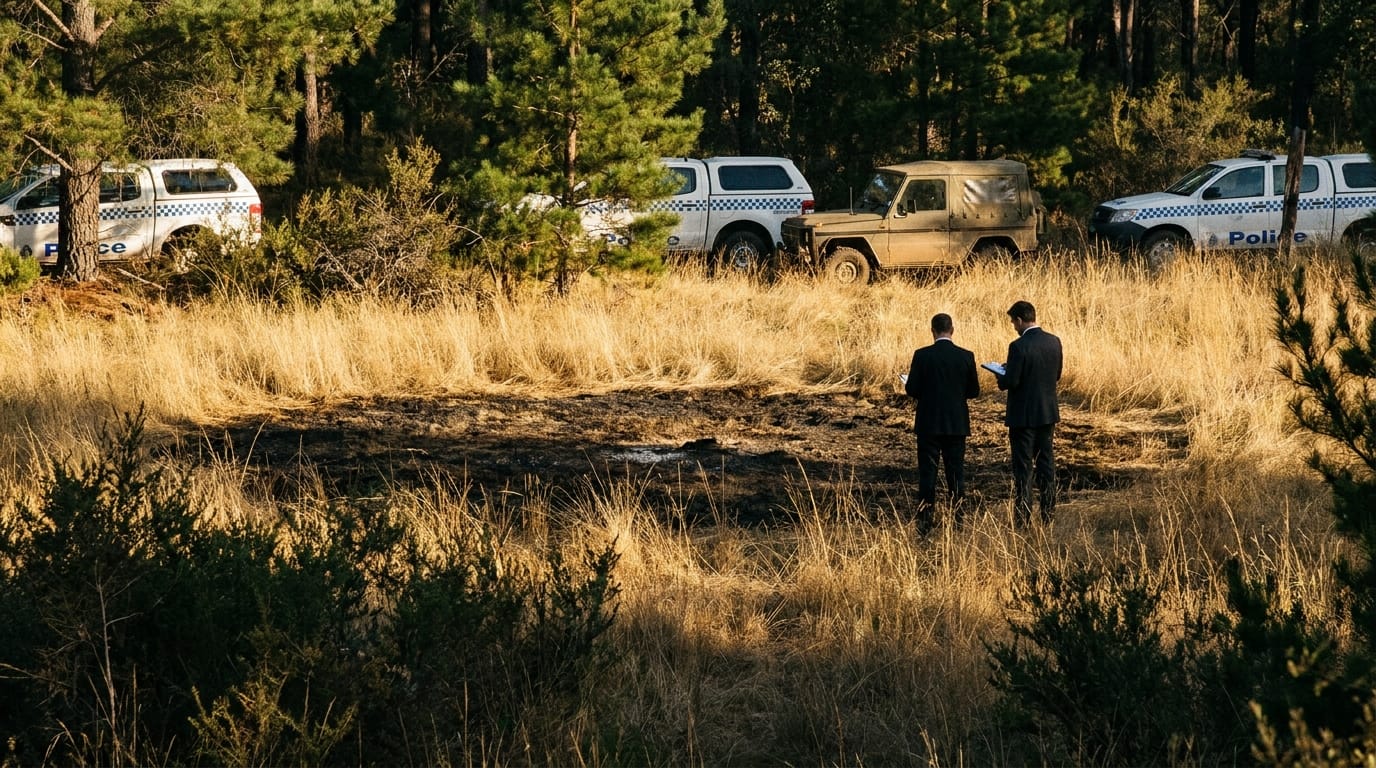
What is documented in multiple witness accounts is that the landing site was not left undisturbed for long. Within 20 to 40 minutes of the object's departure, military personnel, police, and fire brigade vehicles had arrived at The Grange. Some witnesses described seeing men in plain dark suits among the uniformed responders. The site was cordoned off. Photographs reportedly taken by at least one student were confiscated. Soil and grass from the circle were excavated and trucked away.
None of this is independently verifiable today — there is no contemporary photographic documentation of the cleanup. But the cleanup story is consistent across dozens of independently collected witness accounts gathered by Australian researcher Shane Ryan, who spent more than a decade interviewing 100+ primary witnesses for his 2011 documentary Westall '66: A Suburban UFO Mystery.
The Witness Most People Don't Know
The reason Westall has any sustained documentary spine at all is largely because of one person: Andrew Greenwood.
Greenwood was 25 years old in 1966, recently qualified, teaching science to year nine students at Westall High School. He was the only adult member of school staff who would go on the record publicly. He spoke to the Dandenong Journal — the only newspaper that covered the story while it was still happening — and gave the paper the detailed eyewitness narrative that appeared the following week. He spoke to local researcher James J. Kibel. He spoke to Dr. McDonald when McDonald traveled to Melbourne later that year. He spoke to anyone willing to take him seriously.
What Greenwood told his interviewers, in 1966 and in interviews decades later, was not just what he saw. It was what happened afterward.
This is not a man inventing drama for attention. Greenwood spent the rest of his teaching career at Westall and later at other Victorian schools. He never published a book. He never appeared on a paid speaking circuit. He never sought a film deal or a celebrity researcher endorsement. He gave interviews when interviews were requested and he refused to recant. When the Dandenong Journal printed his account, his headmaster — by Greenwood's own description — was "appalled by the head master's behaviour" rather than the other way around: the headmaster told the RAAF, when they called the school asking questions, to "go jump in the lake." The institutional response was internally divided. Some people at the school cooperated with the silencing. The headmaster, at least at first, did not.
One detail worth handling carefully: among witnesses' accounts is the story of a girl who got particularly close to the landing site, became distressed or collapsed, and was carried away in an ambulance. Subsequent attempts by classmates to visit her home reportedly found her family gone. The story circulates in nearly every account of Westall. It is dramatic, it is exactly the kind of detail that grows in retelling, and it is documented in Shane Ryan's witness corpus but has not been independently corroborated through medical or municipal records — partly because we do not know the girl's real name. (She is sometimes called "Tanya" in the literature, but she is a different person from Tania Vassie, a real Westall student who was 13 that day and gave an extensive on-camera interview to the ABC's Australian Story on the 60th anniversary in 2026.) Treat the ambulance story as part of the witness folklore that grew up around the event, not as documented fact.
What the Newspapers Said
The Westall sighting was covered by exactly one local paper while it was still news: the Dandenong Journal. Its April 14, 1966 edition — published eight days after the event — ran the case under a banner headline that has since become emblematic of the entire story:
FLYING SAUCER MYSTERY: SCHOOL SILENT
What was it?
The Journal's reporting included a student's hand-drawn sketch of the object — a round craft "with a hump on top and round things underneath" — and a detailed eyewitness account from Greenwood. Its central editorial observation, embedded in the body copy, was that "students and staff have been instructed to talk to no one" about the incident. That phrase has been the title of nearly every serious retrospective on the case since.
The following day, the Dandenong Journal published a brief follow-up. The headline:
OBJECT PERHAPS BALLOON
An unidentified flying object seen over the Clayton-Moorabbin area yesterday morning might have been a weather balloon.
The Age, Melbourne's major broadsheet, took the same line: probably a weather balloon launched from RAAF Williams (Laverton) some hours earlier, drifting east. Other Melbourne papers ran cartoons making fun of the report. National coverage ended within a week.
The balloon hypothesis is worth examining because it has been the default skeptical reply for 60 years. A radiosonde balloon had reportedly been launched from Laverton roughly two and a half hours before the sighting, 32 kilometers west-northwest of the school. The problem isn't that no balloons were in the air. The problem is that balloons don't behave the way the witnesses described. Balloons don't descend, leave physical traces, and take off vertically. They don't maneuver in response to pursuing aircraft. They don't accelerate and stop, repeatedly, in a pattern Greenwood described as "the most amazing flying" he had ever seen. The balloon explanation requires Greenwood to have hallucinated the cat-and-mouse sequence — but it doesn't require the balloon to do anything balloons do.
The Silencing
Within hours of the sighting, according to witness accounts gathered over the past two decades, the institutional response began. A school assembly was held in which staff and students were told not to speak about what they had seen. Greenwood, as the most prominent witness, was singled out: the visit from the uniformed Air Force officer and his plain-clothes companion, the explicit threat about his teaching career, the suggestion that he would be reported to the Education Department as drunk on duty.
The pattern is not a single coordinated cover-up directed from a central authority. It is something messier and in some ways more interesting: a distributed silencing, applied by different actors at different points of authority, all pointed in the same direction. The headmaster cooperates partly and resists partly. The RAAF calls and is rebuffed. The Air Force visits Greenwood directly. The female phys-ed teacher stops talking to him about it afterward. One of the older female students, who first matched Greenwood's account in detail, abruptly clammed up after going home to talk to her mother. Parents tell their kids to drop it. The local paper covers the story and prints the balloon walkback the next day. Within a week, the story is gone.
What is striking, looking back from 2026, is how effective this kind of distributed silencing was — and how cleanly it broke down once the witnesses themselves started talking to each other. The 50th-anniversary reunion held at The Grange in April 2016 brought together adult versions of the children who had been on the oval that day. Many had spent their lives believing that no one else really remembered. The reunion was, by all accounts, a moment of collective recognition. You saw it too.
The Missing Files
The most institutionally remarkable feature of Westall is not the sighting itself or the silencing. It is the absence of any subsequent paper trail.
In 1984, Australian UFO researcher Bill Chalker — a chemist by training and one of the country's most rigorous documentarians of UAP cases — was granted formal access to the entire RAAF UFO file collection held at the National Archives of Australia in Canberra. Chalker spent weeks reviewing every file the RAAF and the Department of Defence had on unidentified aerial phenomena, covering the period from the early 1950s onward.
He found nothing on Westall. No incident report. No correspondence. No investigation file. No closed case folder. For an event that supposedly involved at least one phone call from the RAAF to the school, the arrival of military personnel at the landing site, and the visit of a uniformed Senior Air Force officer to a science teacher's classroom, there is no documentary residue in any RAAF or Department of Defence archive that any researcher has ever been able to locate.
Shane Ryan, the academic and amateur investigator who has done the most sustained recent work on Westall, has proposed an explanation: it was probably not the RAAF that handled the on-the-ground response. Ryan's theory is that the responding agency was the Department of Supply, which in 1966 was responsible for Australian participation in joint US-Australian high-altitude research programs (including the HIBAL balloon program) and which would have had jurisdiction over an aerial anomaly intersecting with that work. The Department of Supply files held by the National Archives of Australia are vast and only partially catalogued. Thousands of them remain unopened. Among them, somewhere, there may or may not be a Westall file.
In August 2025, a Melbourne UFO researcher named Vaughan Lavac launched a petition to the Australian federal government calling for a formal inquiry into the Westall incident — specifically requesting a search of Department of Supply, RAAF, and Department of Defence archives for any responsive material. Shane Ryan signed it. As of this writing, no inquiry has been announced.
The Skeptical Case
An honest treatment of Westall has to take the skeptical reading seriously, because it is internally coherent and supported by a credentialed analyst.
Australian skeptical investigator Richard Saunders has argued that what happened at Westall in 1966 was real but conventional, and that the dramatic version of the story has been generated by 40 years of memory contamination, witness contact with each other and with UFO documentaries, and the natural tendency of teenage memories to crystallize around vivid imagery. The original 1966 reports, collected close to the event, showed substantial inconsistency — one object or several, one circle or many, weather balloon or structured craft. By the time researchers systematically interviewed the witnesses in the 2000s, decades of public UFO culture had reshaped the memories into a more uniform narrative. This reading is the implicit position of Wikipedia's current Westall article.
What it does not explain: why a science teacher was visited at school by a uniformed Air Force officer and threatened with being reported as drunk on duty. Why the Dandenong Journal — reporting eight days later, before any meaningful memory contamination could occur — printed SCHOOL SILENT and stated that students and staff had been instructed to talk to no one. Why the RAAF called the school at all, on a day when supposedly nothing of military interest had happened. The contemporaneous 1966 evidence already contains the institutional-suppression structure that the memory-contamination hypothesis would require to have emerged later. You can take Saunders' position and still be left with the question: why did the institutional response happen at all, if there was nothing to suppress?
The Honest Take
Westall is not Australia's Roswell, and the comparison flattens what's actually interesting about it. Roswell is famous; Westall is the opposite. What happened at Clayton South on April 6, 1966 was witnessed in broad daylight by over 200 people, recorded contemporaneously in local newspapers, interviewed by a credentialed American physicist within months of the event, and then institutionally erased so completely that no government file documenting it has ever been located. The most remarkable thing about Westall is not what happened — it is the precision and effectiveness of the silence that followed.
You can read this case as a structured craft of unknown origin, as a classified test of an experimental craft no one will acknowledge, or as a misidentified weather balloon enlarged by 60 years of cultural pressure. All three readings are defensible. None of them explain why a science teacher was threatened with being reported as drunk on duty, or why every government file that should exist about it doesn't.
Timeline
Why This Matters in 2026
The current era of UAP disclosure has been preoccupied with American institutional history — AATIP, AARO, the Schumer-Rounds Act, the PURSUE releases. There is a tendency to assume that the phenomenon has been primarily a US story and that meaningful evidence either exists in American military files or doesn't exist at all.
Westall is a reminder that this assumption is wrong. The phenomenon has been globally distributed across the entire history of UAP reporting, with strong cases on every continent and a recurring pattern of national-level institutional responses that look remarkably similar regardless of country: rapid arrival on scene, brief documentation, witness pressure, public-explanation deflection, and a decades-long file gap. The Westall response was Australia's version of the American response to the same kind of event — which suggests that whatever institutional logic produced it was not unique to one country's military or one administration's politics.
The case is also still developing. A federal petition is in circulation. The ABC just covered the 60th anniversary on national prime-time television. Witnesses who were 13 in 1966 are now in their 70s and finally telling their stories on the record. This is a case that may yet acquire its paper trail.
Sources & Primary Documents
- Wikipedia — Westall UFO (overview and Saunders skeptical analysis)
- The Conversation — Westall '66: 50 years on, still stranger than fiction (50th-anniversary retrospective)
- We Are The Mutants — "Talk to No One": The Continuing Mystery of the Westall UFO (Tom G. Wolf, 2018)
- Enigma Labs — Westall School Sighting (with Dandenong Journal headline reproduction)
- UAP Scientific Research — Andrew Greenwood and Westall: a 1966 audio recording (summary of McDonald interview)
- David Halperin — The Westall UFO: A Teacher's Testimony (annotated McDonald interview transcript)
- Dandenong Star Journal — Seeking the Westall UFO 'truth' (August 2025, on the Lavac petition)
- Now To Love — Westall High School witness reveals all (Tania Vassie interview, April 2026)
- State Library Victoria — Strange lights in the sky: The Westall UFO event, 1966
- Westall '66: A Suburban UFO Mystery — Shane Ryan / Rosie Jones documentary (Apple TV)
All links open in new tab. External sources are not endorsed by TruthCapsuleTV; they are provided for independent verification.
Related Briefings
- Edition 001: Nimitz 2004 — Sensor Data vs Testimony Weight (the modern military case with the same "structured craft, no propulsion, impossible acceleration" signature)
- Schratt Deep Dive: Classic Encounters (1940s–60s) (the broader 1960s case archive Westall sits inside)
- Schratt Deep Dive: Advanced Craft & Close Encounters (multi-witness, multi-sensor companion cases)
Key Takeaways
- The Westall event of April 6, 1966 was witnessed in broad daylight by more than 200 students and teachers over a 20-minute observation window
- Science teacher Andrew Greenwood gave the only detailed contemporaneous adult witness account, recorded by atmospheric physicist Dr. James E. McDonald later that year
- Greenwood was personally threatened by a uniformed Senior Air Force officer with being reported as "drunk on duty" if he continued discussing the event publicly
- The Dandenong Journal's April 14, 1966 headline — "FLYING SAUCER MYSTERY: SCHOOL SILENT" — documented the institutional silencing while it was happening
- In 1984, researcher Bill Chalker found no Westall file in any RAAF or Department of Defence archive at NAA
- Shane Ryan's research suggests the responding agency may have been the Department of Supply, whose files at NAA are vast and only partially catalogued
- A federal inquiry petition was launched in August 2025; the case is still actively under public review
- The most editorially significant feature of Westall is not the sighting itself but the precision of the institutional silence that followed it