What the CIA's Gateway Process Document Actually Says
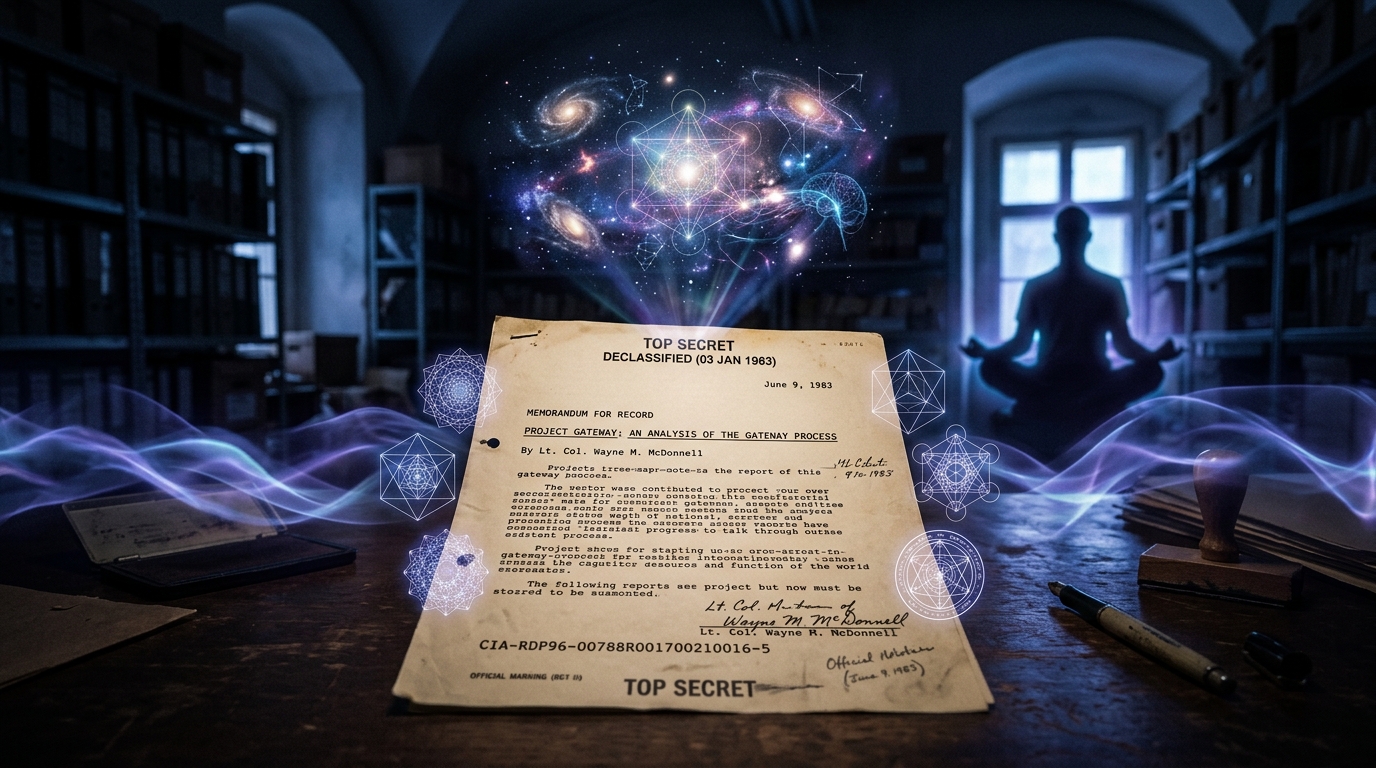
In 2021, a declassified 1983 CIA document about meditation and consciousness went viral on TikTok. The internet had a field day: "The CIA has proof of astral projection." "Government document confirms time travel." "The military was studying telepathy."
The actual document is more interesting than the hype — and more complicated. It's Lt. Col. Wayne McDonnell's Army intelligence assessment of the Gateway Experience, a meditation program that claims to expand human consciousness through binaural audio frequencies. The conclusion? A sincere proposal to operationalize remote viewing, out-of-body experiences, and access to what the document calls a "cosmic hologram."
The tension is what made it go viral: This is an official US government document + This document earnestly discusses telepathy, time travel, and merging with the Absolute = viral sensation.
Here's what the document actually claims, what's scientifically plausible, and what's pseudoscience dressed in physics jargon.
The Gateway Experience: What Is It?
Robert Monroe, a businessman and audio engineer, developed the Gateway Experience in the 1970s at the Monroe Institute. The core technology: Hemi-Sync — binaural beats (different frequencies played to each ear) designed to synchronize left and right brain hemispheres.
The program was structured as a series of "Focus levels":
- Focus 10: "Mind awake, body asleep" — basic meditation
- Focus 12: "Expanded awareness" — deeper focus
- Focus 15: "No-time" — access to the past
- Focus 21: "Gateway Affirmation" — access to the future
- Beyond: "Out-of-body experiences," "time travel," "cosmic consciousness"
McDonnell's job was to explain *why* this would work — to build a scientific framework. He drew from neurology, quantum mechanics, holographic consciousness theory, and cosmology. Some of it is grounded in real research. Some of it is creative speculation. Some of it is pure pseudoscience.
What's Scientifically Sound
Binaural Beats & Brain Entrainment
The idea that auditory stimulation can influence brain activity is real. Binaural beats do produce measurable frequency-following responses in the brain. Research shows they can influence relaxation, focus, and sleep — though the effects are modest and individual variation is high.
Verdict: Plausible baseline mechanism.
Hemispheric Specialization
McDonnell correctly notes that the left and right hemispheres have different strengths (left = language, logic; right = spatial, intuitive). The idea that meditation or binaural beats could enhance interhemispheric communication is speculative but not impossible.
Verdict: Oversimplified but not wrong.
Meditation's Effects on Consciousness
Meditation does alter neural activity and subjective consciousness. Experienced meditators show measurable changes in brain structure and function. The document's nod to meditation research is legitimate.
Verdict: Sound.
What's Pseudoscience
Itzhak Bentov's Biomechanical Model
McDonnell heavily relies on Itzhak Bentov's *Stalking the Wild Pendulum* — a 1977 book blending neuroscience with New Age cosmology. Bentov claims:
- The heart and aorta create standing waves in the brain ventricles
- The human body resonates at 7 Hz with Earth's electrostatic field
- This resonance allows consciousness to "expand" beyond the body
None of these claims have survived peer review. The 7 Hz "Earth frequency" (Schumann Resonance) doesn't work the way Bentov describes. Brain ventricles don't resonate as described. Modern neuroscience has moved far beyond this model.
Verdict: Dated pseudoscience disguised as biomechanics.
Holographic Universe & Consciousness
McDonnell adopts Karl Pribram and David Bohm's holographic brain theory — the idea that consciousness is a hologram tuning into a holographic universe. This *sounds* profound and is popular in New Age circles, but:
- It's speculative metaphysics, not neuroscience
- Modern neuroscience explains memory and perception without invoking holograms
- Pribram himself later moved away from the model
Verdict: Interesting speculation; not mainstream science.
Quantum Mechanics & Consciousness
McDonnell invokes quantum mechanics to explain how consciousness could "click out" of spacetime or access multiple timelines. This is a classic pseudoscience move — using quantum jargon to make mysticism sound rigorous.
Quantum mechanics describes particle behavior, not macroscopic consciousness. The two aren't linked in the way the document implies.
Verdict: Pseudoscience.
Why Did This Go Viral?
The document went viral on TikTok because of the contrast: an official government document written in bureaucratic language seriously discussing astral projection, time travel, and telepathy. That juxtaposition is inherently meme-able.
But the viral framing misses the nuance. The CIA didn't "confirm" these claims. The Army commissioned an assessment of a meditation program. McDonnell speculated about mechanisms. The conclusion was cautious: if this works, here's how we might operationalize it.
TikTok took that and ran with "CIA PROVES ASTRAL PROJECTION" — which is not what the document says.
What We Know Now
Since 1983, neuroscience has advanced significantly. We now know:
- Meditation works — measurably improves focus, emotional regulation, and wellbeing. No mystical framework needed.
- Out-of-body experiences are reproducible in labs — through sensory deprivation, VR, or electrical stimulation. They're neurological phenomena, not evidence of leaving your body.
- Remote viewing hasn't been validated — decades of controlled testing show it performs at chance levels.
- The brain doesn't work like Bentov or Pribram described — modern imaging reveals far more complexity than 1970s models allowed.
The Strongest Angles for Future Research
That said, some kernels in McDonnell's thinking deserve exploration:
- Interhemispheric communication: Does synchronized brainwave stimulation enhance problem-solving or creativity? Testable.
- Binaural beats as clinical tools: Can frequency-following responses be refined for anxiety, focus, or PTSD? Promising early research.
- Meditation's mechanisms: What neural pathways underlie contemplative states? Neuroscience is still mapping this.
The Gateway document wasn't wrong to ask these questions. It was just working with the neuroscience of 1983. The answers are more subtle than McDonnell imagined — and that's okay. Science refines itself.
Download the Full Document
The declassified CIA Gateway Process document is in the public domain. Read it yourself:
📥 Download PDF (2.4 MB)Public domain document. Declassified by the CIA and available at cia.gov.
Get the next briefing first
Briefings go to subscribers before they're posted here. One email per edition, no filler, and your 10% store code arrives with the welcome email.
Subscribe Free →