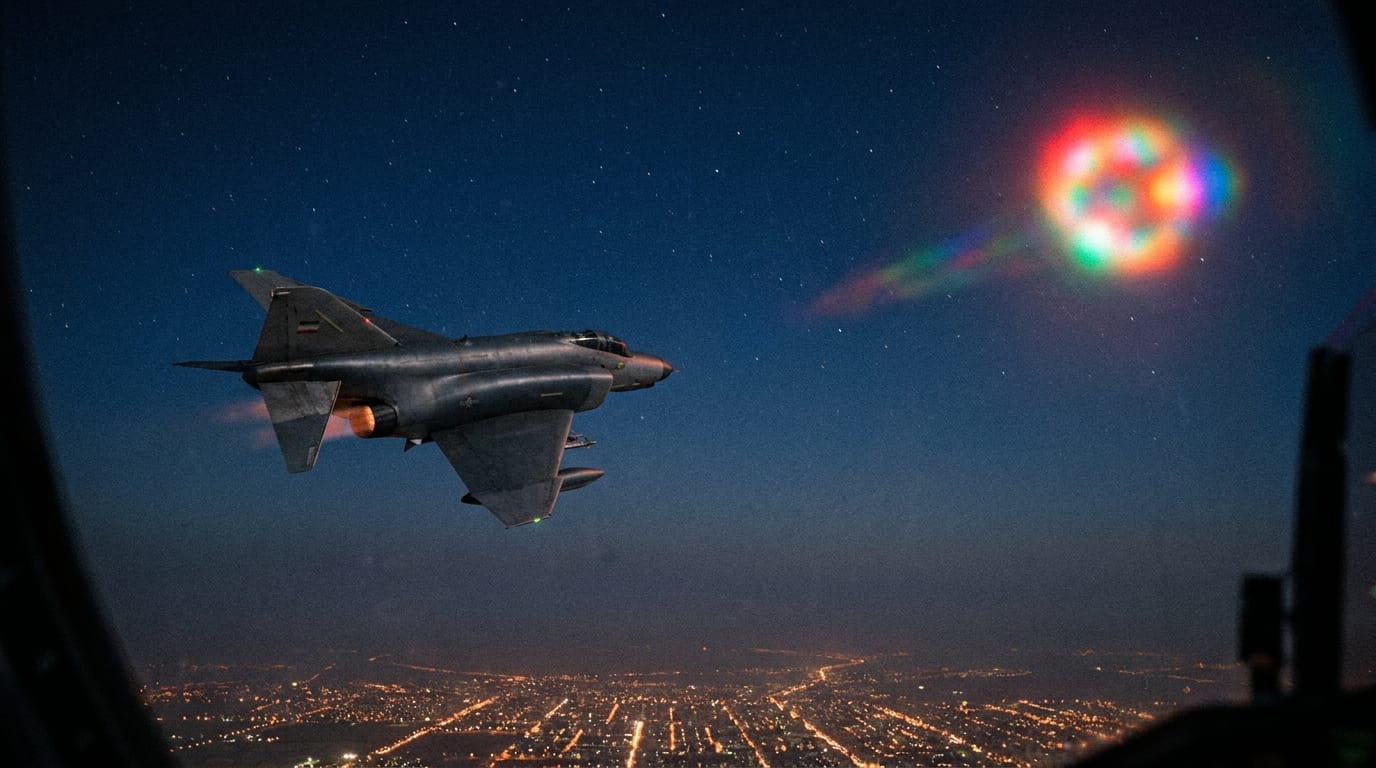
It is just after midnight on September 19, 1976, and the phones at the Imperial Iranian Air Force command post in northern Tehran will not stop ringing. Four separate civilians have called in the same hour to report the same thing: a bright object in the sky over the city, too brilliant to be a star, changing colors and holding position above the rooftops. The night duty officer, General Nader Yousefi, assumes it is a planet and tells them so. Then he steps outside and looks for himself.
What he sees does not behave like a planet. It is brighter than anything in the sky, it is flashing colors, and it is hanging over the capital. Yousefi picks up a phone to Shahrokhi Air Base and orders a fighter into the air. Over the next ninety minutes, two F-4 Phantom II interceptors will close on the object — and both will lose their weapons, their radios, and their flight instruments at almost exactly the same distance from it. The U.S. Defense Intelligence Agency will write the whole thing up and route it to the White House, the CIA, the NSA, and the Secretary of State. An American evaluator will stamp it "an outstanding report."
Fifty years later, no government has ever said what the object was.
The First Jet
Around 1:30 a.m., the first F-4 lifts off from Shahrokhi Air Base and turns toward Tehran. (Accounts differ on the pilot's name — the most commonly cited is Lieutenant Yaddi Nazeri; some sources name Captain Mohammad Reza Azizkhani. The events that follow are consistent across all of them.) The object is so bright the pilot can see it from roughly 70 miles out.
He closes in. At about 25 nautical miles from the object, his instruments die — all of them at once. The radar drops. The radios go silent. The flight instruments stop reading. He can no longer navigate or call home. He breaks off the intercept and turns away from the object, and the moment he does, every system flickers back to life. He lands at Shahrokhi and reports it. By then the command post is already briefing a second pilot.
The Second Jet
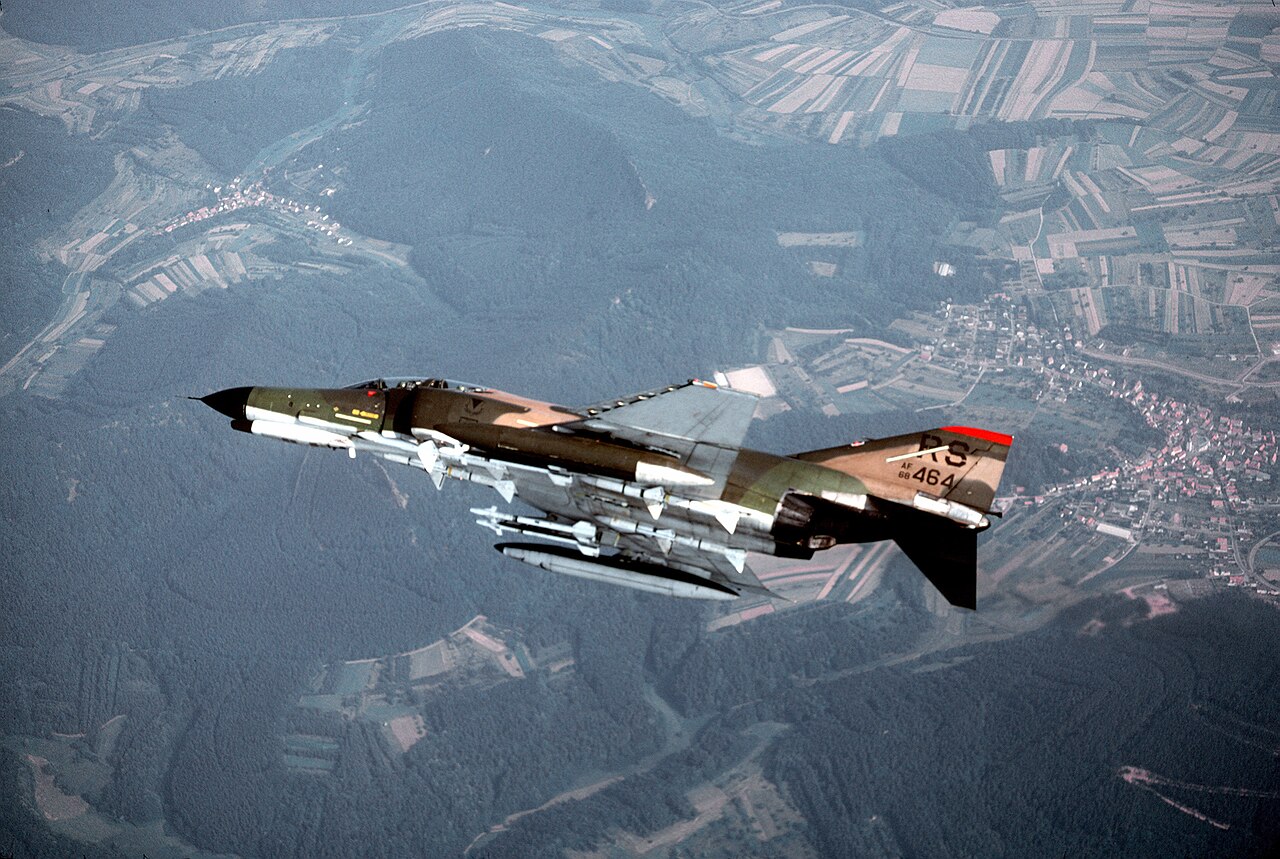
Major Parviz Jafari is a squadron commander, an experienced F-4 pilot trained in part at U.S. Air Force bases. His weapons officer in the back seat is First Lieutenant Jalal Damirian. They launch around 1:40 a.m. with orders to intercept and identify the thing that just disabled the first aircraft.
Jafari's radar locks onto the object at 27 nautical miles. The return is large — he later compared its radar size to that of a Boeing KC-135 Stratotanker, a four-engine aerial refueler. Visually, all he can make out is the light.
As Jafari closes, a smaller object detaches from the main craft and accelerates straight toward his F-4. He reacts the way any fighter pilot would to something closing fast on an intercept: he goes for his weapons and prepares to fire an AIM-9 Sidewinder. The weapons panel goes dead. The missile will not release. His comms cut out. Same effect, same approximate range as the first jet — and again, the moment he banks hard away, the systems come back.
The smaller object follows him briefly, then turns and rejoins the main craft, slotting back underneath it. Then a second small object drops away from the main craft and descends toward the ground southeast of the city. Jafari watches it go down expecting an impact. Instead it appears to settle gently onto a dry lake bed, the terrain glowing for a moment before the light fades. The main object climbs away at a speed neither jet could match.
The Ground
The pilots were not the only witnesses. The control tower at Mehrabad International Airport had no other aircraft on its scope, but tower staff could see the object once Jafari directed their eyes to it. Years later, the main controller and an investigating general said the object had also passed over the tower itself and knocked out its electronic equipment as it did.
The next morning, the F-4 crew flew a helicopter back to the spot where the smaller object had seemed to land. In daylight it was a dry lake bed, with no scorch marks or wreckage. But circling the area, they picked up a strong "beeper" signal — an electromagnetic tone — that grew loudest near a small house. They landed and asked the residents whether anything strange had happened the night before. The family described a loud noise and a brilliant flash of light, like lightning. Radiation testing of the area was reportedly carried out. The results were never made public.
The DIA Report
Iran in 1976 was a close U.S. ally flying American-made aircraft, and American liaison officers had access to Iranian military operations. The U.S. Defense Attaché Office in Tehran compiled a four-page intelligence report titled "IRAN: Unidentified Flying Objects Over Tehran," drawn from debriefings of the Iranian pilots and the Mehrabad radar staff. It was distributed to the White House, the Secretary of State, the Joint Chiefs of Staff, the NSA, and the CIA.
What makes the report unusual is not just its distribution but its tone. The evaluating officer did not hedge or dismiss. The handwritten assessment on the document has become the single most-quoted line in the case.
The evaluation listed why the case stood out: highly credible witnesses, including an Air Force general and trained pilots; confirmation on both airborne and ground radar; electromagnetic effects on more than one aircraft; and an object that out-accelerated front-line interceptors. That combination — credible witnesses plus instrument data plus physical effects — is exactly what most UFO reports lack, and exactly what makes this one hard to wave away.
The Skeptical Case
The most thorough skeptical treatment came from aviation writer Philip Klass, who argued the pilots had chased a bright astronomical object — likely the planet Jupiter, prominent in the sky that week — and that the instrument failures were ordinary electrical faults in the F-4, an airframe with a documented history of intermittent electrical problems.
The Jupiter-plus-malfunction reading has been around for decades, and it deserves a fair hearing. What it struggles to explain: why a planet would produce a hard radar lock at 27 nautical miles on airborne radar and register on ground radar at Mehrabad; why two separate aircraft suffered the same category of total-systems failure at the same approximate range on the same night; why those systems reliably came back the instant each jet turned away; and why a helicopter crew the next morning picked up an electromagnetic anomaly near a specific house whose occupants independently described a flash and a loud noise. Each of those could perhaps be argued in isolation. Stacking all of them onto a coincidence of planet-misidentification and routine electrical gremlins is a heavier lift than the single explanation the DIA evaluator reached for: an unexplained phenomenon that warranted real study.
Jafari, On The Record
Parviz Jafari retired from the Iranian Air Force as a general and kept the encounter largely private for decades. In November 2007, more than thirty years on, he stood at the National Press Club in Washington, D.C., at a panel of former military officials organized by journalist Leslie Kean, and told the story publicly to an international press audience. His account — the radar lock, the weapons failure, the small object breaking off — matched the contemporaneous 1976 DIA report. Where he added detail, it was about what the cockpit felt like, not about what happened. The structural facts never moved.
It is worth noting what did not follow. There was no public Iranian investigation, no American statement of conclusions, no release of whatever the radiation testing found. The most decorated UFO case in U.S. intelligence files produced an "outstanding report" and then institutional silence — a pattern that would repeat in case after case for the next half-century. (Morocco's king had reportedly asked Washington about a similar sighting over his own country that same week; the reply was a polite deflection.)
The Honest Take
Tehran 1976 is one of the strongest aviation UAP cases on record for a simple reason: the evidence chain holds together. A contemporaneous intelligence report distributed at the highest levels of government. A formal U.S. evaluation calling it outstanding. Multiple named witnesses, including a serving general. Radar confirmation from the air and the ground. Electromagnetic effects on two aircraft and, the next morning, on a helicopter's instruments. And a lead pilot who told the same story publicly, on the record, thirty years later.
What's missing is the part that's always missing: a government willing to say what it was. The 1976 report judged the case significant enough to deserve a "valid study." If that study ever happened, it has never been released. Half a century on, the file sits exactly where the DIA evaluator left it — outstanding, and unexplained.
Timeline
Sources
- The Black Vault — Original declassified DIA report and routing documents
- The Black Vault — 1976 Iran Incident case file (timeline and witness statements)
- Wikipedia — 1976 Tehran UFO incident (case overview and references)
- Enigma Labs — Tehran Incident case file
- UFOs: Generals, Pilots, and Government Officials Go on the Record by Leslie Kean (2010) — Jafari's first-person account
External links open in a new tab and are provided for independent verification.