Witnesses Without Documents
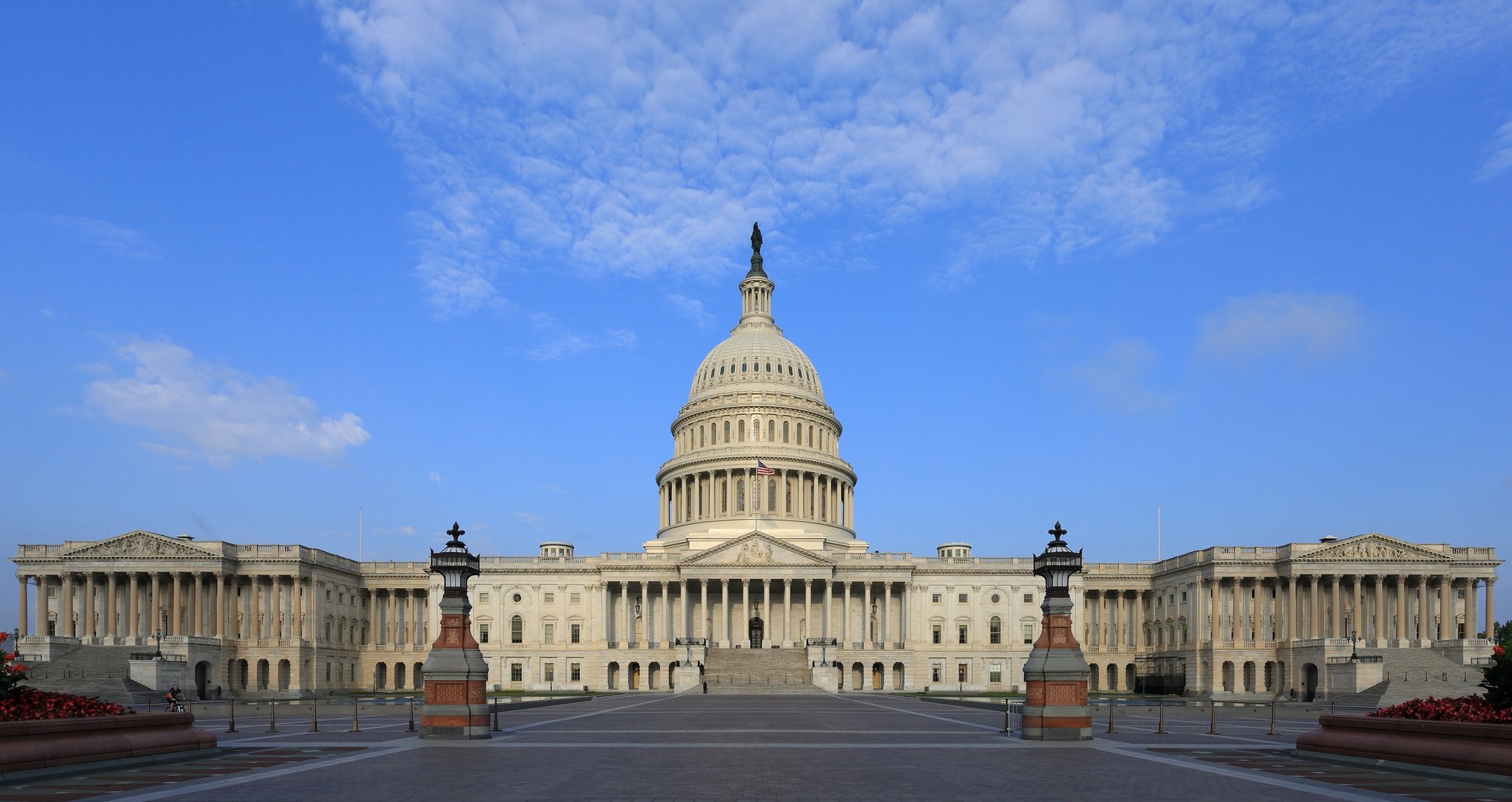
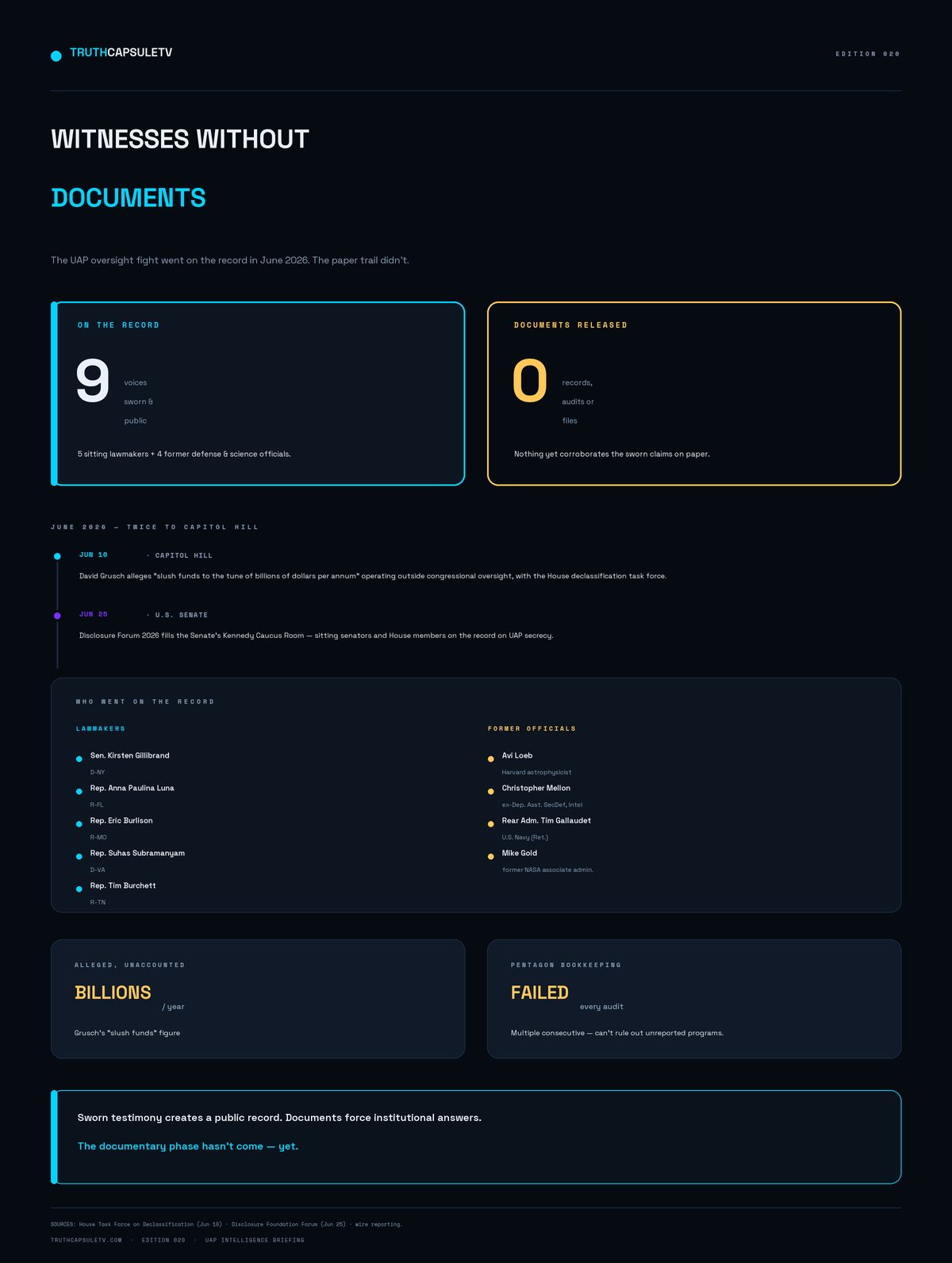
The Kennedy Caucus Room in the Russell Senate Office Building is where the Senate held the Army–McCarthy hearings and the Watergate investigation. On June 25, it hosted something the UAP subject has never quite had before: a full-day public forum inside the Senate's own walls, with sitting members of Congress from both parties — Senator Kirsten Gillibrand, Representatives Anna Paulina Luna, Eric Burlison, Suhas Subramanyam, and Tim Burchett — appearing alongside a Harvard astrophysicist, a former Deputy Assistant Secretary of Defense for Intelligence, a retired rear admiral, and a former NASA associate administrator, all on the record about government secrecy surrounding unidentified anomalous phenomena.
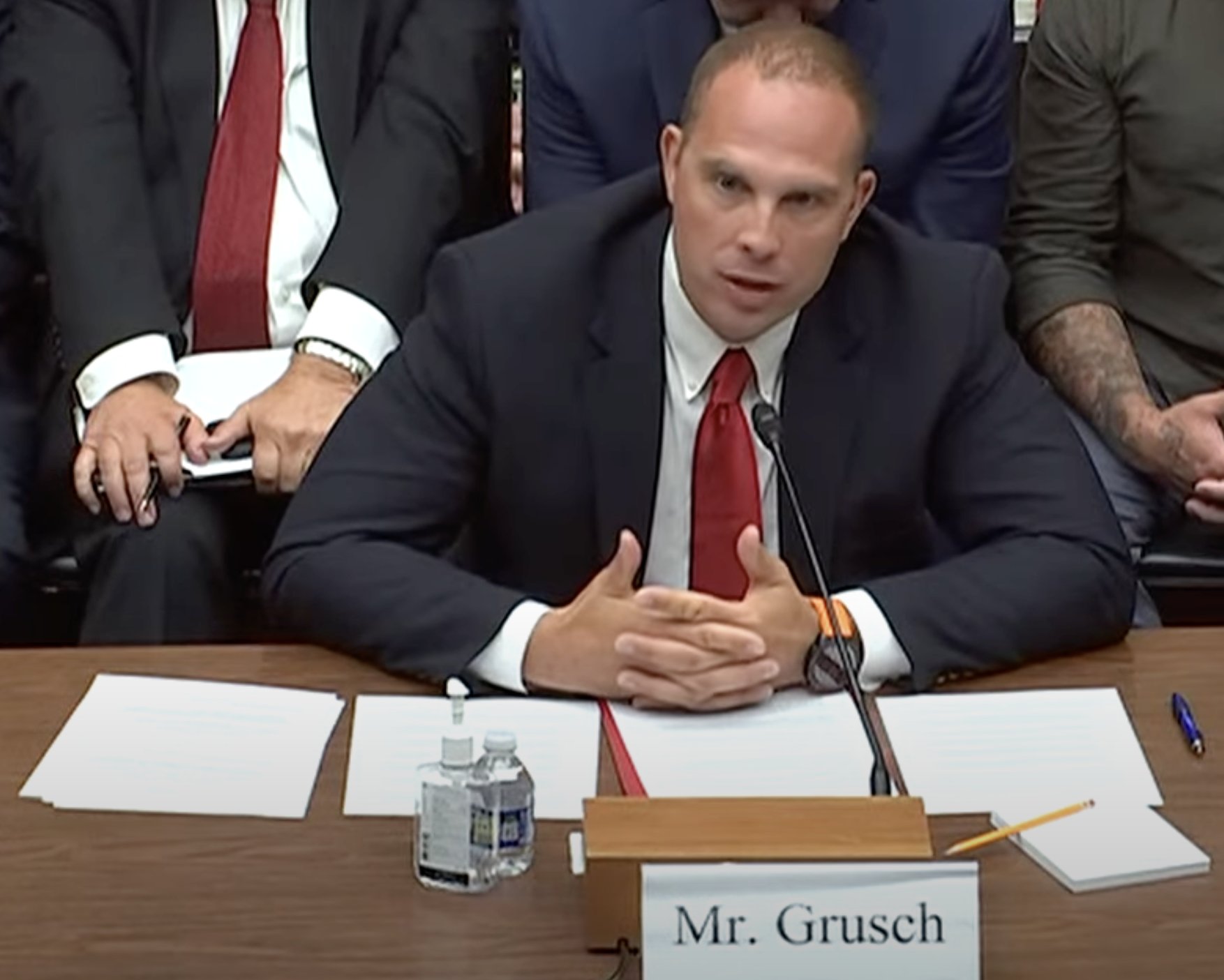
Two weeks earlier and a short walk away, former Air Force intelligence officer David Grusch stood with the House Task Force on the Declassification of Federal Secrets and put a number on the allegation that has been circling this subject for three years. "This is also a real fraud, waste and abuse issue," he said. "During my investigation, I found slush funds to the tune of billions of dollars per annum for these activities."
That is the structural story of June 2026, and it is more interesting than the question of what the objects actually are.
- Jun 9 · Capitol Hill
- News conference with the House Task Force on the Declassification of Federal Secrets — Grusch alleges “slush funds to the tune of billions of dollars per annum” operating outside congressional oversight
- Jun 25 · Senate
- Disclosure Forum 2026, Kennedy Caucus Room, Russell Senate Office Building — all-day public forum convened by the Disclosure Foundation, a nonpartisan 501(c)(3); free to the public and livestreamed
- Lawmakers
- Sen. Kirsten Gillibrand (D-NY) · Rep. Anna Paulina Luna (R-FL) · Rep. Eric Burlison (R-MO) · Rep. Suhas Subramanyam (D-VA) · Rep. Tim Burchett (R-TN)
- Experts
- Avi Loeb (Harvard astrophysicist; chair, UAP Science Advisory Council) · Christopher Mellon (fmr. Deputy Asst. Secretary of Defense for Intelligence) · Rear Adm. Tim Gallaudet, USN (Ret.) · Mike Gold (fmr. NASA Associate Administrator)
- Documents produced
- None released — the spending and secrecy claims remain testimonial; no program records, audits, or files have surfaced
The Repackaging of a Debate
The UAP disclosure debate spent the better part of three decades in a register that made it easy to dismiss: blurry photographs, anonymous sources, convention-circuit advocates making claims that outran any available evidence. What has changed, slowly and then more visibly over the past two years, is that the argument has been repackaged in the language of constitutional governance — spending authority, separation of powers, whistleblower protection — and placed on the record by people with documented institutional backgrounds. Whether that repackaging reflects a genuine shift in the underlying evidence, or a coordinated advocacy campaign that has learned to dress its claims in harder-to-dismiss language, is itself a question the record does not fully answer. But the shift has happened, and June's back-to-back Capitol Hill events show how far it has traveled: from a House committee taking testimony in late 2024 to sitting senators co-headlining a forum in the Senate's most storied hearing room.
The Money Question
Grusch's June 9 allegation is where the constitutional framing gets its teeth. "Slush funds to the tune of billions of dollars per annum" is not a claim about aliens. It is a claim about appropriations — that money Congress authorized is flowing into activities Congress cannot see, through classification structures designed to keep the knowledgeable population small. If true, that is a separation-of-powers violation regardless of what the funded programs actually do. Representative Jared Moskowitz put the fiscal context bluntly: "There's trillions of dollars missing at the Pentagon. Where does that money go?"
The audit failure behind Moskowitz's remark is real — the Pentagon has failed multiple consecutive audits — and it matters here for a narrow, specific reason: an institution that cannot fully account for its own spending cannot credibly certify that no unreported programs exist within it. The audit record does not prove that hidden UAP programs exist. It proves that the bookkeeping that would rule them out does not. Burlison, for his part, called for real penalties for officials who knowingly withhold information from Congress — a legislative signal that at least some members see the problem as enforcement, not just transparency.
The Pentagon's standing position has not moved: its investigations have not produced verified evidence of extraterrestrial technology, and its previous reviews disputed claims of secret crash-retrieval programs. Both things can be simultaneously true — no verified exotic technology, and money moving through oversight gaps — which is precisely why the spending question is the one that can actually be adjudicated with documents.
The Science Lane Opens
The June 25 forum also showcased something newer: an institutional science track running parallel to the whistleblower track. Avi Loeb, the Harvard astrophysicist who chairs the UAP Science Advisory Council — a body he describes as serving the Office of the Director of National Intelligence, the Pentagon's AARO, the White House, and the FBI — used his panel to argue that attention to anomalies is the best path to new knowledge, and said the council has requested information on more than fifty historic UAP reports. That is a different posture from advocacy: it is a formal request channel, aimed at the same underlying records the oversight fight is about, framed in the language of data access rather than disclosure.
Former defense and space officials on the program — Christopher Mellon, Rear Admiral Tim Gallaudet, Mike Gold — pressed the companion argument that UAP is a national security and airspace-safety issue that deserves treatment without stigma. Gallaudet has long framed the executive branch's withholding of UAP information from Congress as a constitutional infringement rather than a bureaucratic inconvenience, and that framing does not require believing anything about extraterrestrial life. It requires only accepting the documented premise that classification decisions affect congressional oversight, and that not all such decisions are made in good faith.
The Ceiling on Testimony
All of this builds on the foundation laid in November 2024, when the House Oversight Committee took sworn testimony from Luis Elizondo, Gallaudet, former NASA associate administrator Mike Gold, and journalist Michael Shellenberger, a year after Grusch's own sworn testimony in July 2023 — four witnesses describing, from different institutional vantage points, the same general experience: UAP-related information systematically withheld from Congress, and retaliation against officials who tried to surface it. That hearing created a public record and committed people to specific claims under penalty of perjury. What it did not produce, and what June's events have still not produced, is documents.
Testimony without documentary corroboration has a ceiling on what it can accomplish, particularly when the information it points toward is classified and the agencies controlling that information are the same ones accused of misusing the classification system. An allegation that stays testimonial can be waited out; agencies have outlasted congressional attention spans before. An allegation that becomes documentary — subpoenaed records, declassified program files, formal Inspector General findings, an audit trail behind the alleged slush funds — forces institutional answers on institutional timelines.
What to Watch Next
The question June 2026 raised and left unanswered is whether the oversight system has now produced anything that obligates a government response, or whether it has produced witnesses without documents — more of them, more senior, in more prestigious rooms, but still without the paper. What happens next in the relevant committees — whether subpoenas are issued, whether Inspector General referrals are formally requested, whether the intelligence committees publicly describe the scope of their UAP briefing access, and whether Loeb's council actually receives the historic case records it has requested — will say more about whether this is a genuine constitutional reckoning than anything said from any stage in June.
Correction, October 1, 2026: An earlier version of this edition dated David Grusch's Capitol Hill news conference June 10; it took place on June 9, 2026. It also listed Grusch among the witnesses at the November 2024 House Oversight hearing; he testified in July 2023, and the November 2024 witnesses were Luis Elizondo, Tim Gallaudet, Mike Gold, and Michael Shellenberger. It described the June 2026 claims as sworn; they were made on the record, not under oath. A photo of Grusch at his 2023 hearing was captioned as an illustration. All have been corrected.
Every edition goes this deep — primary documents, skeptical arguments, and the gaps the official record leaves open. Free, in your inbox every week.
Subscribe Free →