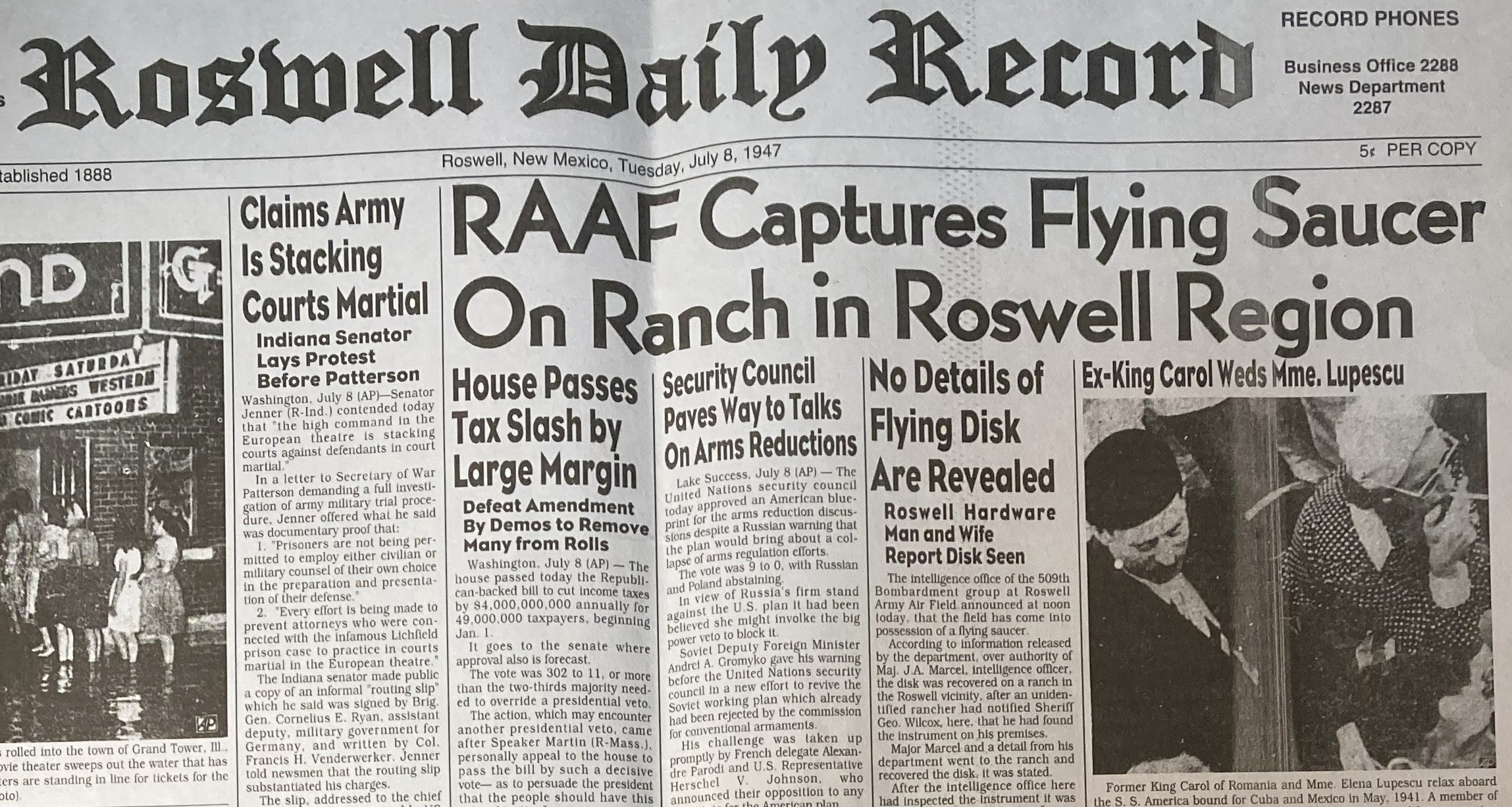
The press release
On the afternoon of July 8, 1947, the Roswell Army Air Field issues a press release through public information officer Walter Haut, stating that the 509th Bomb Group has recovered a 'flying disc' from a ranch in the desert near Roswell, New Mexico. The story is carried by the Associated Press wire and runs in newspapers across the country. Within 24 hours, the Eighth Air Force commander General Roger Ramey holds a press conference in Fort Worth, Texas, with debris arranged on the floor, and announces a correction: the object was a weather balloon. The retraction becomes the official position. The story dies in the press within days.
The Marcel testimony
The case is dormant for three decades until 1978, when nuclear physicist Stanton Friedman interviews Major Jesse Marcel — the intelligence officer who had personally handled the debris at the ranch and transported it to the base. Marcel states that the material released to the press in the Fort Worth photograph was substituted weather-balloon debris, not the material he had recovered. The actual material, he claims, was 'not of this Earth' — featuring a foil-like substance that returned to flat after being crumpled, and structural elements with strange markings that could not be cut or burned. Marcel's testimony, given near the end of his life, becomes the foundation of the modern Roswell case.
What the evidence is and isn't
Roswell sits at credibility 9.2 — but the high score is not because the crash-retrieval narrative is proven. It is because the case stands on the most extraordinary kind of evidence available: an official, signed, on-the-record U.S. military press release stating that a flying disc was recovered, retracted within 24 hours. The press release exists. The retraction exists. The witnesses to the recovery, including Marcel and ranch foreman Mac Brazel, are real and on the record. What the evidence does not establish is what was actually recovered — physical materials have not been independently produced, and the GAO's 1995 inquiry concluded that the debris was likely a classified Project Mogul balloon-borne acoustic sensor designed to detect Soviet nuclear tests.
Why it endures
Roswell is the foundational case of UFO culture because of what the official record actually contains: a military base issued a press release announcing they had recovered a flying disc, then immediately retracted it. That sequence — confirmation, then denial — is the structural template the disclosure community has worked off of for 80 years. Every subsequent allegation of a crash-retrieval program, including David Grusch's 2023 congressional testimony, points back to Roswell as the precedent moment when the U.S. government's posture toward the phenomenon was first publicly visible.
Key Facts
- Roswell Army Air Field press release (July 8, 1947) explicitly used the phrase 'flying disc'
- Retraction issued by Gen. Roger Ramey within 24 hours, citing weather-balloon debris
- Major Jesse Marcel's 1978 testimony reopened the case after 31 years of dormancy
- GAO 1995 inquiry concluded debris was likely classified Project Mogul balloon array
Key Witnesses
- Major Jesse Marcel (intelligence officer, 509th Bomb Group)
- William 'Mac' Brazel (ranch foreman who reported the debris)
- Col. William Blanchard (commander, 509th Bomb Group)