About thirty minutes into his September 11 appearance on the Area52 podcast, actor Thomas Jane told host Chris Ramsay about a blood sample. A Bolivian medic, he said, had stitched up a tall, hairless, blond stranger during the 2019 wildfires, kept the bloody gauze, and later had it tested. “It turns out that the DNA is completely human,” Jane said, “but it's female.” Then: “It was immortal. The blood cells on the gauze didn't decay, they didn't turn black.” He called it “the most fascinating case and maybe the most consequential case” in the book he is writing. The episode had about 1.5 million YouTube views as of October 10, according to the video's public counter.
The medic is Paul Parada, and the case has been investigated by the Spanish author J.J. Benítez, who says he sent the gauze to laboratories. We went back through the English-language record of the case: Jane's retelling, an English translation of Benítez's own description of the results, the podcast that brought the story to Jane, and earlier English coverage. We found three accounts of the lab results that do not agree with each other, and no report or public statement from any of the laboratories named.
-
Parada says he treats an injured, telepathic stranger at a first-aid post during the wildfires in eastern Bolivia and keeps the bloody gauze.
-
An English write-up of the case reports that “there has been no DNA testing undertaken on this bandage.”
-
Benítez says two labs have reported: the blood was a woman's and it “does not belong to any human race.”
-
The English-language podcast airs Benítez's statements in translation and says results from three labs exist.
-
Thomas Jane: the DNA is “completely human,” female, and the blood “didn't decay.”
-
Host Pavel Ibarra, who first brought the case to Jane, says his conviction is “pretty low” and the results are “mostly human DNA.”
The Story Jane Told
The core of the account has stayed largely steady. Parada is described as a doctor in the Psicoactivo podcast's retelling and as a 30-year-old paramedic in UFO Insight's 2023 write-up, which says he volunteered to treat firefighters injured in the 2019 wildfires. In September 2019, he says, a tall man in a one-piece blue suit came out of the dark to his first-aid post with a deep cut on his arm. Parada says the suit was spotless despite the bleeding, and that the man answered his questions without speaking, telling him in his mind that a puma cub had bitten him. Parada closed the wound with stitches over about forty minutes, noticed the man had no body hair, and then, he says, followed him outside to a dark disc hovering over the trees with two small beings beneath it.
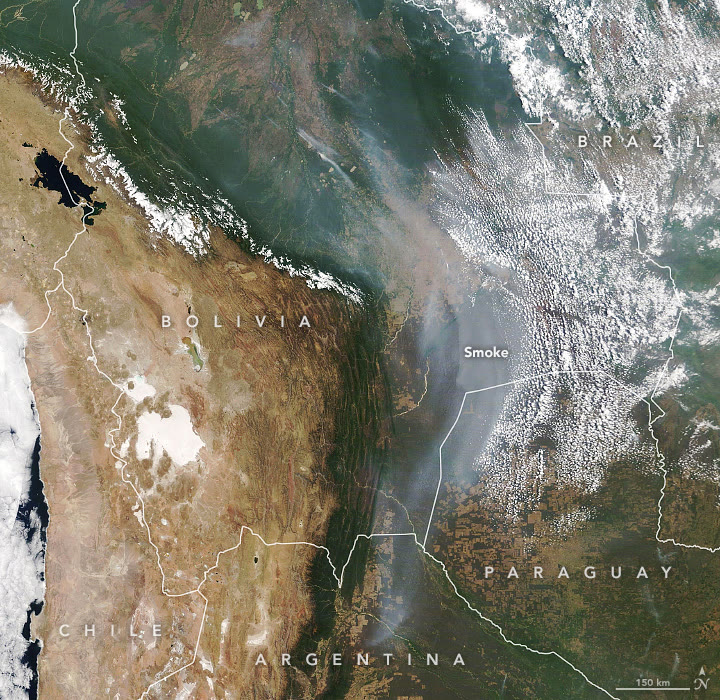
The 2019 fires were real. NASA's Earth Observatory reported that the most intense fire activity was concentrated in the dry Chiquitano and Chaco forests of eastern and southern Bolivia, and cited one estimate that “as much as 5.3 million hectares (13.1 million acres) of Bolivia has burned.” The encounter itself rests on Parada's word, and some details shift between tellings. UFO Insight describes the two small beings as having “pale green skin,” Jane describes them as “greenish,” and the Psicoactivo retelling calls them “classic gray humanoids.” Jane added details we could not find anywhere else, including that Parada's boss fired him after he went public. (Jane refers to him as “Peralta.”)
Three Accounts of One Set of Results
Before Benítez became involved, the record says no test had been done. UFO Insight's October 2023 write-up of the case stated: “To the best of anyone's knowledge, there has been no DNA testing undertaken on this bandage.” Everything that follows describes testing arranged after that.

The first account of the lab results comes from Benítez, the Spanish journalist and author, who took up the case and the gauze. In an interview recorded in the fall of 2025 and aired in English translation on the Psicoactivo podcast on January 6, 2026, he said he had received results from two laboratories, which he named as the University of Santiago de Compostela and a private lab in Madrid. “It was a woman, not a man,” he said. “Second, it does not belong to any human race nor to any human animal, or at least from Earth.” He added that the blood “does not belong, as far as I remember, to any blood group” and that “a microorganism appears” that would prevent the cells from oxidizing, meaning “it would never age.” He said that last point was “to be confirmed with the other analyses,” and that “more reports from the laboratories are needed.” He has written about the case in a 2025 book.
The second account is Jane's, months later: “completely human,” female, “no male chromosomes,” and blood that stayed “fresh.” Jane's “completely human” and Benítez's “does not belong to any human race” cannot both describe the same results. A third account arrived the next day. Pavel Ibarra, host of Psicoactivo and the person Jane credits with bringing him the case, said on September 12 that Parada had shown him some of the results and that his wife, whom he described as a scientist, read them: “it's mostly human DNA, but some of it was inconclusive.”
What the Biology Says
A woman's DNA from a man. A sample showing only X-chromosome markers is what a female profile looks like, and the simplest way for a female profile to appear on gauze is for a woman's DNA to be on the gauze. By all accounts the samples sat with Parada for years and passed through other hands before reaching a lab. Forensic research has shown repeatedly that people transfer DNA to objects they handle, which is why chain of custody matters. Contamination would more often produce a mixed profile, so it fits best if little of the stranger's own DNA survived on the gauze. If the profile really is the stranger's, there is also a known human condition in which people with two X chromosomes develop as male: 46,XX testicular difference of sex development, which MedlinePlus says affects “approximately 1 in 20,000 individuals with a male appearance.”
Blood that never ages. Dried blood changes color on a well-studied schedule, from red through brown to nearly black, as hemoglobin oxidizes. Researchers are developing methods that use that shift to estimate a stain's age, and have measured it changing over days to weeks, with temperature and humidity affecting the pace. A stain that did not change would be remarkable and measurable. The only public sources for it are Jane's retelling and Benítez's description of a microorganism he said was still unconfirmed. No lab result showing it has been published.
“Does not belong to any human race.” Forensic DNA kits compare a profile against population databases. An unusual result can make a profile rare without making it nonhuman. A claim that blood belongs to no human and no animal on Earth would need sequencing, published data and independent replication. None has appeared.
Where the Case Stands Among Its Own Researchers
Some of the strongest doubts come from the podcaster who carried the case to Jane. On his September 12 episode, Ibarra said: “my conviction on this case is pretty low.” Citing his friend Fernando, a fellow researcher, he said that pretty much every researcher who had taken the case seriously “does not take Paul Parada seriously anymore,” that “they feel like he plagiarized a lot of the documents that he showed,” and that Fernando “is now convinced that this guy was not telling the truth.” He described the case as “almost completely dismissed by South American researchers” and said Benítez had made no recent statement. Those are Ibarra's characterizations of other people's views; we have not heard from them directly, and the plagiarism concern has not been documented publicly.
Jane's own retelling acknowledged that something had gone quiet. “Somehow all of that has sort of gotten brushed under the rug,” he said on Area52. “Peralta stopped coming out. He stopped talking.”
On the same episode Jane also described, for the first time publicly, a night in 2011 when he says three glowing geometric shapes came through his ceiling, waited what felt like an hour and a half for his consent, and passed through him. “I know what happened to me,” he said. That account is his, and there is nothing to test it against. The blood case is different, because it comes with physical evidence and named laboratories, and those can be checked.
What This Doesn't Prove
A Physical Sample With No Published Result
1. We found no public statement or report from any named lab. Nothing has appeared from the University of Santiago de Compostela or the private Madrid lab Benítez named. Every description of the results reaches the public through someone other than the lab.
2. The descriptions contradict each other. Benítez's “does not belong to any human race” cannot be squared with Jane's “completely human” or Ibarra's “mostly human,” and Jane's account goes further than Ibarra's “some of it was inconclusive.”
3. Chain of custody is unknown. The gauze stayed with Parada for years before any DNA lab saw it. A female profile on a sample with that history needs contamination ruled out before it means anything.
4. The extraordinary claims arrived late and secondhand. As of 2023, no test had been reported at all. The female, nonhuman and “immortal” claims appeared only after the samples went to labs, and only through other people's descriptions of what those labs found.
What to Watch Next
- The lab reports themselves. Benítez named the University of Santiago de Compostela. A statement or full report from any named lab would carry more weight than any secondhand account.
- The pending analyses. Benítez said results from more labs were outstanding, and Ibarra later said there were results from three. Neither has published what those labs found.
- Jane's book. He says it covers the case in detail. We found no publisher listing yet; when it appears, its sourcing for the blood claims will be worth reading closely.
- An independent sample. Testing of the remaining gauze by a lab with no prior involvement, with the results published, would be the strongest evidence either way.
Where It Stands
A Bolivian medic has told a largely consistent story about treating a strange patient during the 2019 fires. The blood that would make it the most consequential case Thomas Jane knows of has been described three different ways by three different people, none of them a lab, and as late as 2023 no test had been reported at all.
The case is unverified. Ibarra, who brought it to Jane, now says his conviction is low and that other researchers have dropped it, while Benítez has not publicly updated his claims. Until a named lab publishes a full report that someone independently repeats, the “immortal blood” remains unverified.
Thomas Jane's retelling, from about 20:30.
Benítez's lab claims in English translation, from about 11:30.
Pavel Ibarra's update, from about 31:50.
Sources: Area52 with Chris Ramsay, ep. 101, Thomas Jane (September 11, 2026) · Psicoactivo #771, Pavel Ibarra, with J.J. Benítez's statements in English translation (January 6, 2026) · Psicoactivo #1153, Pavel Ibarra (September 12, 2026) · UFO Insight, Marcus Lowth (October 2023) · NASA Earth Observatory, “A River of Smoke” (October 5, 2019) · Mongabay, on the 2019 Bolivian fires (September 6, 2019) · MedlinePlus Genetics, 46,XX testicular difference of sex development · Hanson & Ballantyne, bloodstain age and the hemoglobin Soret band (PLoS One, 2010) · IntechOpen, forensic analysis of bloodstain color · Sessa et al., touch DNA and handling time (Scientific Reports, 2019). Quotes from podcasts are transcribed from the episodes and checked against their timestamps.