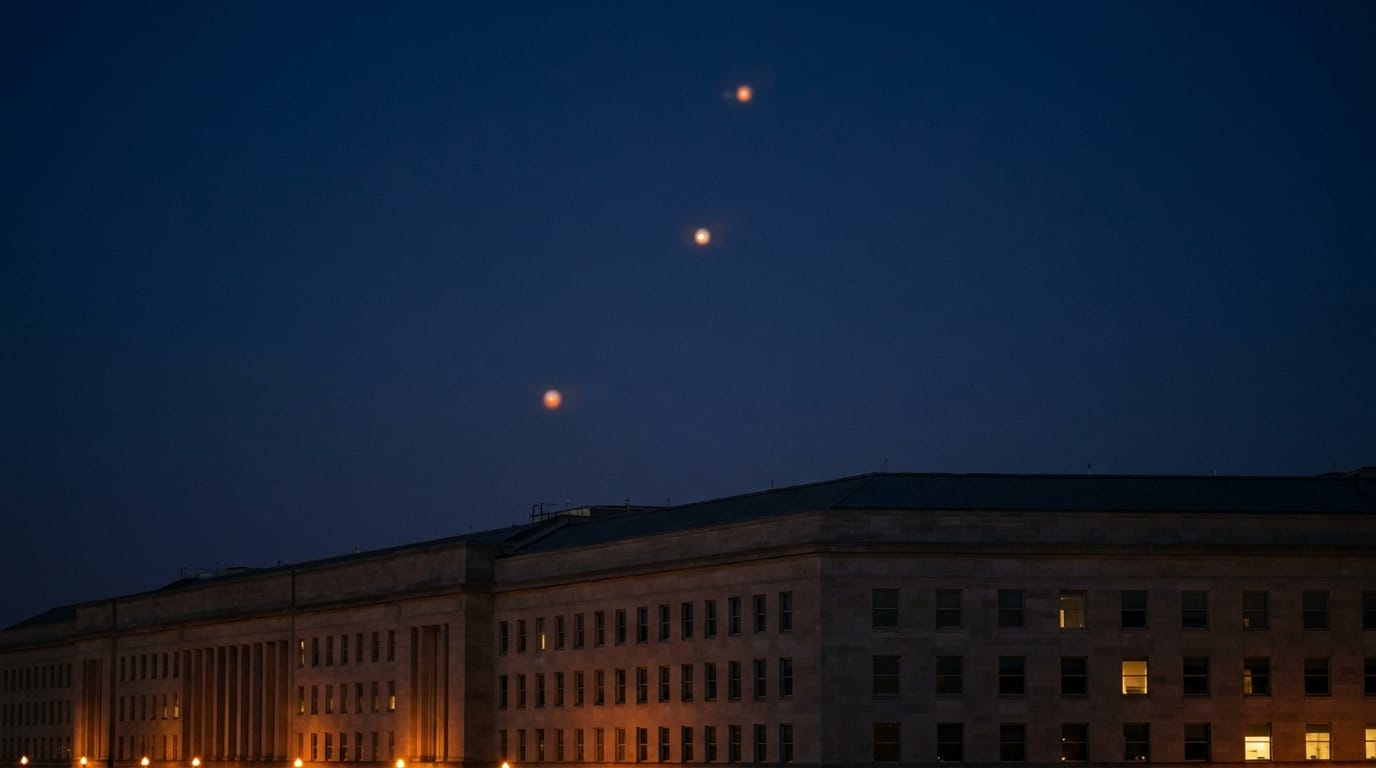
The Department of War's second batch of declassified UFO files, released May 22, 2026, includes a detailed first-hand narrative from a currently serving senior U.S. intelligence officer who observed multiple orange orbs during a multi-hour encounter in late 2025 at a restricted military test range. The account, designated ODNI-UAP-D001, describes objects hovering near the officer's helicopter during an active investigation of prior sightings at the site — an incident the crew found inexplicable enough to leave them "virtually speechless."
The 64 files released under the Department of War's PURSUE initiative also include radar surveillance imagery from PANTEX, the only U.S. nuclear weapons assembly plant, showing what Sandia National Laboratories analysis described as "a craft with a distinct form," alongside 116 pages of documentation from Sandia spanning 1948 to 1950 that detail unexplained sightings and investigations at the New Mexico facility during the early Cold War. The release establishes that the U.S. government has documented anomalous incidents at nuclear weapons sites for decades and is still investigating them at sensitive locations. But it includes no analysis, investigative conclusions, or official interpretation of what the material shows.
The ODNI Helicopter Encounter
The ODNI narrative is the most significant account released so far under PURSUE. According to CBS News and multiple sources describing the document, the intelligence officer was part of a team sent to investigate recurring UAP reports at a military test range when the crew observed several orange orbs. One of the objects positioned itself stationary just above the helicopter's rotor disk.
The officer's narrative, in its closing paragraph, states that orange orbs were "forming a distinct triangle before vanishing," confirming the formation detail as primary-source documentation rather than secondary reporting. The full account also describes an earlier "T" formation of four to five orbs that flared sequentially above the helicopter's rotor disk, then dimmed in reverse order before disappearing — a sequence the officer specifically logged as oval-shaped, orange with a white or yellow center, emitting light in all directions. The officer's narrative, according to CBS, describes what appeared to be a mass swarming display. The encounter lasted multiple hours.
The Encounter Sequence
The ODNI narrative is not a single moment but a multi-phase sequence stretching across hours of observation. The officer documents at least five distinct encounter phases, each with different visual characteristics and witness configurations.
The account's significance rests on its sourcing and timing. This is not a decades-old report from an anonymous witness. It is a contemporaneous narrative from a senior intelligence officer conducting an official investigation of a site already flagged for recurring incidents. The officer went on record in a classified document now made public, accepting the institutional risk that comes with detailed first-hand testimony about an unexplained encounter. The military was treating the location as a site requiring active investigation, meaning command viewed the prior sightings as credible enough to warrant a formal response.
But the document raises as many questions as it answers. The intelligence officer's narrative includes no mention of what the helicopter's instruments recorded during the encounter. There is no indication whether radar, infrared sensors, or other onboard systems captured data, and if so, what that data showed. The release does not name the test range location, explain why it was under investigation, or provide results from any follow-up analysis. What remains is a detailed visual observation from a credible source with no corroborating sensor data and no official interpretation.
The PANTEX Radar Capture
The PANTEX radar capture represents the second class of material in the release — sensor documentation from nuclear weapons facilities. According to reporting from CBS, The Liberty Line, and Newsweek, surveillance radar at the Texas plant recorded an unknown object, and Sandia's subsequent analysis described it as a craft with a distinct form. The phrasing suggests a structured object rather than an atmospheric phenomenon. But without access to the actual imagery, the full analysis, or any statement about what investigators concluded, the incident remains unexplained rather than explained as either conventional or anomalous.
The Sandia Historical File (1948–1950)
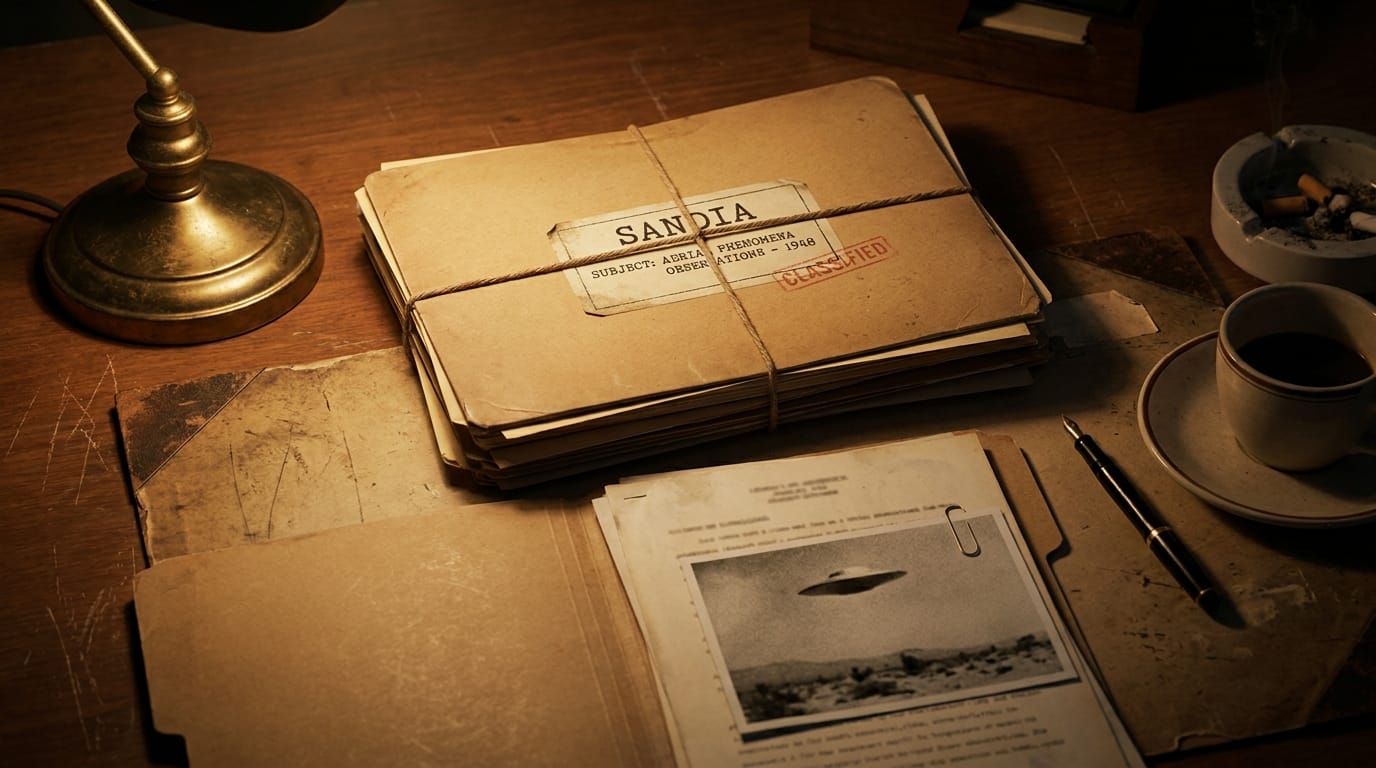
The Department of Energy file adds historical depth. Reuters and Harvard astrophysicist Avi Loeb, who analyzed the release on Medium, report that 116 pages document sightings and investigations at Sandia from 1948 to 1950. The material shows that a top-secret nuclear research facility experienced repeated unexplained incidents during the early Cold War years, significant enough to warrant investigation and documentation. But like the PANTEX material, the file does not reveal what those investigations found. The documents establish institutional awareness. They do not establish institutional conclusions.
The Release Structure
The release structure is telling. The Department of War's second release contained 51 videos, seven audio files, and six PDF documents. Some material is dramatic. Some is prosaic — NASA astronaut audio discussing "fireflies" and "snowflakes" that the agency later determined were frozen condensation, and footage from the 2023 Lake Huron shootdown of what was subsequently reported as a possible hobbyist balloon. The mix dilutes the striking items by surrounding them with cases that have conventional explanations, a pattern that could reflect the actual distribution of phenomena or a deliberate choice to frame the unknowns alongside the knowns.
CBS News reported that many of the videos lack substantiated chain-of-custody documentation — a complaint raised by congressional requesters when the first PURSUE batch was released earlier this month on May 8, 2026. The absence of documentation undermines the investigative value of the material. Without knowing how files were collected, stored, and transferred, questions about context and authenticity remain unresolved. Whether the gaps reflect poor record-keeping, incomplete transfers from prior Pentagon oversight, or intentional withholding is unclear.
Transparency Is Not Disclosure
The releases are transparency in the narrow sense — previously classified material is now public. But they are not disclosure in the sense of revealing what the government believes or knows. There is no War Department assessment of the ODNI encounter. No official statement on what the PANTEX analysis concluded. No summary of what the Sandia investigations from 1948 to 1950 found. Readers receive raw documentation without the institutional interpretation that would turn files into answers.
That gap matters. The interesting question is not whether UAP incidents occur — the documents confirm they do, and have for decades, at some of the most sensitive military and nuclear sites in the country. The question is whether the government has conducted serious analysis of this material and concluded it represents something requiring further study, or whether it has concluded the incidents are explicable and is simply releasing the files to satisfy political pressure. Both possibilities are consistent with what has been released. Neither is confirmed by it.
Trump has repeatedly promised UFO revelations and positioned himself as the disclosure president. PURSUE delivers on that promise in visible terms — two tranches of files in two months, with more expected. The releases maintain momentum on a subject that energizes part of his base and allows him to claim transparency as a policy win. But the structure functions as controlled disclosure. The Department of War releases material that demonstrates responsiveness without committing to a position on what the material means.
What Would Change The Picture
What would change the picture is official analysis. A War Department or ODNI assessment stating what investigators concluded about the helicopter encounter. Sensor data from that incident. The full Sandia analysis of the PANTEX radar imagery with conclusions about the object's identity or origin. Congressional testimony from the senior intelligence officer or from officials responsible for UAP investigations at nuclear facilities. Classified versions of the released documents, if they exist, showing whether additional context or analysis was withheld.
The Honest Take
What the government has released is evidence that it documents unexplained incidents at sensitive sites, not evidence that it understands them. The distinction is not semantic. Documentation without analysis is a dataset. Analysis is a conclusion.
PURSUE so far has provided the former while withholding or omitting the latter, leaving the question of what the government actually knows as open as the question of what the objects are.
Primary Sources
- ODNI-UAP-D001 — Senior U.S. Intelligence Officer Narrative (late 2025 encounter)
- DOW-UAP-D017 — Sandia General Correspondence (1948–1950)
- DOE-UAP-D003 — Pajarito Astronomers Meeting Notice (1986)
- CIA-UAP-D001 — Sary Shagan Intelligence Information Report (1973)
Secondary Reporting
- CBS News — Pentagon releases more UFO files: "Speechless after these observations"
- Wikipedia — United States UFO files (PURSUE)
- EarthSky — 2nd batch of Pentagon UAP files: Over 50 videos to watch
- Hollywood Reporter — Pentagon Releases Second Batch of UFO Files: "We Were Virtually Speechless"