
President Trump's February 19, 2026 directive ordering the Pentagon to release classified files on UFOs, UAPs, and extraterrestrial phenomena landed like a promise to a constituency that crosses partisan lines and includes people who otherwise wouldn't trust him with a crosswalk button. Two months later, the Pentagon released its first PURSUE batch on May 8, coordinating with the Director of National Intelligence, the Department of Energy, NASA, and the FBI. No outlet reported bombshell revelations. No press conference followed. The release satisfied the letter of Trump's order while delivering nothing the public could verify as meaningful.
What happened in between is the interesting part.
The Domain Registration
In mid-March, the White House registered alien.gov and aliens.gov through the Cybersecurity and Infrastructure Security Agency, using Cloudflare hosting. The registrations appeared in public WHOIS records on March 18 and triggered immediate speculation that Trump was preparing a disclosure portal — a central clearinghouse for whatever the Pentagon was compiling. When DefenseScoop and USA Today asked White House Principal Deputy Press Secretary Anna Kelly about the domains, she responded with two words.
The response wasn't a denial. It was an invitation to wait and see. And the alien emoji wasn't random — Secretary of War Pete Hegseth had used the same emoji a month earlier when reposting Trump's directive on X. Kelly was extending an established signal.
The disclosure community did exactly what was asked. UFO researchers, self-described experiencers, and congressional advocates who had invested political capital in Trump's pledge treated the domain registrations as confirmation that something substantive was coming. Rep. Anna Paulina Luna — the Florida Republican who chairs the House Oversight Task Force on the Declassification of Federal Secrets and has publicly told Joe Rogan she has seen evidence of "interdimensional beings" — told PBS News she expects the Pentagon to release 46 UAP videos identified by whistleblowers in a later tranche. Defense Secretary Pete Hegseth said in remarks to DefenseScoop that the Pentagon was "keen to comply" with Trump's directive and had begun work on the release immediately after the February announcement.
The May 8 File Drop
Then May 8 came and went. The Pentagon's multi-agency file drop produced no headlines on release day. No inventory of what was released has been made public. A second batch — PURSUE Release 02 — followed on May 22 and contained 64 files including a senior intelligence officer's first-hand narrative of a multi-hour UAP encounter at a restricted test range (we covered that in Edition 015). Both releases established that the U.S. government has documented unexplained incidents at sensitive sites. Neither established what the government thinks those incidents are.
The Switch
On May 28, aliens.gov launched — not as a UFO disclosure portal but as an immigration enforcement website. The site opens with a stark headline against a space-themed background:
"They walk among us."
"For 60 years, the U.S. government has kept a closely guarded secret. Aliens have been walking among us, living in our neighborhoods, and interacting with us in our daily lives. They've shopped in the same stores, attended the same classes as our children, and lived seemingly normal human existences."
"With one exception — they do not belong here."
The site features a real-time dashboard of ICE arrests, a heat map of immigration enforcement activity, and a tip line encouraging users to "report suspicious aliens." By Thursday evening, the page was displaying over 3.1 million "encounters" drawn from ICE data on migrant apprehensions. The platform praises Trump as "the first to call out the real danger Aliens pose to every American family." The launch was confirmed by Fox News Digital, The Hill, USA Today, multiple Fox affiliate broadcasters, and international press including coverage in Spain, Italy, and India. This is not a fringe report. It is documented.
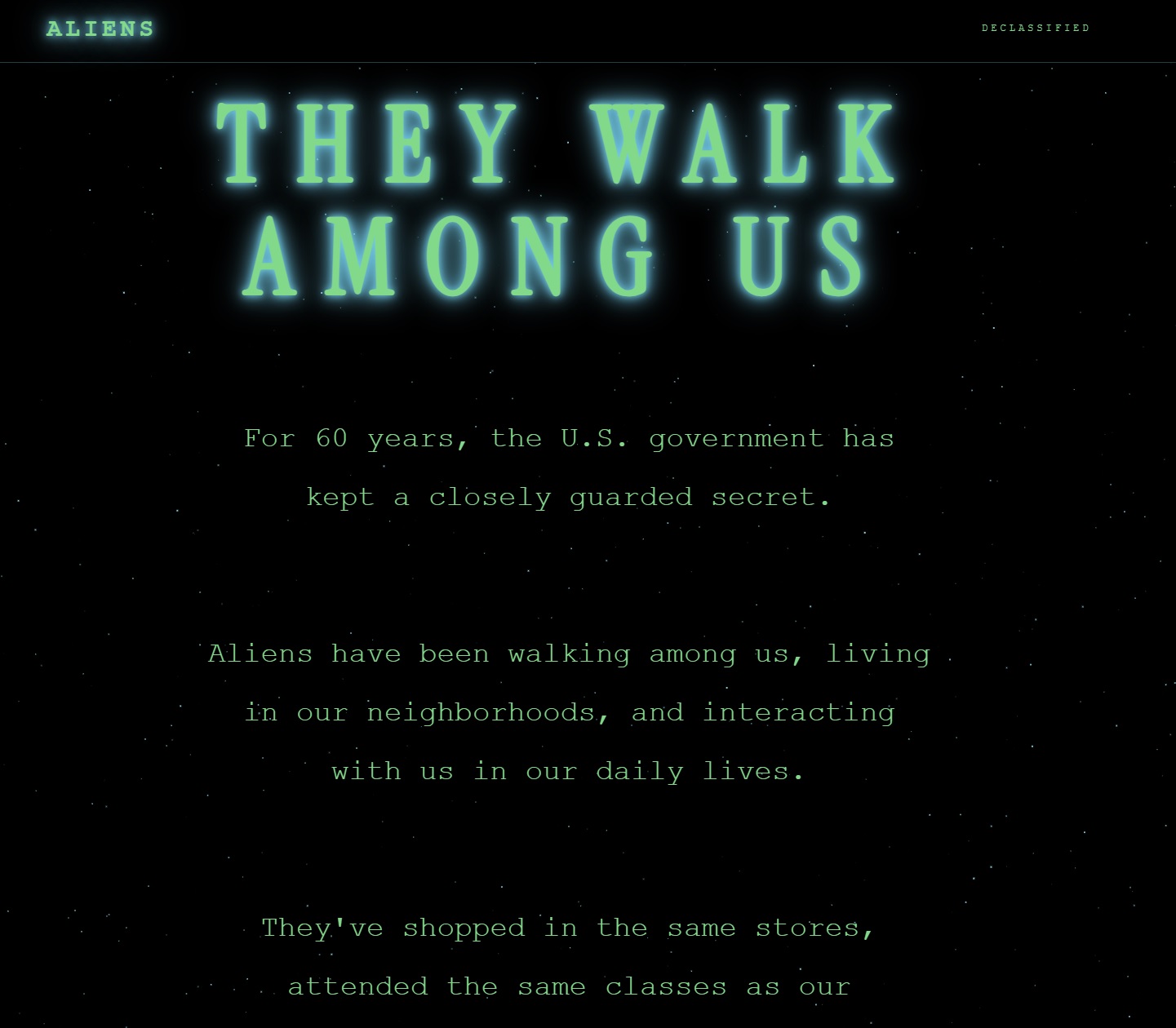
The cultural fascination with "aliens" had been repurposed to serve a different policy priority. The disclosure community experienced the reveal not as disappointment but as mockery — a website that weaponized their belief system to deliver a punchline about undocumented immigrants. As of this writing, the companion domain alien.gov (singular) remains a blank placeholder. Whether that domain will eventually serve UAP disclosure content, follow the aliens.gov immigration model, or remain empty indefinitely is unclear.
The Pattern
What is verified is the sequence. Trump issued a directive that sounded like disclosure. The White House registered domains that sustained speculation. Anna Kelly's "Stay tuned!" maintained the ambiguity for two months. The Pentagon released files that satisfied the directive without making news. And one of those domains ended up serving immigration enforcement rather than UAP transparency.
Whether the immigration outcome was planned from the start or improvised when the May 8 release failed to generate attention is an open question. Either interpretation is unflattering. Either the administration coordinated a two-month tease knowing the payoff would be immigration messaging, or multiple agencies worked at cross-purposes and the domains landed wherever political priorities inside the White House directed them.
The disclosure community's anger is understandable, but their expectations were always misplaced. The Pentagon's 2024 report from the All-domain Anomaly Resolution Office — the Biden-era entity established in 2022 to centralize UAP investigations (see Edition 005 for the institutional breakdown) — found no evidence that the United States had ever confirmed recovery of alien technology. That report was public months before Trump's February directive. The historical record is equally clear. The CIA acknowledged that Cold War-era UFO sightings over the United States were frequently misidentified U-2 reconnaissance flights, and every subsequent administration or congressional inquiry has produced document releases that reveal investigative process but never physical evidence of non-human intelligence. Trump's directive fit the pattern perfectly: it generated attention, positioned him as responsive to a politically diverse constituency, and cost him nothing when the actual release proved unremarkable.
The Timeline
What Crosses Into Theater
Michael Gold, a former NASA space policy official, told The Guardian he supports transparency efforts around UAP investigations, framing them as legitimate scientific inquiry rather than confirmation of extraterrestrial contact. That distinction matters. Transparency about what the government knows and how it investigates aerial phenomena is a defensible goal. Transparency as a vehicle for validating decades of claimed cover-ups about recovered alien spacecraft is something else entirely — a demand the evidence has never supported and the institutional record suggests will never be satisfied.
What made Trump's handling novel was not the outcome but the apparent cynicism of the process. Previous administrations released files and let the disclosure community interpret them however they wanted. Trump's White House registered suggestive domains, encouraged speculation with "Stay tuned!" messaging, then launched one of those domains as an immigration enforcement platform that mocked the very community it had been teasing. That crosses from non-delivery into theater. It treats disclosure not as a policy question but as political currency that can be redirected when convenient.
The gaps in the public record remain significant. No outlet has published a complete inventory of what the Pentagon released across both PURSUE batches. Alien.gov, the companion domain, has not gone live, and the White House has offered no explanation for its intended purpose. The 46 UAP videos Rep. Luna expects based on whistleblower accounts have not been confirmed by any Pentagon official. Whether those videos exist in any government archive, whether the Pentagon intends to release them, and whether they would contain anything verifiable if released are all unknown.
What would settle the question is straightforward. Release the 46 videos Luna expects, if they exist. Publish a complete inventory of the PURSUE file drops. Issue a government statement on what alien.gov is for. Provide internal administration communications about the domain strategy. Any of those would clarify intent and capability. None has materialized, which is itself an answer.
The Honest Take
What the Trump administration's UFO disclosure produced is exactly what every prior disclosure episode has produced: documents that confirm the government investigates reports, procedures that show how those investigations are conducted, and no evidence that resolves the underlying question of whether any government has confirmed non-human intelligence or recovered technology.
The difference this time is that the administration appeared to understand disclosure's function as political theater and leaned into it, using the cultural fascination with "aliens" to build suspense, then redirecting that attention toward immigration enforcement. The disclosure community wanted evidence. They got a website — about something else. What they definitely got was a reminder that disclosure promises are cheap, and what comes after them is usually cheaper.
Sources
- DefenseScoop — White House registers new 'alien'-related .gov domains (March 18, 2026)
- Fox News Digital — Trump White House trolls immigration critics with new aliens.gov website (May 28, 2026)
- The Hill — White House launches 'aliens' site touting immigrant arrests (May 28, 2026)
- WION — They walk among us: White House's aliens.gov website isn't about UFOs (May 29, 2026)
- HuffPost — Anna Paulina Luna on interdimensional beings (Joe Rogan, August 2025)
- NewsNation — Rep. Luna eyes subpoena after Pentagon misses 46-video deadline
- aliens.gov — Official White House website (live)
Related Briefings
- Edition 015: PURSUE Release 02 — the senior intelligence officer narrative and what the file drop actually contained
- Edition 004: The alien.gov domain registration — original analysis of the three-scenario question that we now know the answer to
- Edition 005: AARO — the office that should be analyzing this material
- Edition 003: The Schumer-Rounds UAP Disclosure Act — the legislative spine that survived